Fotoeins Fotografie

location bifurcation, place vs. home

Posts tagged ‘Historic Highlights of Germany’

Jesuitenplatz, Altstadt, Koblenzer Weihnachtsmarkt, Koblenz, Germany, fotoeins.com

Koblenz: Christmas markets in the Old Town

Someone once said to me: “when the weather gets cold and crappy, it’s never too early for Weihnachtsmarkt.”

I replied that depends how early into opening week it is, how many people are aware the markets are open, and how many people are around.

It seems early, but I’m having Glühwein at one of Christmas Market stalls in the southwest German city of Koblenz.

Markets have been set up at six plazas in the city’s Old Town:

  1. Jesuitenplatz (J)
  2. Liebfrauenkirche (L)
  3. Münzplatz (M)
  4. Am Plan (P)
  5. Willi-Hörter-Platz (W) and
  6. Zentralplatz (Z).

At the intersection of the Mosel and Rhine rivers, within this special wine-growing region, it makes sense to have a ‘white’ Glühwein: it’s hot, it’s got alcohol, and it’s goin’ down somethin’ awful smooooth, like throwing on warm tonic to ward the late-autumn humid chill.

What’s also important is how all of this fuels the remaining two of my four weeks in the country.

( Click here for more )

Wurstkuchl, Regensburg, Bayern, Germany, fotoeins.com

Regensburg: Wurstkuchl, historic sausage kitchen

It must be midday, and time for lunch. There’s a queue more than twenty deep for the takeaway- or takeout-counter, as people walk away with a long thin grilled sausage sitting snug in an undersized oval bun. Next to the DΓΆner, I’m also fond of the “Bratwurst”, or grilled pork sausage.

Along the Danube promenade in Regenburg’s Old Town is the historical sausage kitchen, formally “Die Historische Wurstkuchl zu Regensburg”, better known as “Wurstkuchl”. The Wurstkuchl is known as the oldest running grilled-sausage stand in the world, with the presence of a stand serving food to labourers from town and visitors from the river since the 12th-century (A,B).


( Click here for images and more )

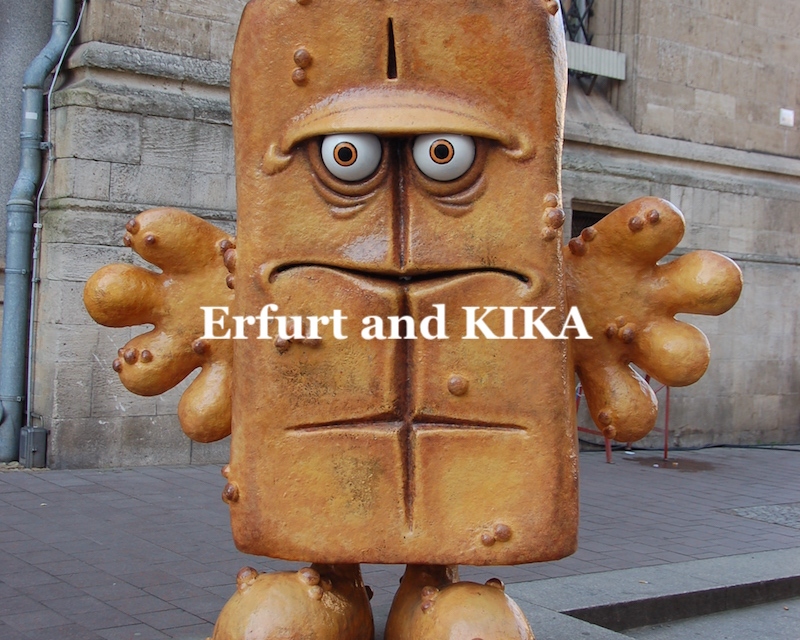
Wiki/CC3: https://de.wikipedia.org/wiki/Datei:Bernd_das_Brot_Erfurt_by_Stepro.jpg

Erfurt: five KiKa character sculptures

Erfurt is the capital city for the state of Thuringia (Landeshauptstadt ThΓΌringen) and is included among many in the Historic Highlights of Germany. As a self-described hub for children’s media, Erfurt is headquarters for the German Children’s Channel, or KInderKAnal, better known in short as KIKA. In commemoration of the channel’s tenth anniversary in 2007, sculptures representing well-loved KIKA characters sprung to “life” around town.

Kids of all ages can now cross the city looking for KIKA characters. My personal favourite is Bernd das Brot (Bernd the bread), a grumpy loaf and reluctant star of late-night tedium … “in the KIKA lounge …” It’s easy to assume I would’ve incorporated a part of the KIKA lineup as part of my early German-language instruction. The truth is there were too many late-nights in my dark one-room apartment with a small television for illumination, and more often than not, crusty Bernd was present (on continuous loop). Like a loaf of bread’s “heel” or end piece that’s undesired and ignored, it’s always there if you need it …

(Click here for images and more )

Erfurt: 12 stations through the Old Town

Above/featured: KrΓ€merbrΓΌcke in shadow, at first light.

Located along the Gera river near the centre of Germany, Erfurt is an historical hub of east-west trade, a stop on the historical road “Via Regia” dating back to the Middle Ages, and is considered a spiritual home for Martin Luther. He left behind plenty of traces throughout the city which is now the capital city for the German state of Thuringia (Landeshauptstadt ThΓΌringens). For its preserved medieval Old Town, half-timbered houses, and churches, Erfurt has the nickname “Thuringian Rome.”

Each of the following locations in addition to the Erfurt’s Hauptbahnhof (Central Station) is indicated with an icon in the map below. All 12 places below can be reached with tram routes 3, 4, or 6 in a common stretch with stops at Anger, Fischmarkt / Rathaus (Fish Market / City Hall), and Domplatz (Cathedral Square).


( Click here for images and more )

Rathaus at night, Fischmarkt, Erfurt, Germany, fotoeins.com

Erfurt: an instant walk back in time (IG)

Erfurt is located near the geographic centre of Germany, and is called the “Rome of Thuringia” for the number of church steeples in the city. Even if being in the middle depends on how borders, especially post-reunification borders, are defined, there are five towns vying for the title “Mittelpunkt Deutschlands” (Germany’s centre), depending upon the technique used to determine where the centre might be.

But Erfurt’s been at the “centre of action” for centuries, in the midst of the “Via Regia” (royal road) dating centuries back to the heyday of the Holy Roman Empire, traditional woad (blue-dye) production, the movement of trade and people along the east-west transeuropean highway, religious pilgrims back and forth and beyond to Santiago de Compostela, Martin Luther stopping by to give an update on the Reformation, and even, Bach’s parents getting married here in town.

It’s easy to overlook Erfurt, but giving this city a chance allows it to sneak up on you. The following Instagram shots provide reasons why you should embrace the sneaky bits.


Thanks to Germany Tourism, Thüringen Tourismus, and the Erfurt Tourism and Marketing Board for support and access to places and activities; and to Mercure Hotel Erfurt Altstadt for their generous hospitality. I made the photos above 26 and 29 April 2015. This post appears on Fotoeins Fotopress at fotoeins.com as http://wp.me/p1BIdT-6LM.