Fotoeins Fotografie

location bifurcation, place vs. home

Posts tagged ‘Hansestadt’

24T22 A look at Hamburg port-harbour (T18)

E21 (E17)

Travel day 22 is wiped out because not only is there heavy rain, but I need to put down a hacking cough that’s clung on the last couple of days. Thankfully I had the foresight of getting a comfy apartment weeks ago, and picking up groceries at the nearby shop and some medicine at the apothecary yesterday.

This is an opportunity to look back at the evening return on travel day 18 of the Halunder Jet catamaran, from Heligoland to Hamburg.

The cool open breezes over the North Sea have been left behind for the Elbe. The return voyage brings us back into Hamburg’s river harbour and its bustling port facility by the fading light of a warm late-spring day. From childhood proximity to the Port of Vancouver, I’ve always been fascinated by the sights, shapes, and sounds from a harbour and port facility.

The city-state of Hamburg celebrated the 835th anniversary of its harbour in 2024.


The port of Hamburg is Germany’s largest seaport facility. By TEUs (20-foot container equivalent units), Hamburg is 3rd in Europe, after Antwerp and Rotterdam; and in the world’s top-20.
2009 container ship “Le Havre Express” (IMO 9332872, MMSI 636093082) registered in Monrovia, Liberia.
2017 container ship “Delphis Riga” (IMO 9780665, MMSI 477234800) registered in Hong Kong.
2010 Concordia-class cruise-ship “Costa Favolosa” (IMO 9479852, MMSI 247311100) registered in Genoa, Italy. Maximum passenger and crew totals at almost 5000.
From left to right a sweeping view of St. Michael’s Church, St. Pauli’s Landungsbrücken (“jetties”) public ferry docks, and Elbe Philharmonic Hall.

I made all images above with an iPhone15 on 25 May 2024 (T18). This post composed with Jetpack for iOS appears on Fotoeins Fotografie at fotoeins DOT com.

24T15 Hamburger Fischbrötchen

Fried-fish’wich, from Fisch & Co.

Into the north on day E14, proximity to both North and Baltic Seas, and the history of the Hanseatic League mean that Hamburg is well-known for its “Fischbrötchen”: literally, any kind of fish or seafood fitted or stuffed into a bread roll. This is my goal, this will be my “fish’wich” of the day.

I’m around Hamburg’s Nikolaifleet (Nicholas canal), and I’m in front of recommended Fisch & Co., a small place that delivers a lot of fish inside the little bistro, and a number of fish-rolls for takeaway. I have a look, but can’t decide between two. I ask the woman who’s just opened the doors if she would go smoked salmon or fried fish. She’s big on the latter, and who am I, to deny the very first fish-fry of the day.

Crispy & crunchy outside, flaky and juicy inside; great fish-to-crust ratio. If I’m not careful, I might just get a second one, “to go” of course …


Fisch & Co., at Deichstrasse 41.
At upper-right are various Fischbrötchen “to go”: I was stuck between Räucherlachs and Backfisch.
Inside the cozy bistro, as customer number 1 of the day.
Backfisch-Brötchen (fried fish in a roll, with remoulade and onions), and a Fritz-Limo Apfel-Kirsch-Holunder (apple cherry elderberry).
Almost fits in one hand. I sat outside on a bench, looking out towards the brick warehouses in the Speicherstadt.
The first bite was … scrumptious.
The perfect size for a (Backfisch-) Fischbrötchen.

From Hamburg’s central station (Hauptbahnhof), the U3 line goes west to Rödingsmarkt station, from which the walking distance is under 0.5 km to Fisch & Co.


I made all images above with an iPhone15 on 22 May 2024. I was neither sponsored nor supported for the visit to the establishment under discussion. This post composed with Jetpack for iOS appears on Fotoeins Fotografie at fotoeins DOT com.

24T14 Hamburg: who’s in Ohlsdorf cemetery?

E13

In the northern part of Hamburg lies Europe’s largest cemetery at over 400 hectares (almost 990 acres) with over a quarter-million graves and almost 1.5 million burials since 1877. I went in search for a couple of names and found a couple more, as well as some fresh air and a stretch of the legs after a lengthy day on trains from Trier.


Front gate of Ohlsdorf cemetery.
Artist Philipp Otto Runge, 1777-1810.
Artist Anita Rée, 1885-1933.
Actress Monica Bleibtreu, 1944-2009.
Physicist Heinrich Rudolf Hertz (after whom the unit of frequency is named), 1857-1894.
Physicist Gustav Hertz, 1887-1986: Heinrich Hertz’s nephew; jointly awarded 1925 Nobel Prize in Physics.
Koch and Schmidt families …
Teacher & environmentalist Hannelore Loki Schmidt (1919-2010), and her husband Helmut Schmidt (1918-2017) who served as chancellor of West Germany from 1974 to 1982.
Eingänge sind Übergänge (Entrances are transitions)
Ohlsdorf cemetery

From Hamburg’s central station (Hauptbahnhof), a ride on either the U4 or S1 to Ohlsdorf brings visitors to the cemetery’s front gate.

Completed after 14 travel days: just over 121 km of walking, in 173649 steps (“Health” estimates).


I made all images above with an iPhone15 on 21 May 2024. This post composed with Jetpack for iOS appears on Fotoeins Fotografie at fotoeins DOT com.

Chilehaus, Kontorhausviertel, UNESCO, Weltkulturerbe, World Heritage, Hamburg, Germany, fotoeins.com

Hamburg UNESCO WHS: Kontorhausviertel (Commercial District)

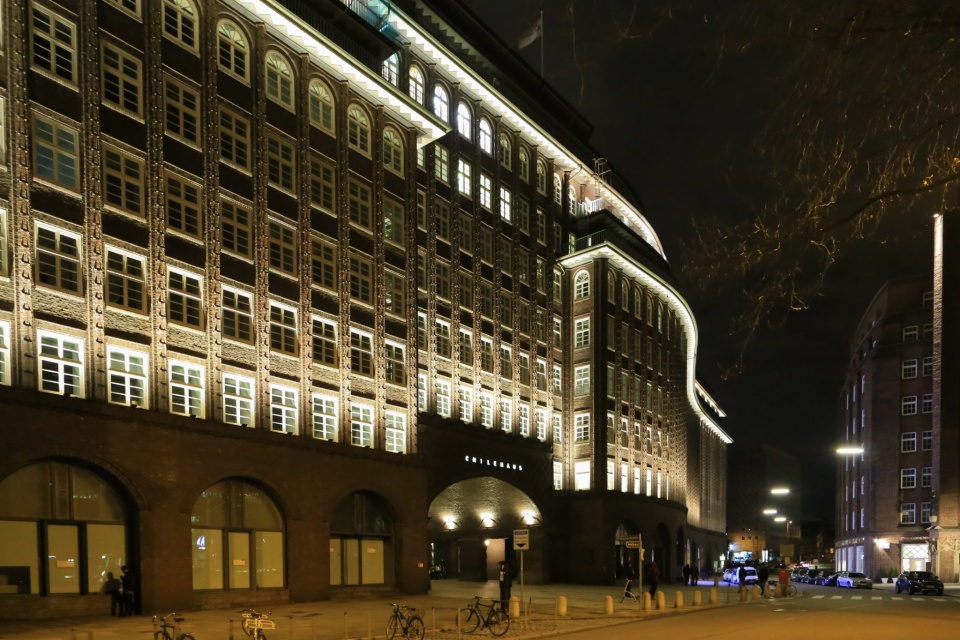
On 5 July 2015, UNESCO awarded World Heritage status to two sites in Hamburg: the Speicherstadt (Warehouse District) and the Kontorhausviertel (Office Building District). In the latter are two important brick buildings: Chilehaus and the Sprinkenhof, representative of the construction in the late 19th- and early 20th-century.

The Chilehaus was built by Fritz Höger for client Henry Sloman from 1922 to 1924 in the Kontorhausviertel as a prime example of German expressionist architecture using hard-fired brick. Höger undertook the project for Hamburg merchant and banker Sloman who made his fortune in importing nitrates from Chile. Built entirely to serve and complement the functions of the warehouses in neighbouring Speicherstadt, the Kontorhausviertel was the first dedicated office- and commercial-district on the European continent.
( Click here for images )

salt-making, Halloren- und Salinemuseum Halle, Halloren, Salinemuseum, Halle (Saale), Halle, Saxony-Anhalt, Sachsen-Anhalt, Germany, fotoeins.com

My Halle (Saale): Making White Gold Since 3000 BC

What do the following six towns and cities have in common?

  • Hall in Tirol, Austria
  • Hallein, Austria
  • Hallstatt, Austria
  • Schwäbisch Hall, Germany
  • Bad Reichenhall, Germany
  • Halle an der Saale, Germany

Hall, more than a large covered room

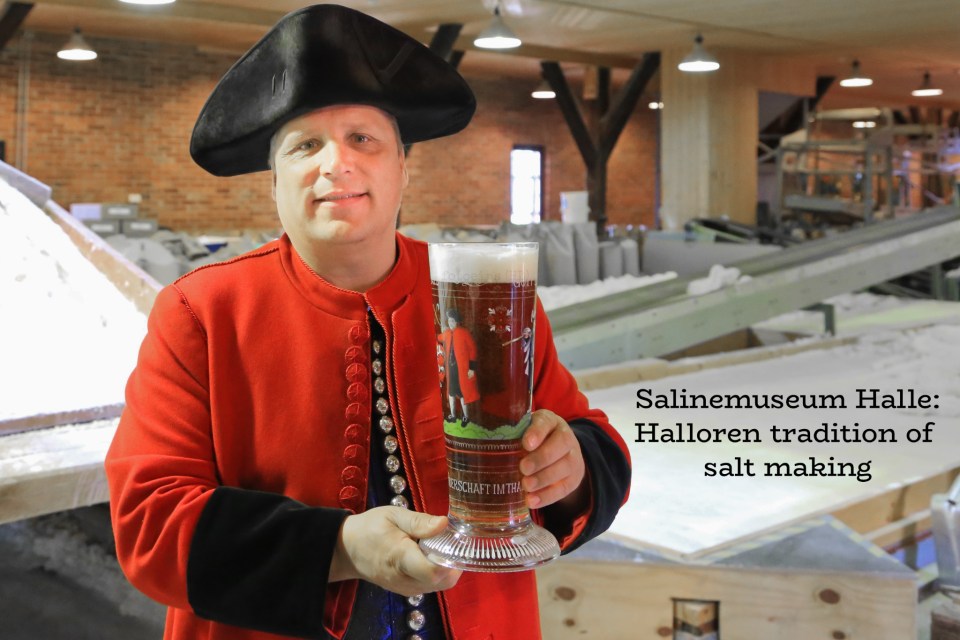
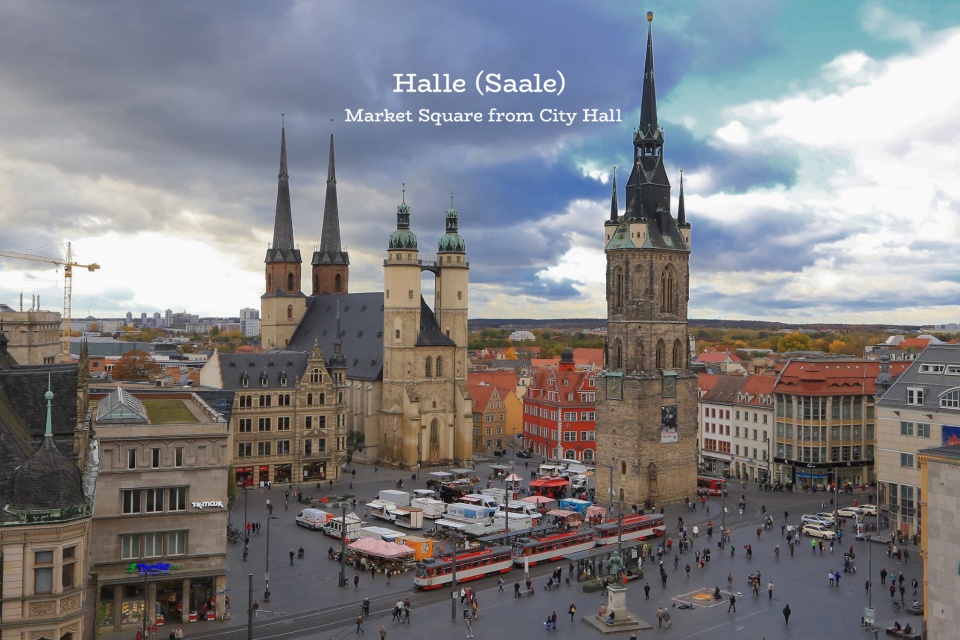
With “hall” in their names, all six towns listed above are historically associated with salt production1,2,3. The word “salt” is represented in Greek as hals and in Celtic (Brythonic) as hal. In pre-Roman Europe, the towns of Halle, Hallstatt, and Hallein were three centres for salt-evaporation4 which eventually became salt-making centres for the surrounding regions of Prussian Saxony, Salzkammergut, and Salzburg, respectively. Archaeological finds around Halle and along the Saale river5 uncovered evidence of heated brine (at Doläuer Heide) from the mid-neolithic age (about 3000 BCE) and briquetage ceramic vessels from the late-Bronze age (about 1000 BCE).

Mark Kurlansky wrote1: “… Salt is so common, so easy to obtain, and so inexpensive that we have forgotten that from the beginning of civilization until about 100 years ago, salt was one of the most sought after commodities in human history.

Once a rarity, salt was a unique additive to improve quality of food preparation and consumption. Food preservation with salt also became a critical measure for survival, but also for improving the quality of food preparation and consumption. Whoever controlled salt production, sales, and distribution held power, wealth, and prestige.

German sayings with salt:

•   “Freundschaft ist des Lebens Salz.” (Friendship is the salt of life.)
•   “Das Essen ist versalzen, du bist verliebt.” (The food is too salty; you must be in love.)

( Click here for images and more )