Fotoeins Fotografie

location bifurcation, place vs. home

Posts tagged ‘European Route of Industrial Heritage’

Before Bauhaus: Alfeld Fagus Factory, UNESCO WHS

Before Bauhaus found its first footing in Weimar, there was in the town of Alfeld in central Germany the Fagus-Werk factory building.

The Fagus factory building is looked upon as the first building in the world for the modern architectural age, and is the predecessor to the elegant 1926 Bauhaus headquarters building in Dessau. Fagus company founder Karl Benscheidt commissioned architect and future Bauhaus founder, Walter Gropius, to create and build a shoe-making factory as an artistic project. Gropius and his collaborator Adolf Meyer stuck with working floor-plans by architect Eduard Werner, and set their sights on new exterior and interior designs. Completed in 1911, the factory’s office building set a new standard for 20th-century industrial architecture with steel and glass construction and tall unsupported windows at the corners of the building.

“Fagus” is Latin for “beech tree”, and shoemaking began with shoe lasts or moulds constructed from beech wood, which were sold and distributed around the world to other companies for the productions of shoes. In the 1920s, Benscheidt developed the turning precision-lathe speeding up production, prompting growth and expansion and elevating the company to world’s top producer of shoe lasts. Today, the building is still a working factory: Fagus creates plastic lasts milled by automated machinery to precise specifications for specific designs by shoe companies. Also on-site is GreCon which produces systems for fire-detection and fire-extinguishing in industrial settings. The Fagus factory building was recognized as “unique living monument” and inscribed by UNESCO as World Heritage Site (Welterbe) in 2011.

With a population of over 20-thousand people, Alfeld is located in the German federal state of Lower Saxony. The town’s reach by train is 30-minutes from Hannover or 40-minutes from Göttingen, after which is a short 5- to 10-minute walk from Alfeld(Leine)1 train station to the entrance of the Fagus/GreCon complex. Visitors can walk around the working factory site, stop at the World Heritage Site Visitor Centre, sit in the neighbouring café for coffee or tea, and visit the museum dedicated to the building’s origins, the building’s century-long history of shoe-making, and a general history of footwear.

Walter Gropius and others would move to Weimar to establish a centre of art, design, thought, and attitude for Bauhaus in 1919, eight years after inauguration of the Fagus-Werk.

Die Baukunst soll ein Spiegel des Lebens und der Zeit sein.
(Architecture should be a mirror to life and its time.)

– Walter Gropius.

( Click here for images and more )

salt-making, Halloren- und Salinemuseum Halle, Halloren, Salinemuseum, Halle (Saale), Halle, Saxony-Anhalt, Sachsen-Anhalt, Germany, fotoeins.com

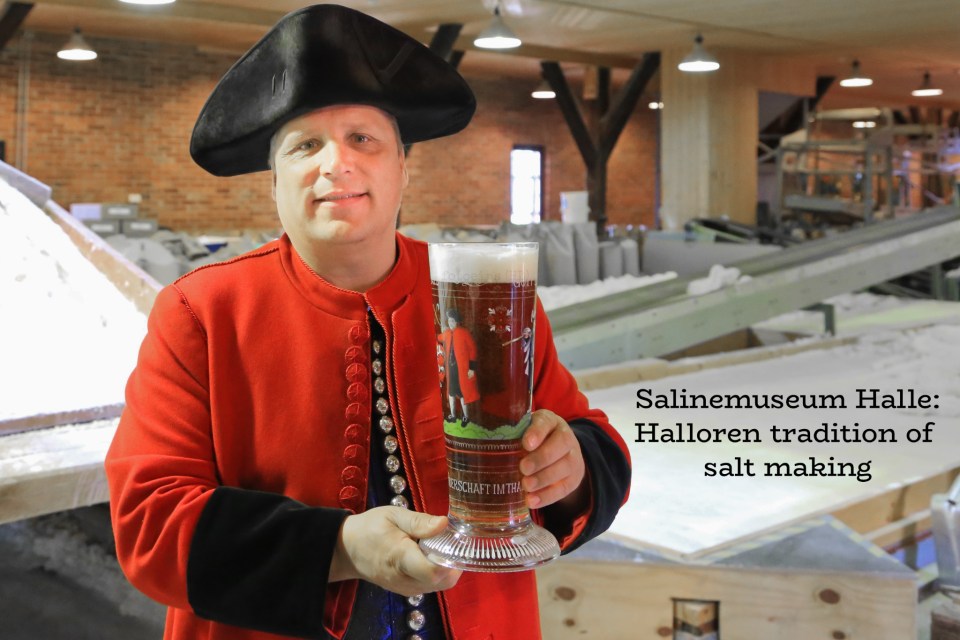
My Halle (Saale): Making White Gold Since 3000 BC

What do the following six towns and cities have in common?

  • Hall in Tirol, Austria
  • Hallein, Austria
  • Hallstatt, Austria
  • Schwäbisch Hall, Germany
  • Bad Reichenhall, Germany
  • Halle an der Saale, Germany

Hall, more than a large covered room

With “hall” in their names, all six towns listed above are historically associated with salt production1,2,3. The word “salt” is represented in Greek as hals and in Celtic (Brythonic) as hal. In pre-Roman Europe, the towns of Halle, Hallstatt, and Hallein were three centres for salt-evaporation4 which eventually became salt-making centres for the surrounding regions of Prussian Saxony, Salzkammergut, and Salzburg, respectively. Archaeological finds around Halle and along the Saale river5 uncovered evidence of heated brine (at Doläuer Heide) from the mid-neolithic age (about 3000 BCE) and briquetage ceramic vessels from the late-Bronze age (about 1000 BCE).

Mark Kurlansky wrote1: “… Salt is so common, so easy to obtain, and so inexpensive that we have forgotten that from the beginning of civilization until about 100 years ago, salt was one of the most sought after commodities in human history.

Once a rarity, salt was a unique additive to improve quality of food preparation and consumption. Food preservation with salt also became a critical measure for survival, but also for improving the quality of food preparation and consumption. Whoever controlled salt production, sales, and distribution held power, wealth, and prestige.

German sayings with salt:

•   “Freundschaft ist des Lebens Salz.” (Friendship is the salt of life.)
•   “Das Essen ist versalzen, du bist verliebt.” (The food is too salty; you must be in love.)
( Click here for images and more )

Spinnerei, Leipzig, Sachsen, Saxony, Germany, fotoeins.com

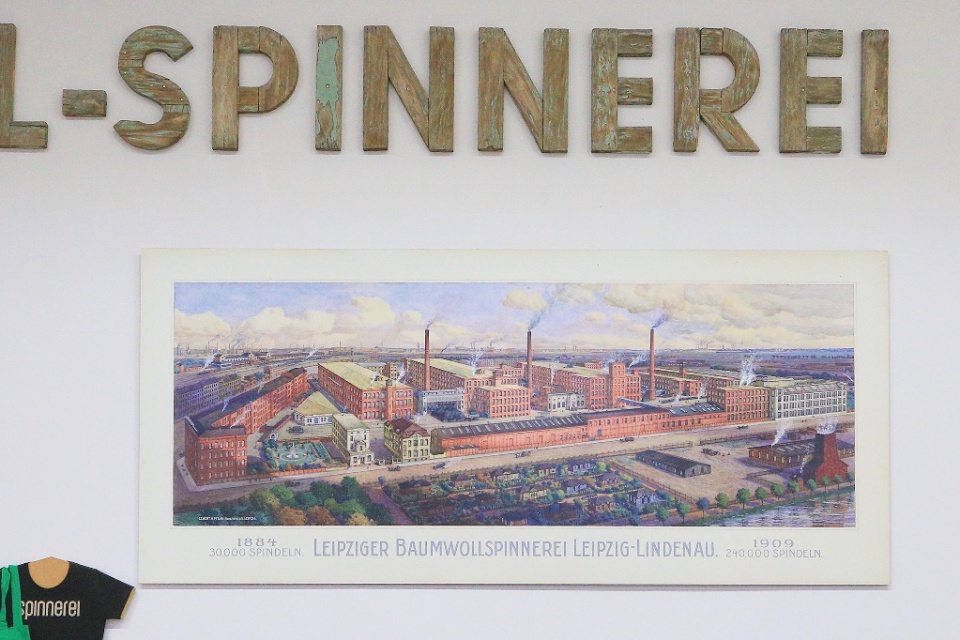
Leipzig Spinnerei: from cotton mill to arts centre

The Leipzig Spinnerei is a former cotton mill (Baumwollspinnerei) in the western industrial suburb of Plagwitz. The massive site at an area of 10 hectares (over 1 million square feet) with rows of factory buildings began operation in 1884 and eventually became the largest cotton mill in Europe with thousands working and living on-site. After the site ceased to produce spools of cotton thread shortly after reunification, artists took advantage of the cheap empty space, and transformed the area into studios, galleries, and exhibition halls. Much has been written about the impact and examples of art and space on Leipzig as the “new Berlin” as well as the “New Leipzig School.” The site as art and culture space opened its doors in 2005.

( Click here for images and more )

Haus Meissen, Meissener Porzellan, Staatliche Porzellan-Manufaktur Meissen, Meissen, Sachsen, Saxony, Germany, fotoeins.com

Meissen: centuries of porcelain-making tradition

In a present-age of speed, screens, and instant gratification, there are reasons to hold onto something tangible in your hands, something as simple as a cup, a plate, a bowl; all high-quality products made in the slow time-honoured way developed over centuries as an important local and, now national, cultural tradition.

First time porcelain production began in China going back at least 1000 years BCE with the subsequent centuries yielding hard durable highly-valued products in white, blue-and-white, and green. With European naval powers reaching Asia in the 16th and 17th-centuries, porcelain found new customers and high demand as “white gold” on par with gold and silver. Admiration and envy got many in Europe to thinking: all we need are some chalky deposits, some water, and some big hot ovens, and we’ll be rich … apart from chemistry, the correct firing or curing temperatures, experimentation, and skill. Until the early 18th-century all porcelain came from China, which is how the present-day phrase “(fine) china” arises.

The European debut to porcelain-making began in 1710 in Albrechtsburg castle in Meissen. When the big guy (who pays your wages or is holding you prisoner) says: “go ye therefore and make me some ‘gold'”, one tends to heed those orders. Frequently in need of funds, Augustus the Strong imprisoned and ordered the alchemist Johann Friedrich Böttger to produce “gold”, but with mathematician and physicist Ehrenfried Walther von Tschirnhaus’ guidance, the two gentlemen did the next best thing and produced Europe’s first “white gold.” Porcelain manufacturing moved from the castle to the present location outside of Meissen’s old town in 1863.

We enter the Meissen Couture and its porcelain museum for a look behind the scenes. Why worry about modern techniques like 3-d printing when you’ve got motivated people willing to put in the hours; their hearts, minds, and souls into their craft? The basic creative instinct and personal touch live on in the town of Meissen in Germany’s Saxony.


( Click here for images and more )