Fotoeins Fotografie

location bifurcation, place vs. home

Posts tagged ‘Deutschland’

My Berlin: Wrapped Reichstag at night, 30 years on

Above: “Wrapped Reichstag 1995–2025” light show.

In 1995, the artist duo Christo & Jeanne-Claude carried out a bold but contentious project by covering Berlin’s landmark Reichstag parliament building. Plans for the project had taken over 20 years, even though the artwork had always meant to be temporary and all expenses had been covered without corporate sponsors. Over 5 million visited in a period of 12 days in the summer of 1995 to look at the undulating “silver dream” in the German capital city. The timing was ideal. After reunification of the two Germanys in 1990, the new home of the federal parliament would be Berlin’s Reichstag. Renovations to the building began in the autumn of 1995 with the federal parliament opening in the spring of 1999.

From 9 to 22 June 2025, the Reichstag building was illuminated nightly with a light show in a 30-year anniversary tribute to the famous 1995 artwork. In a 20- to 30-minute cycle, the light-show appeared to first envelop the building in silver fabric. The fabric cover flapped in artificial breeze, before the cover lost its shape and fell onto the ground at the base of the building. The free-of-charge light show began shortly after sunset at about 930pm and continued until 1am. Whatever Christo and Jeanne-Claude chose to cover and transform, their art works posed questions of perception, origins, shape, functionality, and permanence.

•   DW: Germany Arts
•   Visit Berlin


( Click here for images )

Nuremberg: The Landmark Trials in Room 600, 80 years on

Above: In front of the Justizpalast (Palace of Justice) at the corner of Benjamin-Ferencz-Platz and FĂĽrther Strasse in Nuremberg, Germany.

On 20 November 1945, an extraordinary trial got under way in the German city of Nuremberg, only six months after the Nazis surrendered to the Allied nations in World War 2. For the first time in modern history, an assembled tribunal of international judges presided over trials against top leaders of a nation for crimes against peace, war crimes, crimes against humanity, and conspiracy to carry out these crimes.

What is called the “Nuremberg Trials” refers primarily to the “Major War Criminals Trial” where over 20 leaders in German Nazi high command were put on trial before the International Military Tribunal (IMT) from November 1945 to October 1946. The IMT consisted of judges from each of the four Allied nations: Great Britain, France, United States, and the U.S.S.R. Subsequently from late-1946 to 1949, 12 additional trials were held before American military tribunals to uncover and highlight the extent and depth to which additional leaders in German society supported the Nazi dictatorship.

“… The privilege of opening the first trial in history for crimes against the peace of the world imposes a grave responsibility. The wrongs which we seek to condemn and punish have been so calculated, so malignant and so devastating, that civilization cannot tolerate their being ignored because it cannot survive their being repeated. That four great nations, flushed with victory and stung with injury stay the hand of vengeance and voluntarily submit their captive enemies to the judgment of the law is one of the most significant tributes that power has ever paid to reason.”

– Opening statement by Robert H. Jackson, U.S. chief prosecutor, on the second day of the Nuremberg Trials (Major War Criminals Trial), 21 November 1945; see Sources below.


( Click here for images and more )

My Berlin: Dussmann Kulturkaufhaus, more than a bookshop

Pieces & places in Berlin

If I have 3 days or 7 weeks to spend in the German capital city, I make time to stop at Dussmann.

Conveniently located near Berlin’s Friedrichstrasse train station, the “department store of culture” offers more than simply German-language books to serve fiction read-needs or magazines to gauge what’s happening near and far. There’s a separate English language bookshop, as well as an enormous catalog of music, film, and television. The space is also large enough to hold some cultural events. Naturally, there’s a “BerlinShop” for my postcard and your souvenir requirements. And because it’s Berlin, they stay open past 11pm Monday to Saturday.

Dussmann is an important place and piece to the extensive conceptual mosaic I’ve created over the years with the amount of time spent in Berlin since 2002. I never regret any visit to Dussmann. I always regret what’s about to happen: my wallet gets a little lighter, and that I somehow have the massive fortitude to leave with “only” a handful of books.


Dussmann Kulturkaufhaus, Berlin, Deutschland, Germany, fotoeins.com

Completed in 1997, the lower 5 floors of the 8-storey building is all about the Kulturkaufhaus, whereas the upper 3 floors are reserved for office space which includes the Dussmann Group. Photo, 27 May 2025.
Dussmann Kulturkaufhaus, Berlin, Deutschland, Germany, fotoeins.com

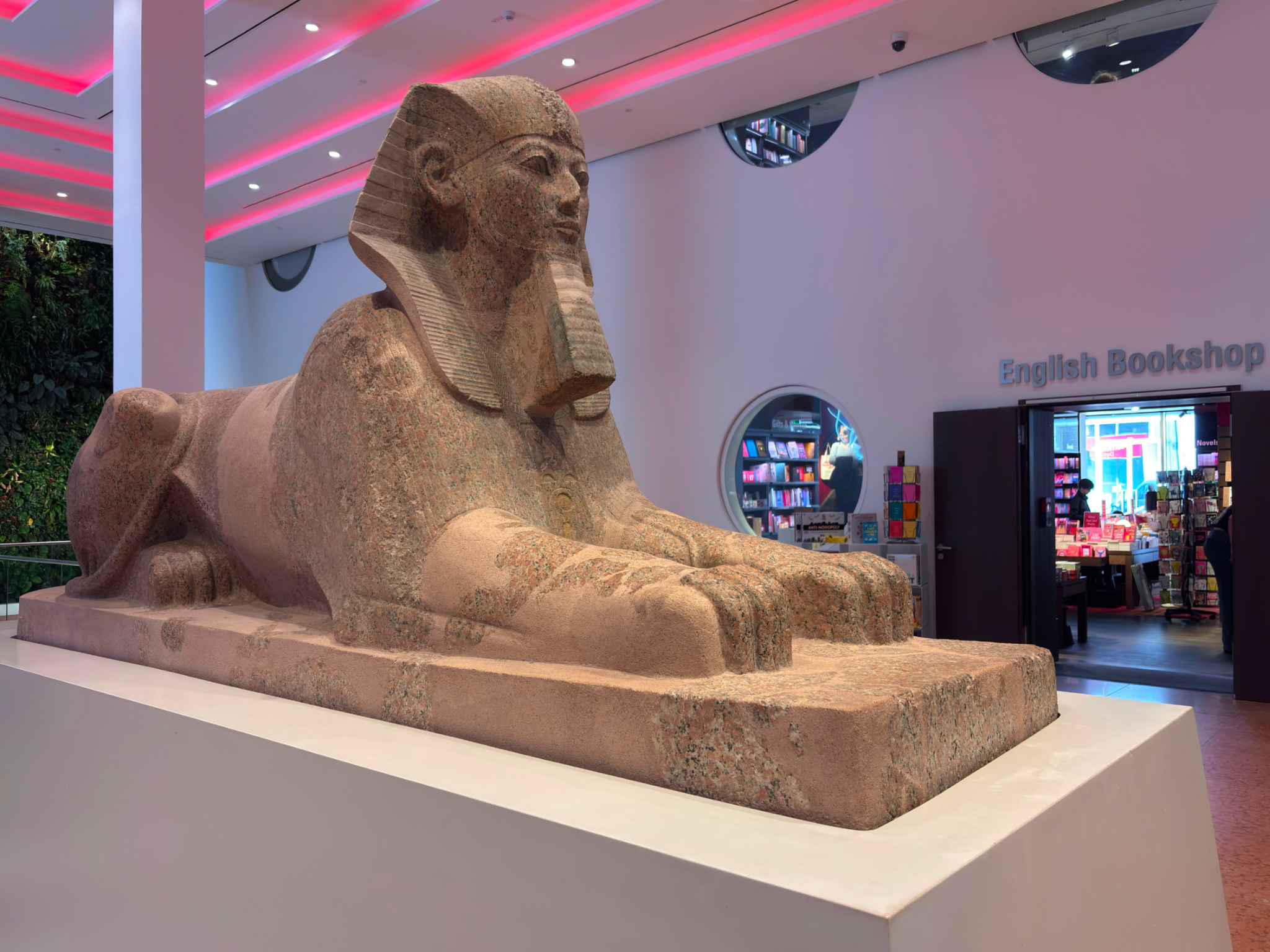
At the far end on the ground floor (Erdgeschoss) is the sphinx of Egypt’s Queen Hatshepsut (about 1475 BCE), on permanent loan from the Egyptian Museum of Berlin. The inscrutable statue greets visitors to the café below, as well as the English language bookshop at right. Photo, 27 May 2025.

Dussmann Kulturkaufhaus, Berlin, Deutschland, Germany, fotoeins.com

From the 2nd floor (erste Obergeschoss) this view along the central aisle shows how the combination of natural light from above, mix of artificial lighting and colours, and hanging leafage provides a welcoming atmosphere, which undoubtedly makes it easier for customers to spend. Photo, 30 May 2025.
Dussmann Kulturkaufhaus, Berlin, Deutschland, Germany, fotoeins.com

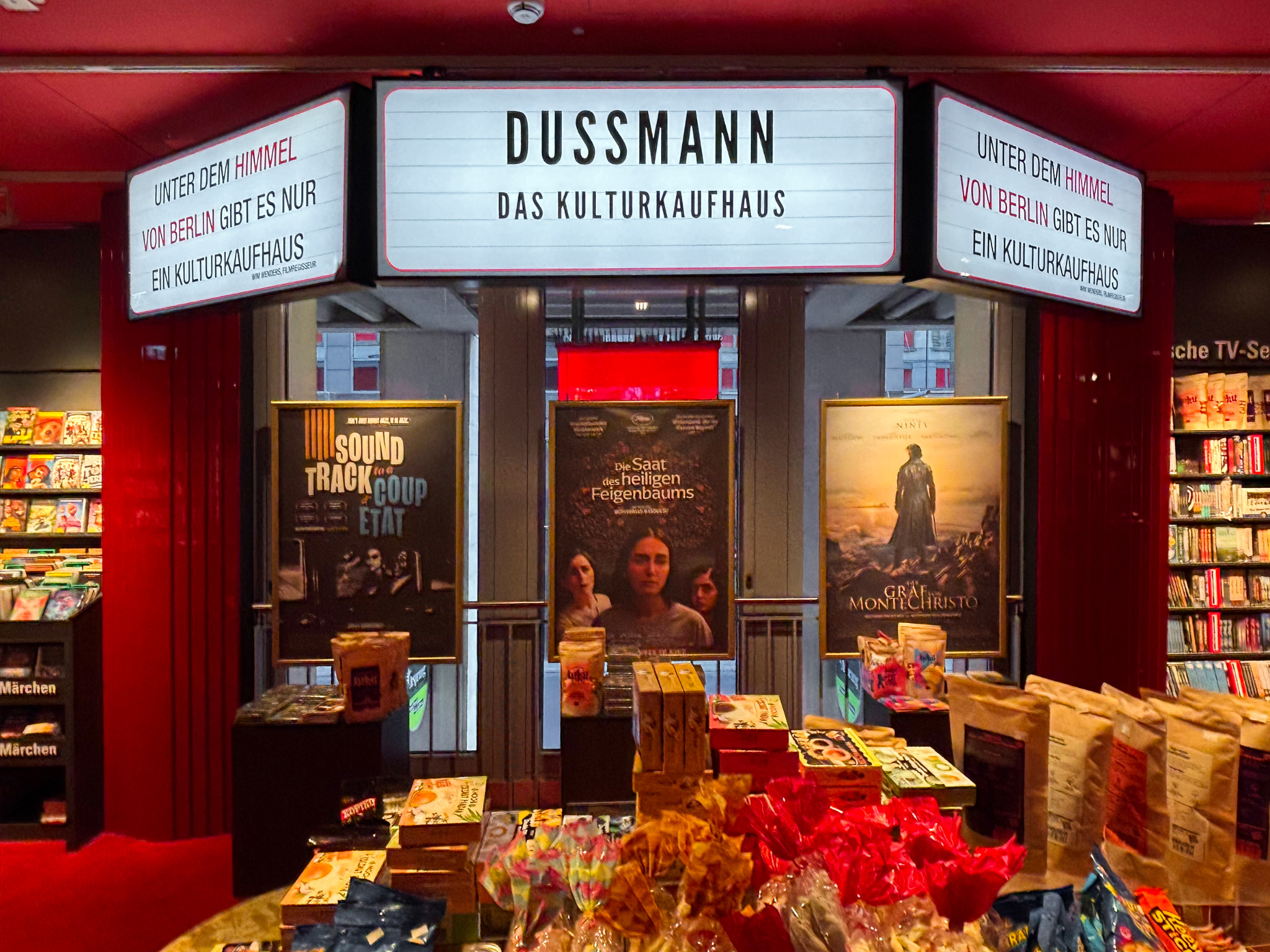
“Under Berlin’s skies, there’s only one Dussmann.” On the 2nd floor, the theatre banner-like display highlights the movie and television section, and if the quote is indeed from Wim Wenders, it’s an interesting play on the title “Der Himmel ĂĽber Berlin”, a film Wenders directed in 1987. In the television section, I found DVDs for early-seasons (series) of New Zealand’s “The Brokenwood Mysteries”, distributed in Germany as “Brokenwood – Mord in Neuseeland”. Photo, 30 May 2025.
Café Nénom, Dussmann Kulturkaufhaus, Berlin, Deutschland, Germany, fotoeins.com

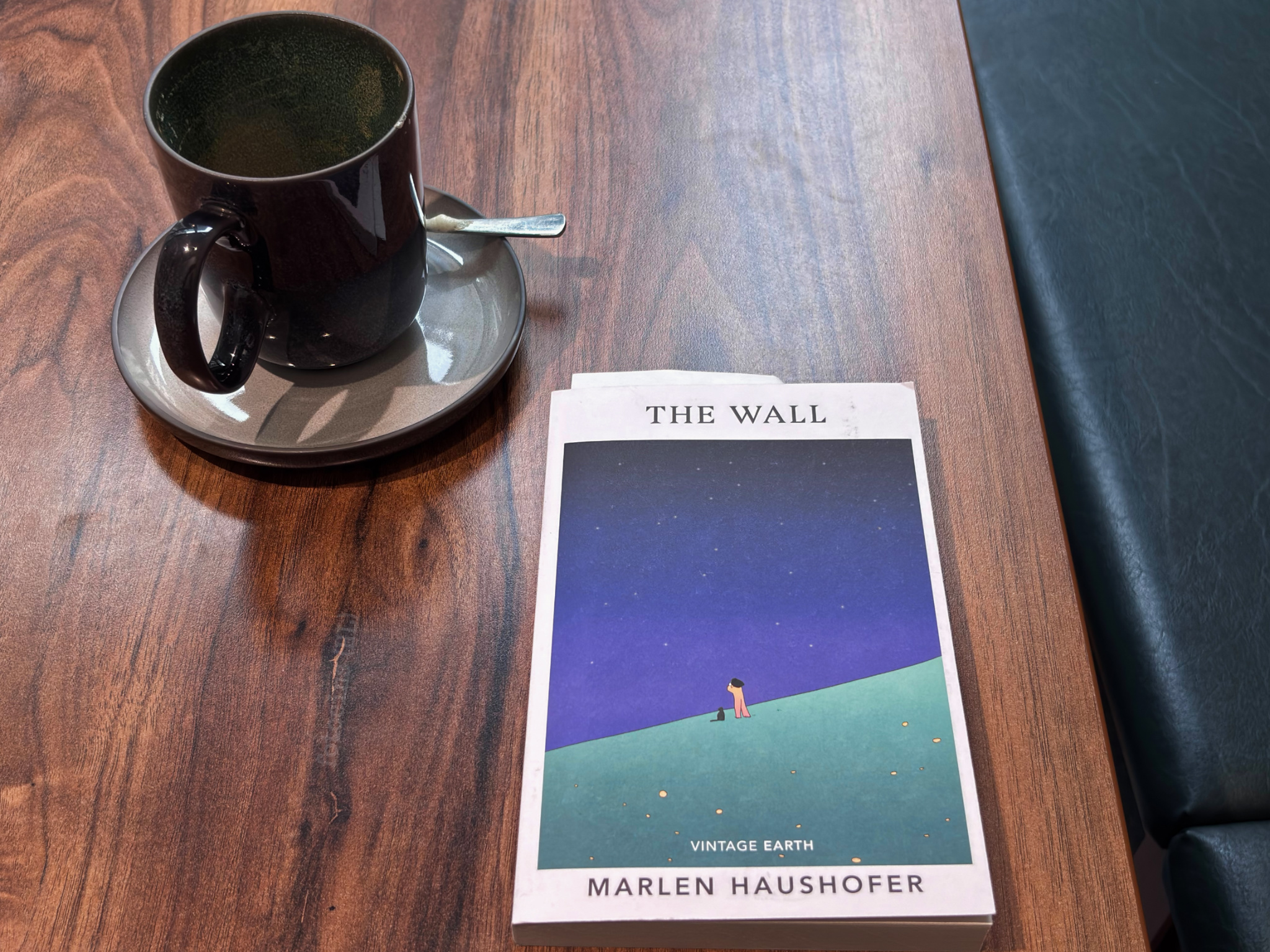
Afternoon break at CafĂ© NĂ©nom with coffee and book: “The Wall” (“Die Wand”), a work of fiction published in 1963 and written by Austrian Marien Haushofer. Photo, 27 May 2025.


Directions & Hours

•   BVG U-Bahn U6 train to Friedrichstrasse station.
•   S-Bahn Berlin train: S1, S2, S25, S26; S3, S5, S7, or S9 to Friedrichstrasse station.
•   Leaving Friedrichstrasse station, it’s a short 120-metre (400-ft) walk south to the shop.
•   BVG Tram M1 or 12 to stop “S+U Friedrichstrasse Bhf”.

Monday to Friday: 9h–0h; Saturday: 9h–2330h; Sunday (BerlinShop only): 13h-18h.

( View this location in OpenStreetMaps )

I received no prior support or subsequent compensation for this piece. I made all above images with a P15 on 27 and 30 May 2025. This post appears on Fotoeins Fotografie at fotoeins DOT com as https://wp.me/p1BIdT-wj0.

Regierungsviertel, MarschallbrĂĽcke, Spree, Berlin, Germany, Deutschland, fotoeins.com

Fotoeins Friday, Berlin 2025 (9): Government District

Facing west to the Regierungsviertel (Government district) over the Spree river from the bridge Marschallbrücke, the Reichstag is a symbol of the turbulent and tragic past, and the post-reunification buildings that are the Paul-Löbe-Haus and the Marie-Elisabeth-Lüders Haus are representative of the present and hope for the future.

I made the image above on 27 May 2025 with a Fujifilm X70 fixed-lens prime and these settings: 1/1000-sec, f/13, ISO1000, and 18.5/28mm focal length. This post appears on Fotoeins Fotografie at fotoeins DOT com as https://wp.me/p1BIdT-vHD.

Berlin, Deutschland, Germany, Helmut Newton, Helmut Newton Stiftung, Museum fuer Fotografie, fotoeins.com

Fotoeins Friday, Berlin 2025 (8): Helmut Newton’s Polaroids

Polaroid by Helmut Newton, for American Vogue, Monaco, 1979.

Newton made many small Polaroid images throughout his renowned career as a way to test or experiment with ideas, because all he had at the time were film-cameras. In other words, he could afford to “waste” Polaroids, but not his “work film”. Yes, I know: I made a photograph of a Polaroid made to print and set on display in a museum in Berlin. But there’s something subversive about this digital version existing somewhere in the aether, an image which many will look and pass by, in a similar manner unknowing to them of having seen a physical print somewhere in a museum or gallery.

I made the image above on 25 May 2025 with a Fujifilm X70 fixed-lens prime and these settings: 1/60-sec, f/4, ISO3200, and 18.5/28mm focal length. This post appears on Fotoeins Fotografie at fotoeins DOT com as https://wp.me/p1BIdT-vHs.