Fotoeins Fotografie

location bifurcation, place vs. home

Posts tagged ‘Deutschland’

Hennes, 1. FC Köln, Köln, Cologne, North Rhine Westphalia, Nordrhein-Westfalen, Germany, Deutschland, fotoeins.com

My Cologne: 1. FC Köln, Stadium, Anthem

Above/featured: “Hennes”, mascot for 1. FC Köln (GO4KÖLN, Breitestr. 36). Photo, 16 Jun 2023 (X70).

“Gute Laune, Laute Stimme”: the “EffZeh” (F-C) experience has me hooked.

I’m among men and women, young and old, swimming in a sea of red and white, and surrounded by full-volume chanting. Not only is it a big deal to procure a “Stehplatz” (standing spot) for under €20, but to be present in the stadium’s standing-only terraces is a big thrill. The terraces are present in German football stadia but banned in England (for historical reasons). I’m convinced I’m going to memorize their famous fan anthem as quickly as possible.

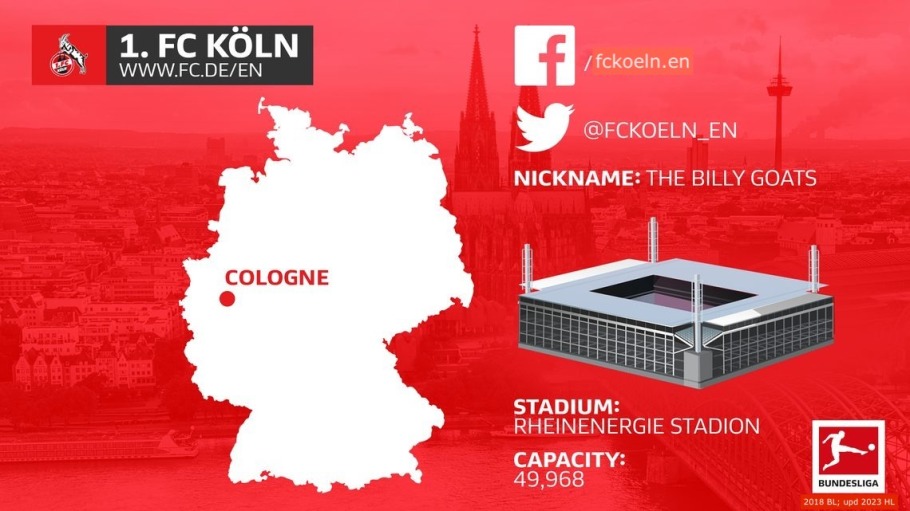
Founded on 13 February 1948, the football (soccer) team 1. FC Köln plays out of the Müngersdorfer Stadion, known also as the sponsored Rhein-Energie-Stadion (Rhine Energy Stadium) in Cologne. The stadium’s maximum capacity is about fifty-thousand, and the football side regularly sells out their home matches. The team’s mascot is a billy goat (Geissbock) for its steadfast stubborn perseverance; the team’s nickname is The Billy Goats. I’m also convinced there’s another “Kölle” verbal pun. “Geist-bock” is a compound noun consisting of “Geist” for (team-, fan-) spirit, and “Bock” for the people’s stubborn steadfast support. Various generations of “Hennes”, the mascot goat, have appeared on the sideline for home matches, and the mascot is prominent in the team badge’s and familiar red-and-white home kit (jersey).

The English version of the Bundesliga website highlights the team, reminding us they were the first ever champions of the newly established Bundesliga for the 1963-1964 season.

Bundesliga, 1. FC Köln, Rhein-Energie-Stadion, Köln, Cologne, North Rhine Westfalen, Nordrhein-Westfalen, Germany, Deutschland

Basic club info from Bundesliga (2018-2019), with updated FB link.

1. FC Köln, Bahnhof Ehrenfeld, Cologne, Köln, Germany, fotoeins.com

“1. FC Köln” mural at Ehrenfeld station – 14 Jan 2013 (450D).

Zesamme Simmer Stark, FC Kölle, 1. FC Köln, Effzeh, Hilton Cologne, Köln, Cologne, North Rhine Westphalia, Nordrhein-Westfalen, Germany, Deutschland, fotoeins.com

“Zesamme Simmer Stark”: Hilton Cologne. Photo, 26 May 2016 (6D1).

1. FC Köln, Köln Hauptbahnhof, Köln Hbf, Köln, Cologne, North Rhine Westphalia, Nordrhein-Westfalen, Germany, Deutschland, fotoeins.com

1. FC Köln fanshop “Stadion”, at Köln Hbf (Cologne central station). Photo, 13 May 2022 (X70).


( Click here for images and more )

Erfurt: 12 stations through the Old Town

Above/featured: Krämerbrücke in shadow, at first light.

Located along the Gera river near the centre of Germany, Erfurt is an historical hub of east-west trade, a stop on the historical road “Via Regia” dating back to the Middle Ages, and is considered a spiritual home for Martin Luther. He left behind plenty of traces throughout the city which is now the capital city for the German state of Thuringia (Landeshauptstadt Thüringens). For its preserved medieval Old Town, half-timbered houses, and churches, Erfurt has the nickname “Thuringian Rome.”

Each of the following locations in addition to the Erfurt’s Hauptbahnhof (Central Station) is indicated with an icon in the map below. All 12 places below can be reached with tram routes 3, 4, or 6 in a common stretch with stops at Anger, Fischmarkt / Rathaus (Fish Market / City Hall), and Domplatz (Cathedral Square).


( Click here for images and more )

Kölner Dom, Hohenzollernbrücke, Köln, Cologne, Germany, fotoeins.com

Cologne’s two grand landmarks

Give them any excuse, the people in Köln (Cologne) love to party at any time. It’s a wonder but no surprise this is where I find some of the happiest people in the country. As the calendar flips to a new year, the time heralds the annual shenanigans of the Kölner Karneval. For residents and visitors, two of the best-known landmarks in the city are the Kölner Dom (Cologne Cathedral) and the Hohenzollernbrücke (Hohenzollern Bridge).

( Click here for more )

Weimar: City Church at Herderplatz, UNESCO WHS

Weimar is a compact town with a large number of buildings as a part of two UNESCO World Heritage Sites. As part of the “Classic Weimar” World Heritage listing, Herderplatz (Herder Plaza) in the northern part of the city’s old town is known most for the church with two spires and a dark grey roof. This is the Stadtkirche (City Church), known also the Church of Saint Peter and Paul.

The church dates to the middle of the 13th-century AD (CE) when town and charter were first established, although a settlement in the area goes further back to the beginning of the 10th-century AD. Built initially as late-Gothic and redesigned as Baroque, and what fires and war bombing couldn’t destroy, several phases of rebuilding and renovations were completed in 1953, 1977, and 2000.

Johannes Gottfried Herder (1744-1803) was German philosopher, writer, and theologian. From 1776 until his death, he lived and worked in Weimar as General Superintendent for the Saxon-Weimar Duchy, Court Chaplain, member of the church advisory council, and President of the Supreme Consistory. For his service to the city’s people and contributions to German philosophy and literature, and as the site of his burial, the church is also known as Herderkirche (Herder Church).

Cranach Altar

The Cranach Altar is an important testament to the history of the Reformation in the state of Thuringia. The triptych was started by Lucas Cranach the Elder in 1552, and continued by his son, Lucas Cranach the Younger, in 1554. Completed in 1555, the entire piece was installed over the main church altar by 1557. The paintings include portraits of Lucas Cranach the Elder and Martin Luther, and centre around “Christus am Kreuz” (Christ’s crucifixion). Christ’s blood streams out and touches Cranach the Elder’s forehead, symbolizing a direct relationship between God and people without the need for or the intercession of priests; more here.

Contemporaries

Lucas Cranach the Elder, 1472-1553.
Martin Luther, 1483-1546.
Lucas Cranach the Younger, 1515-1586.

Johannes Gottfried Herder, 1744-1803.
Johann Wolfgang von Goethe, 1749-1832.
Friedrich Schiller, 1759-1805.

( Click here for images and more )

Denkmal fuer die ermordeten Sinti und Roma Europas, Memorial to Murdered Sinti and Romas in Europe, Dani Karavan, Tiergarten, Berlin, Germany, fotoeins.com

My Berlin: Moving Memorial to Murdered Sinti and Roma

In the German capital city, among the rustling of tall trees is a quiet space in the northeast corner of Tiergarten Park adjacent to the Reichstag. Between the chirps and whistles of small birds, a recording of a violin plays. Individual notes are held, as long as possible, as if life depended upon the existence of each note. Slowly, the sound accumulates into a keening wail, burrowing deep (if you let it) and tearing from within (if you feel it). You’d do well not to stumble, as you gingerly move through the memorial, careful not to step on words like “Auschwitz”. Inscribed on flattened stones spreading out from the pond are the names of important places, critical to maintaining memory, with intention and purpose.

Created by Dani Karavan, the Memorial to Murdered Sinti and Roma consists of a circular pond. At the centre is a triangular slab on which fresh flowers are placed. In a ring around the pond are the words of a poem, “Auschwitz”, by writer and composer, Santino Spinelli, a member of the Italian Sinti and Roma.

Muj šukkó, kjá kalé vušt šurde; kwit. Jilo čindó bi dox, bi lav, nikt ruvbé.

Drenperdo Mui, phagede Jakha, schiel Wuschtia; Pokunipen. Phagedo Dschi, kek Ducho, kek Labensa, kek Asvia.

Eingefallenes Gesicht, erloschene Augen, kalte Lippen. Stille. Ein zerrissenes Herz, ohne Atem, ohne Worte, keine Tränen.

Pallid face, dead eyes, cold lips. Silence. A broken heart without breath, without words, no tears.

( Click here for video and images