Fotoeins Fotografie

location bifurcation, place vs. home

Posts tagged ‘deutsche Hauptstadt’

Stelenfeld, field of stelae, Holocaustdenkmal, Holocaust Memorial, Berlin, Germany, fotoeins.com

My Berlin: in the field of stelae

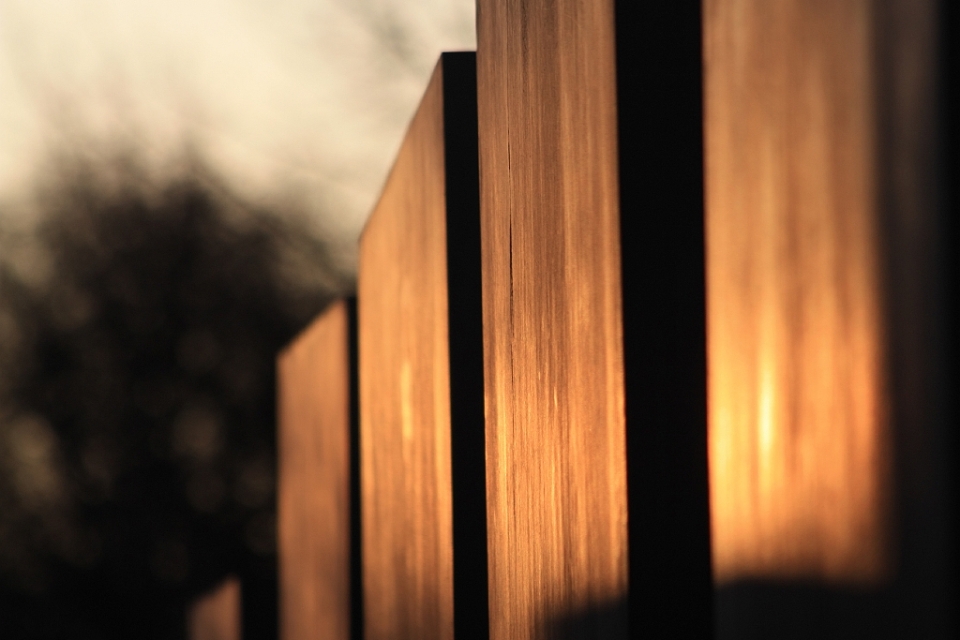
Above/featured: Reflection – 19 Mar 2011 (450D).

In Berlin’s Mitte district between Brandenburg Gate and Postdamer Platz is a field of standing blocks (Stelefeld).

The slabs of concrete are uniform in colour, composition, length, and width. However, the blocks stand at different heights, the curved ground below undulates, and when the slabs loom suddenly overhead, the spaces in between can be eerie, adding to feelings of confusion and disconnection.


( Click here for more )

My Berlin: autumn colours in the German capital

Above/featured: A swath of “Mitte” colour in the fog – 16 Nov 2012 (450D).

Berlin doesn’t have the easy natural landmarks of mountains or open waters immediately adjacent to the city. But there’s plenty more urbanity in Berlin which includes countless green spaces inhabited by deciduous trees whose leaves reveal their colours as temperatures drop with the change in season. The colour change by day gives way to night-time illuminations of colour and pattern onto buildings and landmarks during October’s annual Festival of Lights. I found myself absorbing and remembering the colours to tie me through the subsequent cold dark grey doldrums.

I made all photos on multiple visits to the German capital between 2006 and 2021 with the following devices: Canon PowerShot A510 (A510), Canon EOS450D/Rebel XSi (450D), Canon EOS6D mark1 (6D1), and Fujifilm X70 fixed-lens prime (X70). This post appears on Fotoeins Fotografie at fotoeins DOT com as http://wp.me/p1BIdT-LK.

( Click here for images and more )

Currywurst, noxoss, Bernd Petrikat, Pixabay

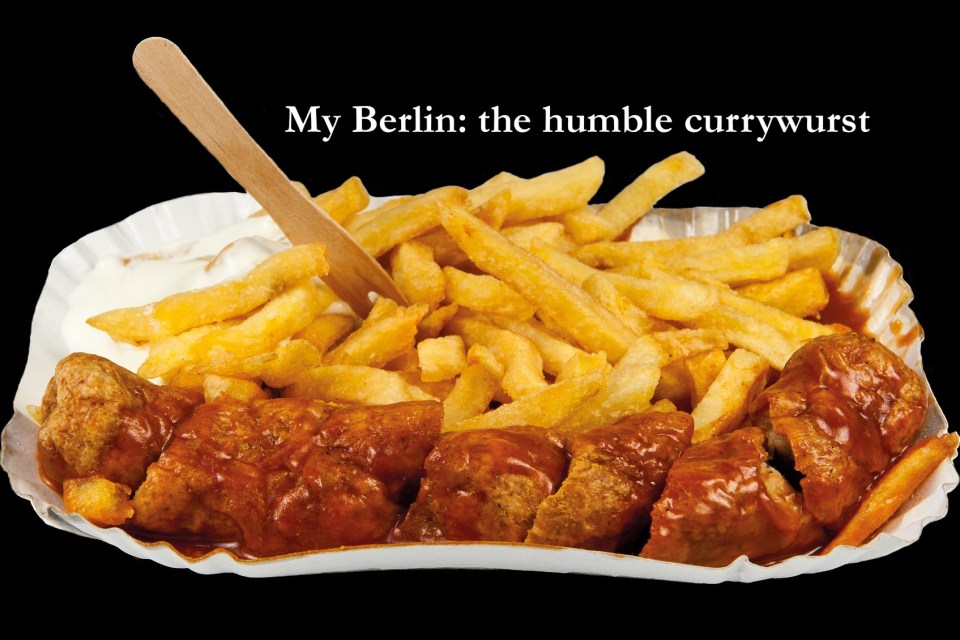
My Berlin: the humble currywurst

Above/featured: Image by noxoss (Bernd Petrikat) on Pixabay.

In Germany’s capital city, Berlin is populated by countless venues for Döner, falafel, and currywurst. For the latter, I highlight two examples: Curry 61 (Hackescher Markt) and Curry 36 am Zoo (Zoologischer Garten), both of which are easily accessible with the city’s U- or S-Bahn.


Curry 61 – Hackescher Markt

(17 March 2011.)

Walking around Berlin’s Mitte district on a wet March afternoon, I found myself in the area around Hackescher Markt. I stepped briefly into the quiet Hackesche Höfe courtyard complex to pick up some postcards (at Schönhauser Design). I’d already subjected myself to the sights and scents emanating numerous cafés, bakeries, and snack shops. I hadn’t had lunch, and with food possibilities reaching my eyes, the grumbling belly meant time to feed.

The ubiquitous yet humble currywurst came to the rescue. I retraced my steps back towards Hackescher Markt, and I arrived at the street-side counter for Curry 61.

A short history of Berlin’s claim to currywurst’s origins goes something like this. In 1949, Herta Heuwer, who ran a snack counter in Berlin, mixed curry powder and Worcestershire sauce with ketchup, and when she served grilled pork sausage with the new sauce to her customers, they loved the new concoction. She patented the sauce as “Chillup” years later. Today, currywurst is ubiquitous, challenging even the Döner as the champion of street-food throughout Berlin.

Currywurst at Curry 61, Curry 61, Berlin Mitte, Germany, Hauptstadt, Deutschland, fotoeins.com

Curry 61 – 17 Mar 2011.

Bratwurst mit Darm, Currywurst at Curry 61, Curry 61, Berlin Mitte, Germany, Hauptstadt, Deutschland, fotoeins.com

Grilled sausage, with casing. Curry 61 – 17 Mar 2011.
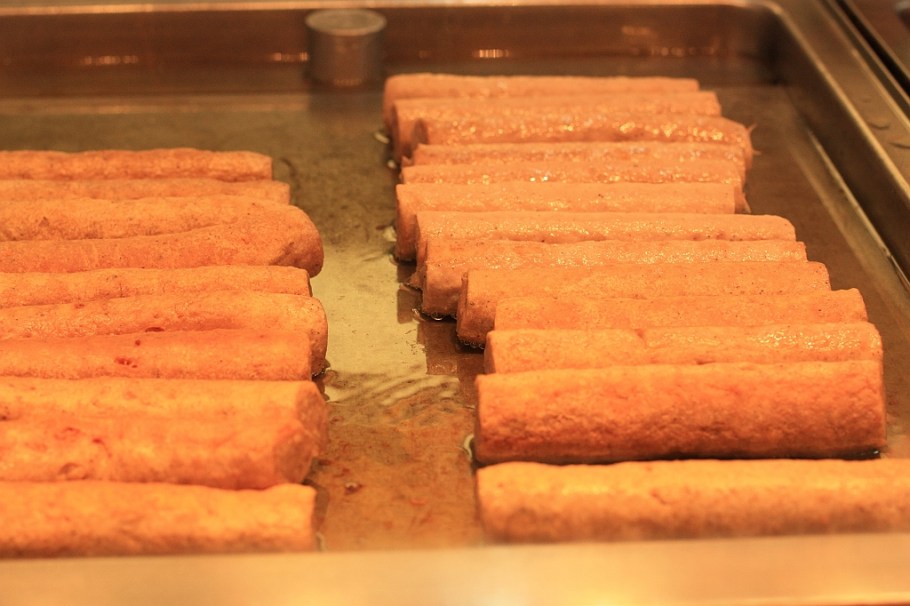
Bratwurst ohne Darm, Currywurst at Curry 61, Curry 61, Berlin Mitte, Germany, Hauptstadt, Deutschland, fotoeins.com

Grilled sausage, without casing. Curry 61 – 17 Mar 2011.

A short conversation in German with the owner went something like this:

•   Was hätten Sie gern? — Einmal mit (Darm) und Pommes rot; scharf, bitte.
•   Woher kommen Sie? — Kanada, doch ich arbeite zurzeit in Chile.
•   Was machen Sie hier in Berlin? — Urlaub, ein paar Freunden besucht.
•   Wie sprechen Sie so gut Deutsch? — Schon 2. Jahre hier gewohnt, und viele Mass Bier getrunken.

Which roughly translates in English as:

•   What would you like? — An order with (casing), and fries ‘red’; spicy, please.
•   From where do you come? — Canada, but I work presently in Chile.
•   What are you doing in Berlin? — Vacation, visiting friends.
•   How did you come to speak German? — 2 years in the country, and many litres of beer.

The owner seemed to like my answer to his last question.

Although the owner asked if I really wanted the spicy (Scharf) version, I got a good dose of spice; my serving had a good sharp edge.

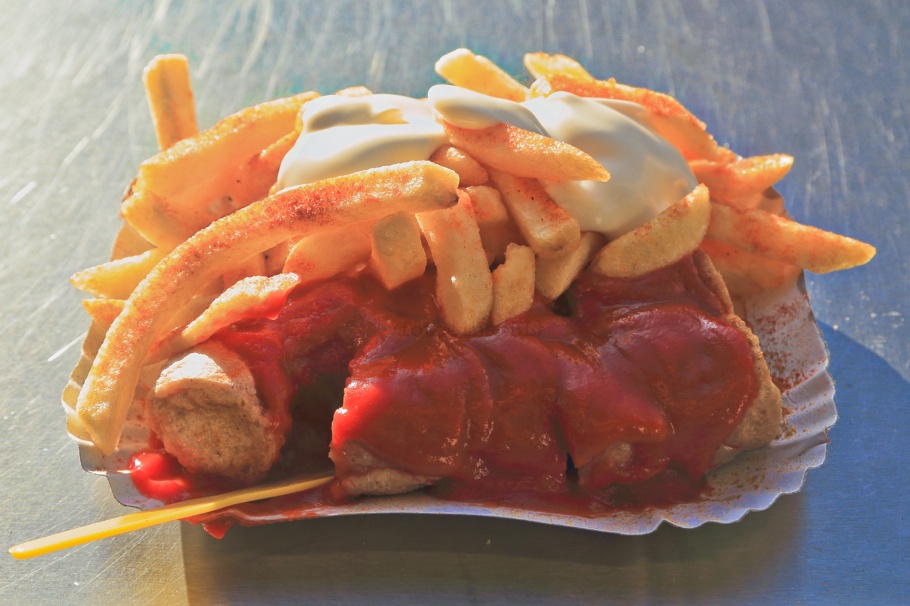
Currywurst mit Pommes, Curry 61, Berlin Mitte, Germany, fotoeins.com

Pork bratwurst with fries doused in ketchup and topped with curry and chili powders. Curry 61 – 17 Mar 2011.


Curry 36 – Zoologischer Garten

(9 Dec 2014.)

In subsequent visits to Berlin, I’m passing through the train station near the city’s zoo more frequently. Next to the station at Hardenbergerpltaz is a satellite of Curry 36. While their key location is near Mehringdamm station, Curry 36’s location next to Zoologischer Garten station gets its fair share and flow of people streaming in and out of the station serving U-Bahn, S-Bahn, and regional trains.

I order a Doppel (double-order), both “ohne Darm” (no casing) and sliced into bite-sized pieces, accompanied by “Pommes rot-weiss” (red white) that’s a portion of fries slathered with ketchup and mayo and topped with curry powder.
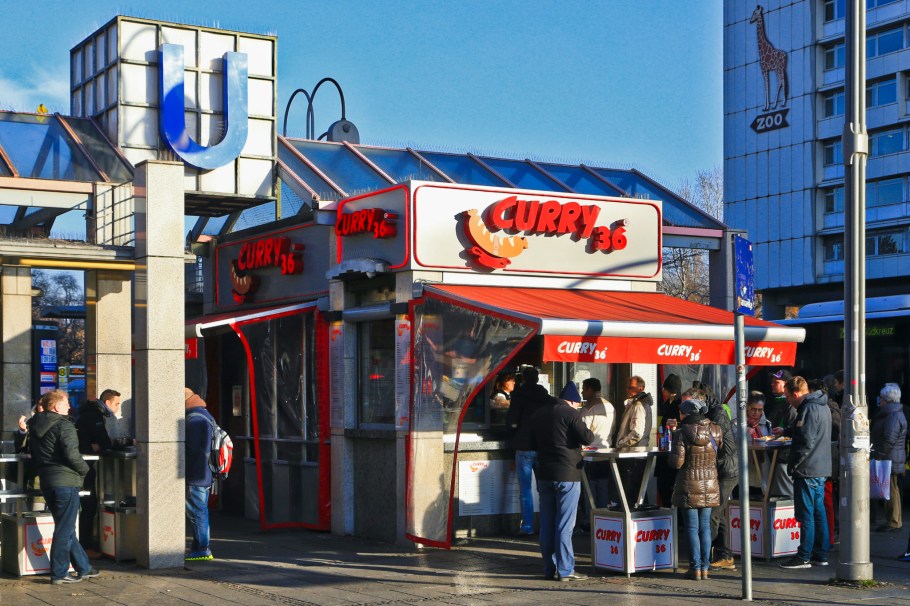
Curry 36, currywurst, Zoologischer Garten, Hardenbergplatz, Berlin, Hauptstadt, Germany, Deutschland, fotoeins.com

Curry 36 am Zoo – 9 Dec 2014.

Curry 36, currywurst,  Zoologischer Garten, Hardenbergplatz, Berlin, Hauptstadt, Germany, Deutschland, fotoeins.com

Curry 36 am Zoo – 9 Dec 2014.


Many have written about and swear by these currywurst joints in Berlin: Curry 36 and Konnopke’s Imbiss. I’ve also visited the German Currywurst Museum to learn about the history and evolution of the snack. Come to think of it, every time I’m in Berlin, I’ll seek out the currywurst, from one “Imbiss” stand to the next, in my perpetual search for the ultimate taste of the city.

I made all photos with a Canon EOS450D/Rebel XSi on 17 Mar 2011 and 9 Dec 2014. This post appears on Fotoeins Fotografie at fotoeins DOT com as http://wp.me/p1BIdT-pr.

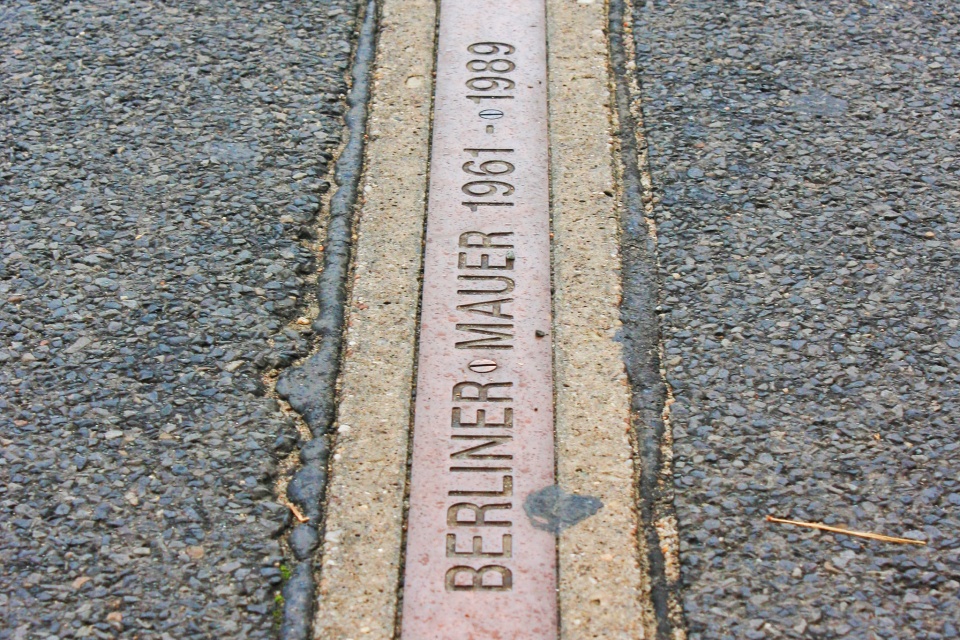
Pavement marker Niederkirchnerstrasse, between Martin-Gropius Bau & Topographie des Terrors, Berlin, Germany - 2. Okt. 2009

The Berlin Wall, 1961-1989

Some view East Germany (GDR/DDR) with great fondness, if it’s a comparison made between today with the “good old days.” I’m not interested in the “Ostalgie” (nostalgia for the former east). I’m interested in learning how a system in place does a gradual creep, takes over a country and her people. Before they realize what’s happening, their own government has locked them inside the borders to prevent them from leaving; get caught trying to escape near the border, and you’ll be shot for your trouble.

“No intention to build a wall …”

On 15 June 1961, when asked at a press conference if a wall would be erected between west and east Berlin, Walter Ulbricht, leader of the GDR’s only recognized political party, the Socialist Unity Party of Germany (Sozialistische Einheitspartei Deutschlands), answered:

“Die Bauarbeiter unserer Hauptstadt beschäftigen sich hauptsächlich mit Wohnungsbau, und ihre Arbeitskraft wird dafür voll eingesetzt. Niemand hat die Absicht, eine Mauer zu errichten.”

“Construction workers in our capital city are fully engaged in residential construction, and the labour force is deployed for that purpose. No one has any intention of putting up a wall.”

(Chronik der Mauer | YouTube )

Privately, Ulbricht had already been pushing hard to build a wall to stop the increasing number of people leaving East Germany for the West. Building a wall would also strengthen the (buffer) position of East Germany within the developing Soviet satellite-empire.

Two months later at midnight on August 13, work began quietly on a wall, and orders were given for additional troops to guard and “protect” the border. Berliners awoke at daybreak to a divided city.


( Click here for more )

Erna-Berger-Strasse, Berlin, Germany, fotoeins.com

My Berlin: a lonely watchtower stands in Mitte

I’m sure I would’ve immersed myself in European history and languages, had I not studied physics or astronomy. After two years of working in Germany, I developed a deep interest for language and her people. Even after having left the country in 2003, I’ve been fortunate to return once or twice each year.

I had read about one of the few remaining DDR-Wachtürme (East German Watchtowers) in Berlin. On a December afternoon, light snowfall in the German capital city seemed to slow both human and mechanized activity. I wandered slowly into Berlin Mitte to check out the location of an old East German watchtower that’s been listed as a historical monument since 2001.

( Click here for more )