Fotoeins Fotografie

location bifurcation, place vs. home

Posts tagged ‘deutsche Hauptstadt’

Berlin & 125 successive weekends

The first weekend begins Friday, August 9, 2013, in the German capital city of Berlin.

To the unmistakable sounds of low rumble hustle of traffic and the happy chirps and tweets of birds. That’s strange, because I’m asleep; aren’t I? It’s much better if I’m not, a warm and gentle possibility in the spotlight of my mind.

My eyes struggle to open, brilliant morning light streaming through the open balcony windows and past the billowing room-high drapes. I pad slowly to the source of the light, and part the drapes to see what’s outside. I’m on the 5th-floor apartment of an “Alt Bau” in the city’s Westend. The apartment’s windows face north which means plenty of summer morning light.

I open the bedroom door. She smiles at me, her gaze warm and alive as a summer breeze. “Good morning.”

From that August weekend, I’ve kept a single promise to let her know I’m thinking about her. I’ve sent a text-message every single weekend without fail. Except for one weekend about a year ago when I missed my schedule, and she promptly sent an e-mail asking – no, demanding to know – if things were all right, if I was all right. There’s busy and there’s her kind of busy, and I understand all of it. Her urgent message strikes something solid, commencing the melt for the first time in a very long time.

On December 9, 2015, she asks me to stop.

( Click here to read more )

Berlin Grunewald: no train will ever leave track 17 again

Present in the vicinity of a train station are very distinct and familiar sounds: the racket of heavy locomotives chugging down the rail and the screech of high-friction braking. A breeze sweeps through two columns of trees, creating a low keening sound which escapes into the open space beyond. To stop and listen, the sounds could easily be human: faint shouts and cries. Are they tricks of the mind, or are the dead speaking? The spectre of cruelty, despair, and suffering clings to the abandoned track; seven decades in the past don’t seem very far.

On a cool grey late-autumn afternoon, I’m on an S-Bahn train heading towards Potsdam. Beyond the limits of the “Stadtbahn” and one stop beyond the “Ring” at Westkreuz, the train pulls into the former goods and freight station at Grunewald. Dropping into the underground passage, signage points to the memorial at track 17. I leave the station by the southeast exit, and turn left to ascend the ramp along the side street.

In the Berlin borough of Charlottenburg-Wilmersdorf, Grunewald station lies on the S7 S-Bahn line serving central Berlin city, the city of Potsdam to the southwest, and Ahrensfelde to the northeast in the Berlin borough of Marzahn-Hellersdorf. Grunewald station began operation in 1879 under its original name Hundekehle named after a nature reserve nearby. The station changed its name to “Grunewald” in 1884 when the old Grunewald station began its new life as “Halensee” station. Grunewald station and its tracks were incorporated into Berlin’s S-Bahn train network in 1928.

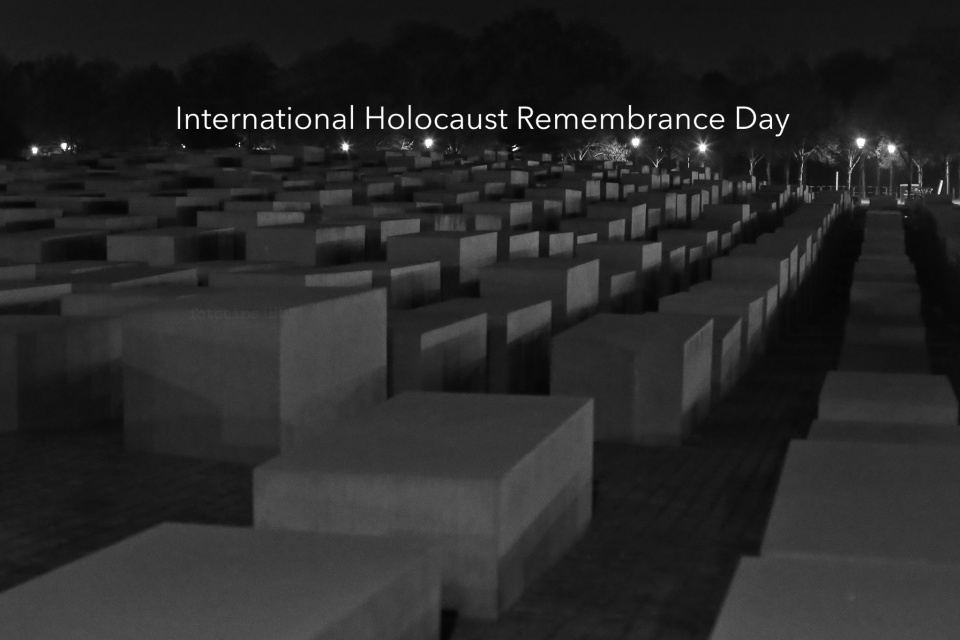
Many companies including the Deutsche Reichsbahn (German Imperial Rail) were actively complicit in the machinery of mass murder during Nazi rule. After reunification of East and West Germany in 1990, the two separate railways also merged to form Deutsche Bahn in 1994, and calls arose for the new company to acknowledge its dark past. To mark the Reichbahn’s collaboration in deporting people to camps and their deaths, present-day Deutsche Bahn AG established a memorial at track 17. Inaugurated in 1998 the memorial was designed and built by architects Hirsch, Lorch, and Wandel who were very mindful of the 1991 Karol Broniatowski memorial near the station’s entrance.

Along track 17, metal plates have been inserted, one for every transport train which took Berlin’s Jews to their deaths. Each plate includes the transport date, the number of people deported, and the transport’s destination. The first train of record departed Grunewald on 1941 October 18 when 1251 Jews were deported to Łódź. Another plate marks the last train of record (so far) leaving Grunewald on 1945 March 27 when 18 Jews were deported to Theresienstadt; blank plates leave room for additional commemorations with new uncovered information. More than 50-thousand Jews from Berlin were deported from this station alone. The first set of trains went to concentration-camps in eastern Europe, but by the end of 1942, trains were directed to Auschwitz and Theriesenstadt.

The vegetation that’s been left to grow around the track over the years is a visible symbol and an unspoken promise to all: that no train will leave track 17 ever again.

( Click here for images and more )

Denkmal fuer die ermordeten Sinti und Roma Europas, Memorial to Murdered Sinti and Romas in Europe, Dani Karavan, Tiergarten, Berlin, Germany, fotoeins.com

My Berlin: Moving Memorial to Murdered Sinti and Roma

In the German capital city, among the rustling of tall trees is a quiet space in the northeast corner of Tiergarten Park adjacent to the Reichstag. Between the chirps and whistles of small birds, a recording of a violin plays. Individual notes are held, as long as possible, as if life depended upon the existence of each note. Slowly, the sound accumulates into a keening wail, burrowing deep (if you let it) and tearing from within (if you feel it). You’d do well not to stumble, as you gingerly move through the memorial, careful not to step on words like “Auschwitz”. Inscribed on flattened stones spreading out from the pond are the names of important places, critical to maintaining memory, with intention and purpose.

Created by Dani Karavan, the Memorial to Murdered Sinti and Roma consists of a circular pond. At the centre is a triangular slab on which fresh flowers are placed. In a ring around the pond are the words of a poem, “Auschwitz”, by writer and composer, Santino Spinelli, a member of the Italian Sinti and Roma.

Muj šukkó, kjá kalé vušt šurde; kwit. Jilo čindó bi dox, bi lav, nikt ruvbé.

Drenperdo Mui, phagede Jakha, schiel Wuschtia; Pokunipen. Phagedo Dschi, kek Ducho, kek Labensa, kek Asvia.

Eingefallenes Gesicht, erloschene Augen, kalte Lippen. Stille. Ein zerrissenes Herz, ohne Atem, ohne Worte, keine Tränen.

Pallid face, dead eyes, cold lips. Silence. A broken heart without breath, without words, no tears.

( Click here for video and images

My Berlin: Schöneberg 2009–2017

Above/featured: Entrance to U-Bahnhof Rathaus Schöneberg.

It seems as universal as the common opinion about how cool and interesting Berlin is.

Both residents and visitors mention the same names in conversations throughout the city: Prenzlauer Berg, Mitte, Friedrichshain, Kreuzberg, Neukölln, and the hybrid “KreuzKölln”, even as Wedding and Lichtenberg begin weaving their way into the dialogue.

Of the neighbourhoods within the city’s Ring, what about Charlottenburg or Schöneberg? The answers often arrive as expected. Why would anyone visit there or live there? It’s boring! It’s too quiet! It’s dead! Lots of sniffy snobby dismissive exclamation points! That few choose the area is precisely why I’m in Schöneberg for three months at the tail end of my year-long around-the-world.

For many in Berlin, they’re living, working, and playing in areas where they’re close to the action and housing costs may on average be slightly cheaper. There’s something to be said about proximity and small “stumbling distances” after a night of drinking. For some, Schöneberg is too far, too expensive, too quiet, or all of the above. I don’t mind the 20-, 30-, or 45-minute travel times to places where friends eat, drink, or hang out.

It’s always a matter of choice for me to be in Schöneberg. There’s a comfortable stillness here that always sets me at ease, where I can tune out or turn down the noise, and find my calm. For a very special time, this area in Berlin, “der schöne Schöneberg,” is home.

( Click here for images and more )

U6 train, Oranienburger Tor, Berlin, Germany, fotoeins.com

My Berlin: Hauptstadt Memories, 2009-2010

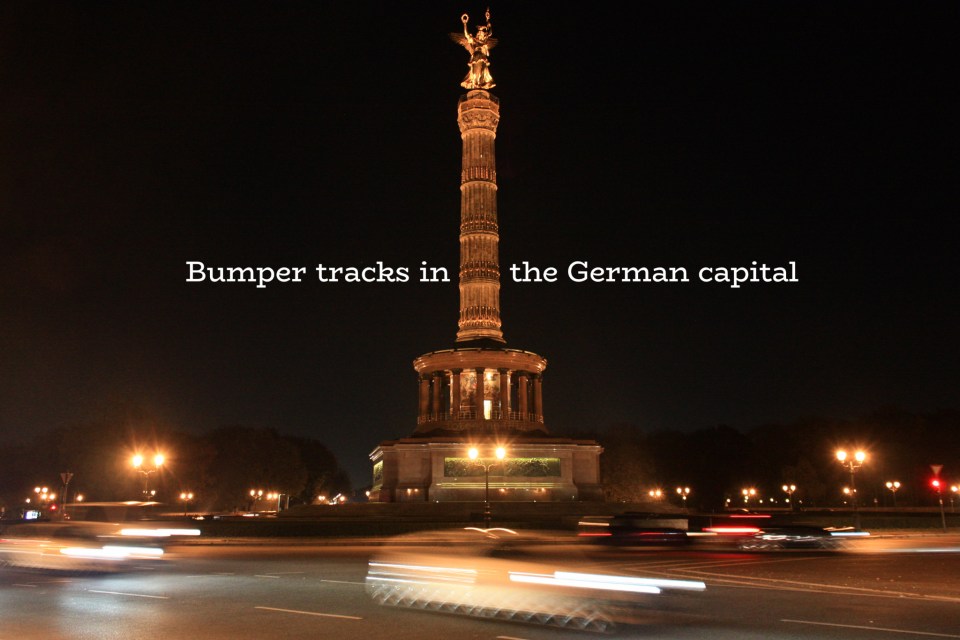
Berlin is one of my favourite cities in the world. Since visiting the German capital city the first time in 2002, it’s been an ongoing love story, which now is entering a second decade.

There are a massive number of sights throughout Berlin, but to get a sense of the city and her people, I’ve always believed in combining public transport (trains!) with lots of “pounding the pavement” on foot. The photographs above are personal measurements of motion, geometry, a sense of place, and of locations around the “Hauptstadt.” Upon reflection, I’ve consciously chosen images which are (mostly) out of the direct spotlight of visitors, and even at well-visited locations, I’ve chosen a a longer focal length and/or a tighter crop to show a different point of view.

( Click here for images and more )