Fotoeins Fotografie

location bifurcation, place vs. home

Posts tagged ‘deutsche Hauptstadt’

Denkmal fuer die ermordeten Sinti und Roma Europas, Memorial to Murdered Sinti and Romas in Europe, Dani Karavan, Tiergarten, Berlin, Germany, fotoeins.com

My Berlin: Moving Memorial to Murdered Sinti and Roma

In the German capital city, among the rustling of tall trees is a quiet space in the northeast corner of Tiergarten Park adjacent to the Reichstag. Between the chirps and whistles of small birds, a recording of a violin plays. Individual notes are held, as long as possible, as if life depended upon the existence of each note. Slowly, the sound accumulates into a keening wail, burrowing deep (if you let it) and tearing from within (if you feel it). You’d do well not to stumble, as you gingerly move through the memorial, careful not to step on words like “Auschwitz”. Inscribed on flattened stones spreading out from the pond are the names of important places, critical to maintaining memory, with intention and purpose.

Created by Dani Karavan, the Memorial to Murdered Sinti and Roma consists of a circular pond. At the centre is a triangular slab on which fresh flowers are placed. In a ring around the pond are the words of a poem, “Auschwitz”, by writer and composer, Santino Spinelli, a member of the Italian Sinti and Roma.

Muj šukkó, kjá kalé vušt šurde; kwit. Jilo čindó bi dox, bi lav, nikt ruvbé.

Drenperdo Mui, phagede Jakha, schiel Wuschtia; Pokunipen. Phagedo Dschi, kek Ducho, kek Labensa, kek Asvia.

Eingefallenes Gesicht, erloschene Augen, kalte Lippen. Stille. Ein zerrissenes Herz, ohne Atem, ohne Worte, keine Tränen.

Pallid face, dead eyes, cold lips. Silence. A broken heart without breath, without words, no tears.
( Click here for video and images

My Berlin: Schöneberg

Above/featured: Entrance to U-Bahnhof Rathaus Schöneberg.

It seems as universal as the common opinion about how cool and interesting Berlin is.

Both residents and visitors mention the same names in conversations throughout the city: Prenzlauer Berg, Mitte, Friedrichshain, Kreuzberg, Neukölln, and the hybrid “KreuzKölln”, even as Wedding and Lichtenberg begin weaving their way into the dialogue.

Of the neighbourhoods within the city’s Ring, what about Charlottenburg or Schöneberg? The answers often arrive as expected. Why would anyone visit there or live there? It’s boring! It’s too quiet! It’s dead! Lots of sniffy snobby dismissive exclamation points! That few choose the area is precisely why I’m in Schöneberg for three months at the tail end of my year-long around-the-world.

For many in Berlin, they’re living, working, and playing in areas where they’re close to the action and housing costs may on average be slightly cheaper. There’s something to be said about proximity and small “stumbling distances” after a night of drinking. For some, Schöneberg is too far, too expensive, too quiet, or all of the above. I don’t mind the 20-, 30-, or 45-minute travel times to places where friends eat, drink, or hang out.

It’s always a matter of choice for me to be in Schöneberg. There’s a comfortable stillness here that always sets me at ease, where I can tune out or turn down the noise, and find my calm. For a very special time, this area in Berlin, “der schöne Schöneberg,” is home.

( Click here for images and more )

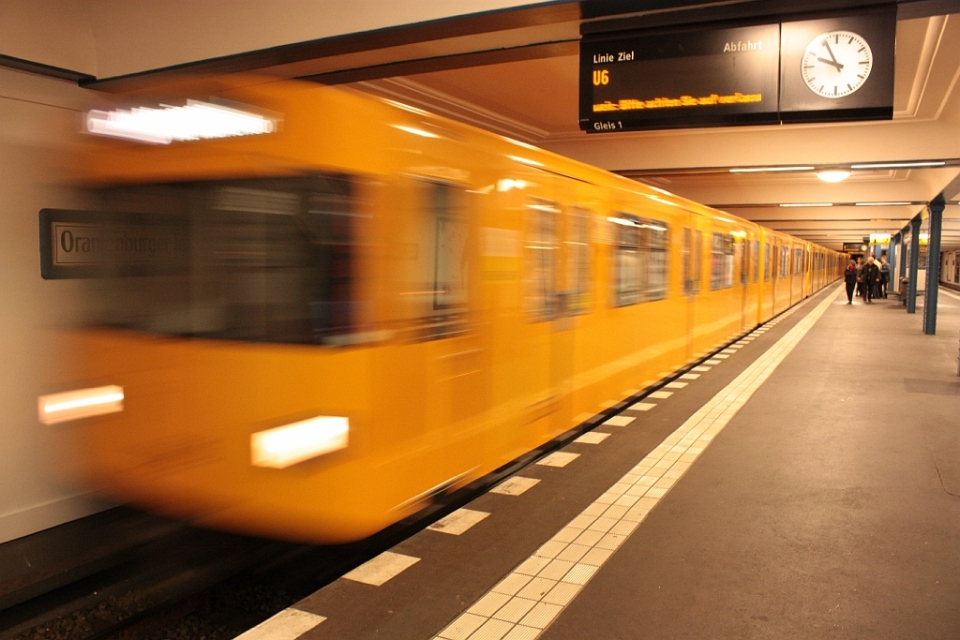
U6 train, Oranienburger Tor, Berlin, Germany, fotoeins.com

My Berlin: Hauptstadt Memories, 2009-2010

Berlin is one of my favourite cities in the world. Since visiting the German capital city the first time in 2002, it’s been an ongoing love story, which now is entering a second decade.

There are a massive number of sights throughout Berlin, but to get a sense of the city and her people, I’ve always believed in combining public transport (trains!) with lots of “pounding the pavement” on foot. The photographs above are personal measurements of motion, geometry, a sense of place, and of locations around the “Hauptstadt.” Upon reflection, I’ve consciously chosen images which are (mostly) out of the direct spotlight of visitors, and even at well-visited locations, I’ve chosen a a longer focal length and/or a tighter crop to show a different point of view.

( Click here for images and more )

Berlin Gleisdreieck: winter vs. summer

Gleisdreieck (“railway triangle”, “triangular junction”) is a U-Bahn train- and junction-station at the western end of the Kreuzberg district in the German capital city of Berlin.

The station has both upper-level and lower-level platforms serving lines U1 and U2, respectively, although both sets of track are raised above ground. At Gleisdreieck, the U1 line runs west-east, whereas the U2 line runs perpendicularly and temporarily “north-south”.
( Click here for more )

Berlin: the city’s oldest Jewish Cemetery

Der Jüdische Friedhof (Old Jewish Cemetery), Grosse Hamburger Strasse

In the past, I’ve often felt guilty for taking photographs at a cemetery, as if the act of opening and closing the camera’s shutter somehow “exposes and steals” the essence of people who are laid to rest. Only in the last few years have I overcome these feelings, as I now see cemeteries as beautiful places to visit and to witness frozen snapshots to individual lives over time. On this late-autumn afternoon, I stood in the middle of the garden, transported to a different place and a different time, surrounded by tranquility and living memories.

Große Hamburger Straße (or Greater Hamburg Street) was the key central road in what was once the Spandauer Vorstadt, which was the suburb or town at the foot of the former Berlin city gates. The road allowed for trade and movement from Berlin in the direction towards the nearby town of Spandau.

According to berlin.de, the area developed around the Hackesche Market and Courtyards:

Historically, development of the Höfe went hand in hand with the growth of Berlin as a thriving urban centre. The expansion started around 1700 from an outer suburb known as Spandauer Vorstadt, located outside the Spandau City gate which already had its own church, the Sophienkirche as early as 1712. Friedrich Wilhelm I built a new city wall here and the former suburb became a new urban district belonging to Berlin. Today’s Hackescher Markt takes its name from the market built here by a Spandau city officer, Count von Hacke.

The influx of Jewish migrants and the exiled French Huguenots gave the district the cosmopolitan diversity which it never lost. The first synagogue was built in this area and the first Jewish cemetery established on the Grosse Hamburger Strasse. Another name for the area, the Scheunenviertel (barn district) is associated today with up and coming art galleries and the more bohemian side of Berlin. The largest synagogue in Germany was built in nearby Oranienburger Strasse in 1866.

In use from 1672 to 1827, this is Berlin’s oldest cemetery for the Jewish community. Buried here is Moses Mendelssohn (1729-1786), philosopher, a founding father of the Jewish Enlightenment, and grandfather to the great composer Felix Mendelssohn. During the last stages of fighting in the Second World War, 2425 dead were buried here in 16 mass graves. With no clear boundaries separating those buried in the past from those buried during the war, the new memorial garden was constructed and restored in 2007-08 with all of the buried left undisturbed as they were.

The present location was also the site of the first nursing home in 1844 for the Jewish community in Berlin. The Gestapo transformed the home in 1942 to a collection and staging point for prisoners, and ordered the destruction of the entire site in 1943. 55000 Berlin Jews from infants to the elderly were deported and murdered in the concentration camps at Auschwitz and Theresienstadt.

( Click here for images and more )