Fotoeins Fotografie

location bifurcation, place vs. home

Posts tagged ‘Berlin’

My Berlin: The Parliament of Trees

Above: “Parlament der Bäume gegen Krieg und Gewalt.”

In Berlin’s government district is a patch of ground – a garden, really, with tall trees and a place that’s easy to overlook. The official name is “Parlament der Bäume gegen Krieg und Gewalt” (Parliament of Trees Against War and Violence), begun by artist Ben Wagin in 1990.

Wagin (1930–2021) began planting trees on land where the former Berlin Wall used to run near the historic Reichstag government building, as authorities began dismantling the physical wall. What remains of Wagin’s experiment is a piece of ground that acts as both memorial to what the Wall represented and fractured, and an aspiration for both modern Germany and Europe.

Of the many trees in this space, 16 of them represent the 16 modern federal states of Germany. There are also slabs of granite on which are engraved the names of the victims of the Wall. The “back” wall is painted with murals and messages, and in between are little paths and flower beds. I think Wagin also wants to remind us that in many parts in Berlin and throughout Germany, the former Wall dividing the city and the two former nations, respectively, have been reclaimed by nature.


( Click here for images and more )

25 for 25: fotoeins fotos in 2025

Above/featured: “Göttin” (goddess), by AlfAlfA, also known as Nicolás Sánchez, for One Wall 2017. Photo, 17 Jun 2025 (P15).

In continuation of high spirits and enthusiastic support of leading choices, I’m very grateful to significant time spent:

  • in the Bay Area, to visit mum’s family in Sacramento and long-time friends in the South Bay;
  • in Vienna for the 4th consecutive summer; and
  • in Berlin for the 1st time in 4 years, as set up for a repeat in the new year.


( Click here for images and more )

Berlin: S-Bahn S15 on its way

Above: Berlin S-Bahn S15 icon, from Wikimedia, by users F84 (original) and Minoa (rework).

15 June 2026

S15 made its debut today after the planned 25 March opening date was pushed back. The S-Bahn Berlin app shows the service is up and running with 10-minute frequencies (weekday). The “eastern” section Gesundbrunnen — Wedding — Hauptbahnhof is open for service, and although the “western” section of Westhafen — Hauptbahnhof is completed, there is no timeline set for the latter to open for service.

This marks the implementation of the first phase of the long-anticipated overall S21 project, which is to provide an additional north-south trunk which connects Berlin’s Ringbahn (circle line) directly with the city’s central station. Full implementation of the second and third phases is set for the 2030s to 2040s.
Schienenliniennetz, Streckenkarte, Berlin, BVG, S-Bahn Berlin, VBB, DB, Deutsche Bahn

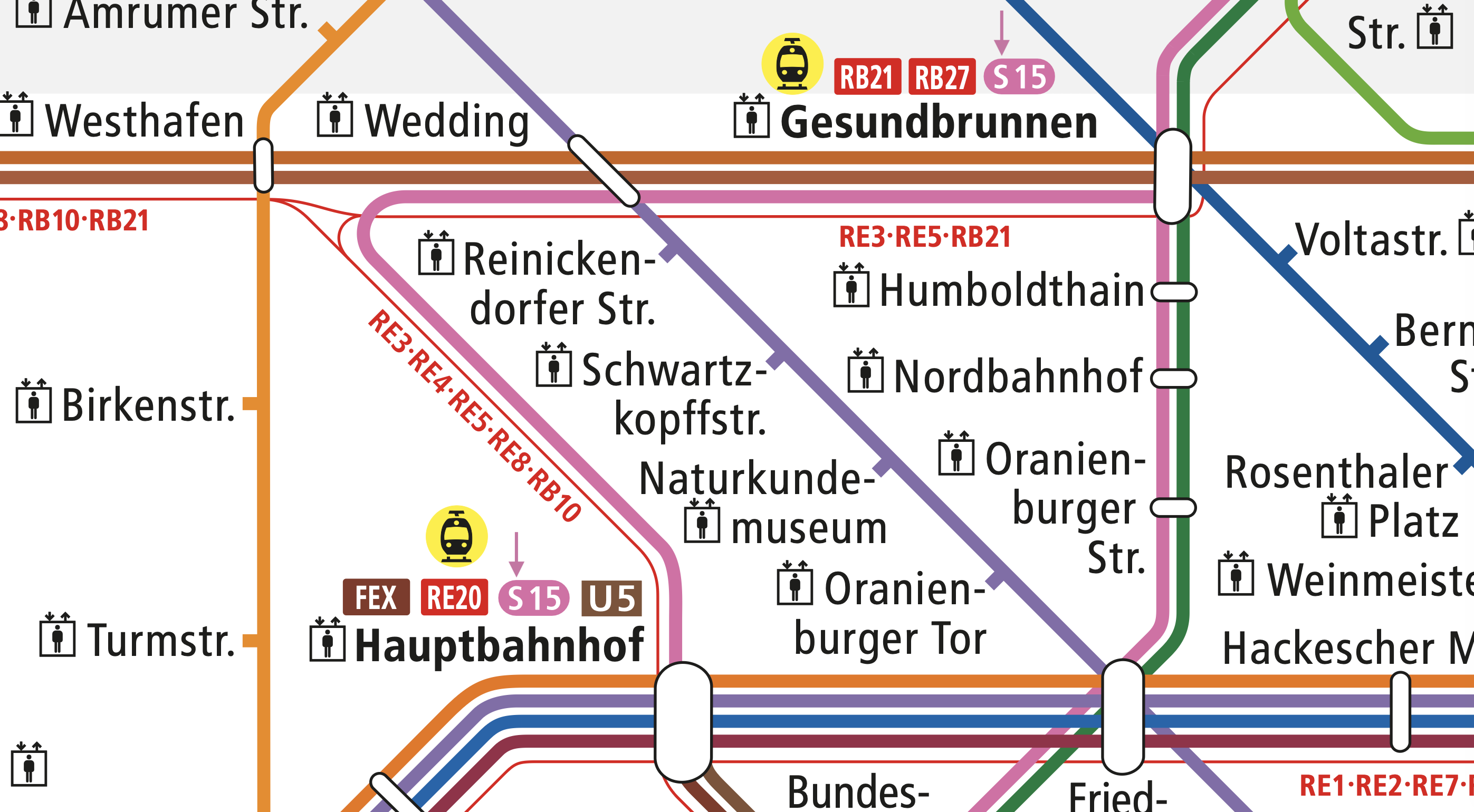
Section of the Berlin AB-zone urban-transport route map, effective 15 June 2026. Two vertical arrows in light-pink point to the end-stations at Gesundbrunnen and Hauptbahnhof; between the arrows in light-pink is the S15 route which also stops in each direction at Wedding.
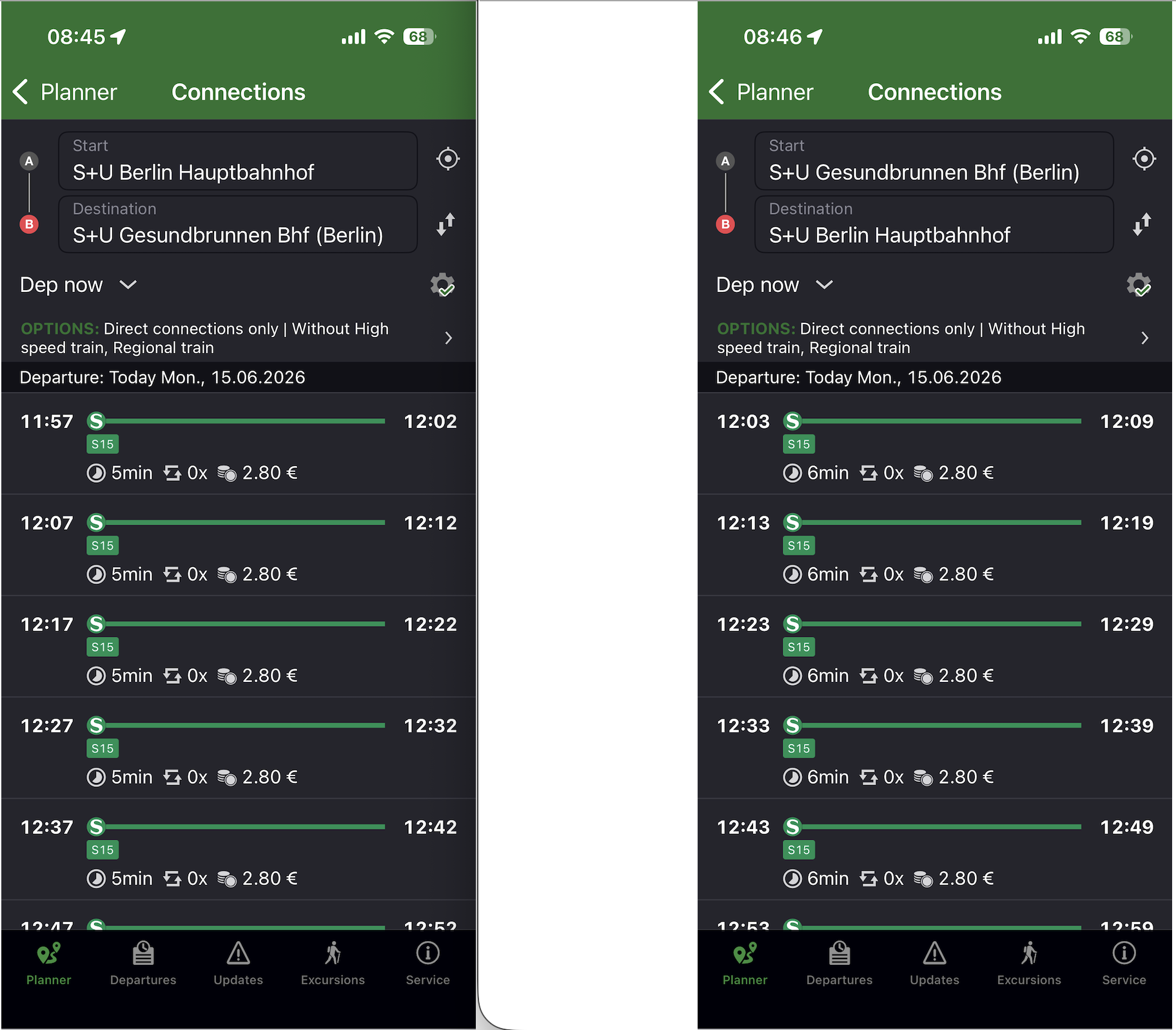
S-Bahn Berlin app: S15 service Berlin Hauptbahnhof ↔ Gesundbrunnen began 15 Jun 2026 just before high-noon.


22 December 2025

For me, living memories of countless times in Berlin since 2002 include public transport with her U-Bahn and S-Bahn trains and routes. Like many, I never want that S-Bahn three-tone door-closing signal to go away, but that only comes with the older Baureihe 481-482 vehicles used for the trains, which will go away with the requirement to comply with European Union regulations.

On my first visit in 2002, I immediately asked: why isn’t there a U-Bahn connection or an S-Bahn connection with the shiny Berlin central train station? The U5 finally answered the first question in 2020, whereas the S-Bahn connection is coming up in 2026. The S-Bahn line provisionally labelled S15 is part of the larger long-term S21 project to connect the north and south parts of the S-Bahn Ring with the central station, and helping to alleviate traffic along the existing north-south S1-S2 route. In late-2025, news came out with a scheduled opening: on 28 March 2026, the S15 will open for public service between Gesundbrunnen and Hauptbahnhof via Wedding. The updated map doesn’t mark any S15 service between Westhafen and Hauptbahnhof, which might await the future redevelopment and reopening of the Siemensbahn further to the northeast.

I’m looking forward to seeing for myself in the summer of 2026 how the S15 works out. Announcement items in German: RBB24Entwicklungsstadt

Berlin Hauptbahnhof, Berlin, Germany, Deutschland, fotoeins.com

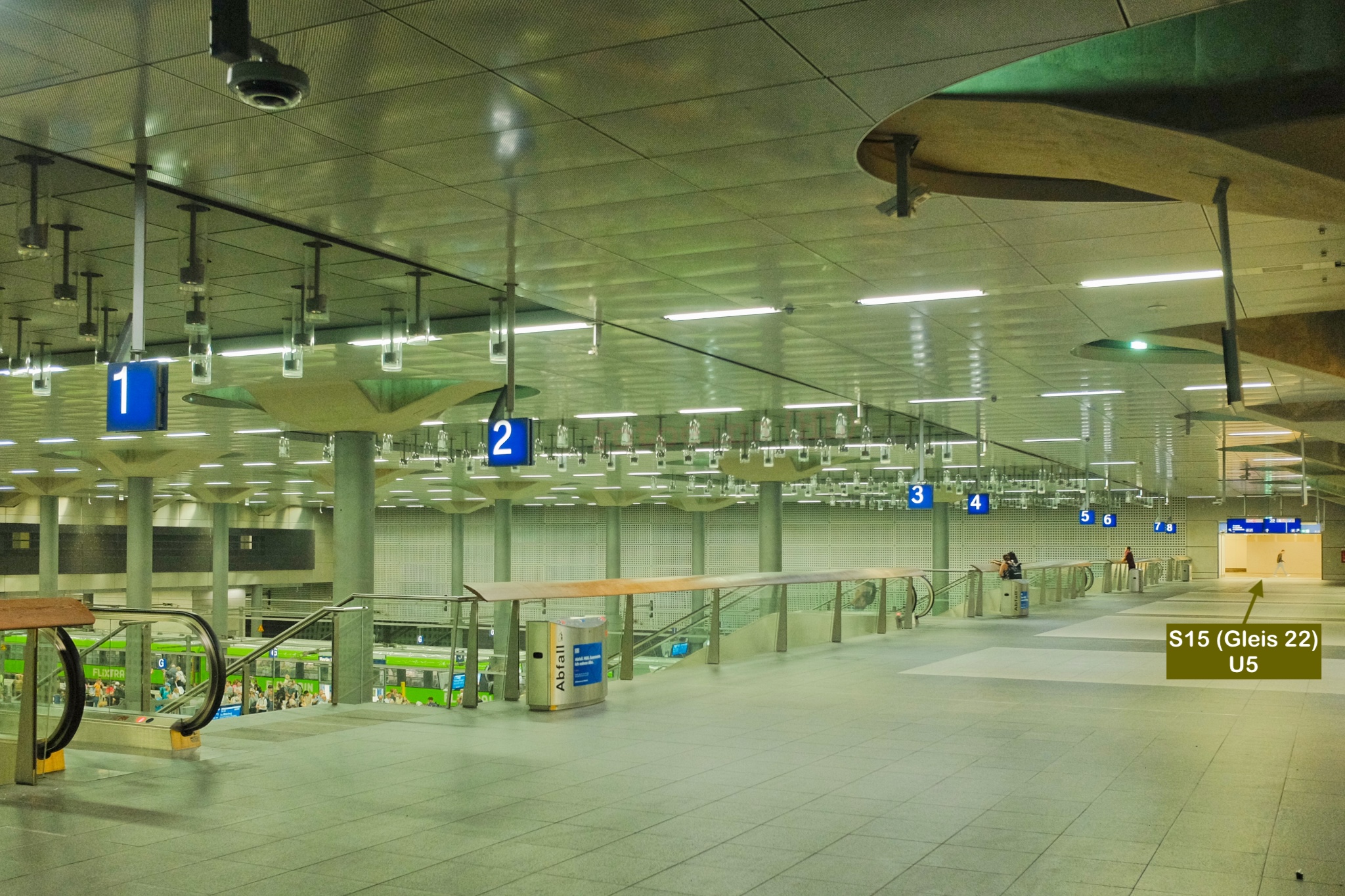
Above: Berlin Hauptbahnhof, 1. Untergeschoss (Berlin central station, basement level 1), with signage for tracks 1 to 8 below on the 2nd basement level. Labelled at right is entry to a passageway for the operating U5 U-Bahn line and not-yet-for-primetime S15 S-Bahn line. Photo, 15 Jun 2025 (X70).

Berlin Hauptbahnhof, Berlin, Germany, Deutschland, fotoeins.com

Berlin Hauptbahnhof, 1. Untergeschoss (Berlin central station, basement level 1): sign for additional bus and tram connections up on street-level, as well as the U5 U-Bahn line and upcoming track 22 for the S15 S-Bahn line. At the time of this photo, there was no open access to track 22, which I’m guessing is behind that wall there in the background. Photo, 15 Jun 2025 (X70).
Westhafen, Ringbahn, S15, S21, S-Bahn Berlin, Berlin, Germany, Deutschland, fotoeins.com

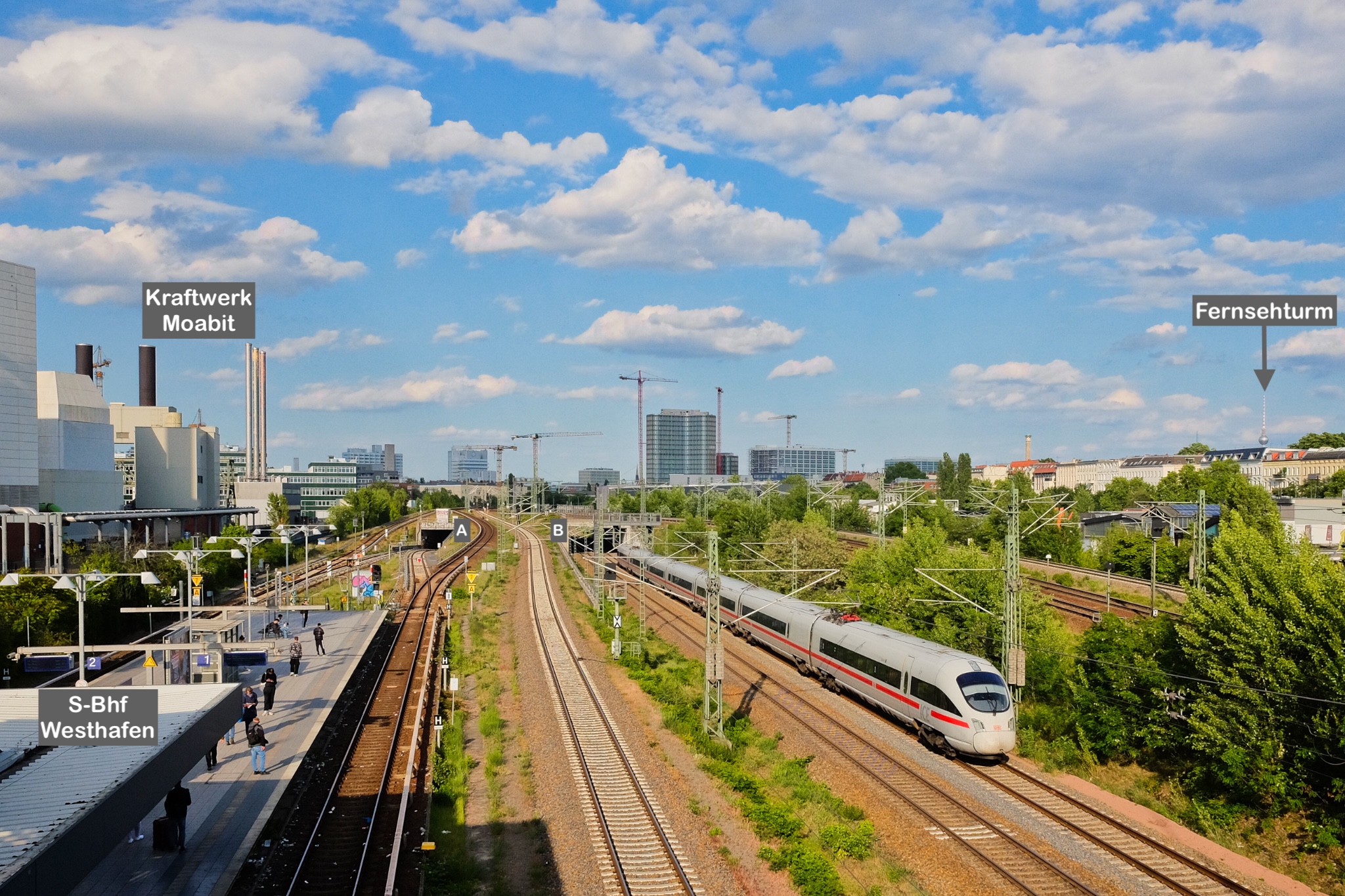
Berlin Westhafen station, facing east from Putlitzbrücke bridge. At upper left is the Moabit power station, and at lower-right is the S-Bahn station Westhafen. Visible at the very right is the Fernsehturm (TV Tower). Tunnels A and B, respectively, are double-tracks for the new S-Bahn S15 line from Hauptbahnhof, and double-tracks for long-distance rail bypassing the station. Also visible is a Deutsche Bahn InterCity Express train bypassing Westhafen station on approach to Hauptbahnhof. Photo, 24 May 2025 (X70).


I made three images above on 24 May 2025 and 15 Jun 2025 with a Fujifilm X70 fixed-lens prime (X70); the other two images are from Wikipedia and the BVG. This post appears on Fotoeins Fotografie at fotoeins DOT com as https://wp.me/p1BIdT-x3s. Last edit: 17 Jun 2026.

Berlin U5-Museumsinsel: Mozart, Schinkel, & Dudler

Above: Museumsinsel U-Bahn station entry-exit ‘A’. Photo, 17 May 2025 (P15).

The Berlin U-Bahn metro station Museumsinsel adjacent to the world renowned Museum Island is located on the U5 line which connects the city’s central station (Hauptbahnhof) with Alexanderplatz and the city’s eastern neighbourhoods. Construction for the station began in 2012 and lasted over 8 years. For the station interior at track level, architect Max Dudler was inspired by Karl Friedrich Schinkel’s 1815–1816 design of the stage for the Mozart opera “Die Sauberflöte” (The Magic Flute). For the appearance of the Queen of the Night, Schinkel imagined a large dome-like space like the overhead starry night sky. Over each of the two tracks in the U-Bahn station, Dudler designed a dark blue barrel-shaped vault embedded with thousands of white point-sources of light.

The fully-completed U5 extension from Hauptbahnhof to Alexanderplatz opened to the public on 4 December 2020, which at long last connected the Hauptbahnhof with Berlin’s U-Bahn city transport system. The Museumsinsel station on the U5 line opened on 9 July 2021. In addition to the city’s bus network, the station now allowed visitors to use the U-Bahn metro to reach the Museum Island complex, inscribed by UNESCO as World Heritage Site in 1999.

Artist and architect Karl Friedrich Schinkel (1781–1841) has his “fingerprints” on many of the city’s early- to middle 19th-century architecture, including in the immediate vicinity of the station the Neue Wache (New Guard House), Schlossbrücke (Castle Bridge), Friedrichswerder Church, Bauakademie (Building Academy), and the Altes Museum (Old Museum).


( Click here for images )

My Berlin: Wrapped Reichstag after 30 years

Above: “Wrapped Reichstag 1995–2025” light show.

In 1995, the artist duo Christo & Jeanne-Claude carried out a bold but contentious project by covering Berlin’s landmark Reichstag parliament building. Plans for the project had taken over 20 years, even though the artwork had always meant to be temporary and all expenses had been covered without corporate sponsors. Over 5 million visited in a period of 12 days in the summer of 1995 to look at the undulating “silver dream” in the German capital city. The timing was ideal. After reunification of the two Germanys in 1990, the new home of the federal parliament would be Berlin’s Reichstag. Renovations to the building began in the autumn of 1995 with the federal parliament opening in the spring of 1999.

From 9 to 22 June 2025, the Reichstag building was illuminated nightly with a light show in a 30-year anniversary tribute to the famous 1995 artwork. In a 20- to 30-minute cycle, the light-show appeared to first envelop the building in silver fabric. The fabric cover flapped in artificial breeze, before the cover lost its shape and fell onto the ground at the base of the building. The free-of-charge light show began shortly after sunset at about 930pm and continued until 1am. Whatever Christo and Jeanne-Claude chose to cover and transform, their art works posed questions of perception, origins, shape, functionality, and permanence.

•   DW: Germany Arts
•   Visit Berlin


( Click here for images )