Fotoeins Fotografie

location bifurcation, place vs. home

Posts tagged ‘Bayern’

24T34 Bamberg Old Town, world heritage

E33

In Bavaria’s Upper Franconia, the city of Bamberg is described as “a central European town with a medieval plan and with a number of surviving secular and ecclesiastical buildings from the medieval and baroque periods.” For its architectural, cultural, and historical character, UNESCO inscribed the city’s Old Town as World Heritage Site in 1993.

This is my 2nd time in Bamberg, after my 1st visit 14 years ago on this very same month.


From Geyerswörthbrücke: Old Town Hall, perched on top of the Regnitz.
World Heritage Centre: modest visitor centre with displays about the city’s heritage landmarks and the road to inscription.
Bamberger Dom (Bamberg Cathedral).
Bamberger Reiter (Bamberg Rider).
Dionysius, and beheaded.
Neuer Residenz (New Residence).
Rose garden inside New Residence; the 2 steeples from St. Michael’s appear at left.
“Gruß aus Bayern” (Greetings from Bavaria).
Michelsberg, Kloster Michelsberg.
View from Michelsberg towards the New Residence and the Cathedral.
Outdoors terrace café at Michelsberg, with a cold Rauchbier (smoked beer) on tap.
Back to the “beginning”: the old town hall, with late-afternoon illumination on the west side.
This west side of Old Town Hall is lit up in the afternoon.
Stadtwappen (city’s coat of arms), between clockface and balcony.
Maximiliansplatz.

I made all images above with an iPhone15 on 10 Jun 2024. This post composed with Jetpack for iOS appears on Fotoeins Fotografie at fotoeins DOT com.

24T33 Bayreuth’s Margravial Opera House

(E32)

The Margravial Opera House in Bavaria’s Bayreuth is a fine surviving example of Baroque theatre architecture. Completed in 1748, the building was initiated by Margravine Wilhelmine and her husband Margrave Friedrich III of Brandenburg-Bayreuth for their daughter’s wedding. For its unique architectural, cultural, and historical character, UNESCO inscribed the building as World Heritage Site in 2012.


Not bad at all from the outside (0.8x)
… but inside, the auditorium is much better.
Left side tiers of loges, facing the stage.
Right side tiers of loges, facing the stage.
Front, and up (0.5x).
Back of the venue; court loge.
“Pro Frederico et Sophia – Josephus Gallus Bibiena fecit – Anno Domini MDCCXLVIII.” (Built for Friedrich & Wilhelmine-Sophie, by Giuseppe Galli Bibiena, in 1748 A.D.)
Back of the auditorium, and up to the ceiling with god Apollo surrounded by arts and muses (0.5x).
From the right side loge-seats.
On the stage proper (guided tour), facing out to the back.
Markgräfin (Margravine) Wilhelmine of Bayreuth: portrait by Antoine Pesne, in 1738-1740. Multilingual and trained in both arts and literature, Wilhelmine was daughter of Prussian king Friedrich Wilhelm I, and sister to Friedrich the Great.
Wilhelmine memorial bust, on Schlossberglein, opposite the opera house.
Afternoon illumination, from Schlossberglein and above the Wittelsbacher fountain. The opera house is at centre.
The Margravial Opera House, in Bayreuth.

This visit to Bayreuth completes my 8th new German UNESCO WHS over the last 33 days. My total tally is now up to 42 (of 52).


I made all images above with an iPhone15 on 9 Jun 2024. I received neither sponsor nor support from any organization. This post composed with Jetpack for iOS appears on Fotoeins Fotografie at fotoeins DOT com.

My GaPa: the Wank (vistas) over Werdenfelser Land

Before the reader goes on a titter, the German word “Wank” is likely related to old-Bavarian or Bairisch Wang/Weng, meaning “meadow on a slope” or “an opening in the forest”. The modern definition of the German verb “wanken” is “to stumble” or “to stagger.”

I’ve previously described southern Bavaria’s Garmisch-Partenkirchen (GaPa) and the natural beauty on offer around town. I’ve also made the ascent to Zugspitze a couple of times, particularly in glorious winter conditions. The return journey between Garmisch-Partenkirchen and Zugspitze isn’t cheap, but I was very glad to see the Alps in 5 different countries; the interested visitor should check the summit webcams for weather conditions before heading up.

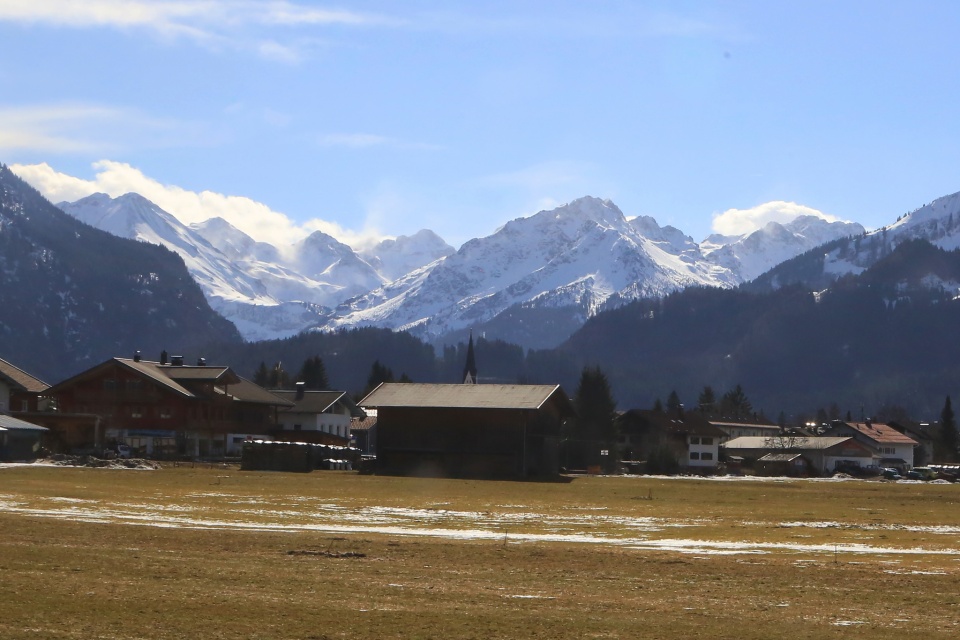
If you want a cheaper alternative, there are mountain views to be had at Wank, an 1800-metre tall “hill” just north of Garmisch-Partenkirchen. Here are some equally beautiful views from the Wank summit on a visit during a warm afternoon in late-May.


( Click here for images and more )

Munich: Ghost station “Olympic Stadium”

In the vicinity of Munich’s Olympic Stadium is a train station overgrown with brush and weeds. The tracks stretch north and south, but go nowhere.

Munich played host to the Summer Olympics in 1972; physical reminders include the Olympiadorf (Olympic Village), Olympiapark, and the Olympiastadion (Olympic Stadium). In 1988, the train station “München Olympiastadion” closed to train service for the final time. Rail tracks which connected the station with the North Ring freight tracks were cut, isolating the station and leaving it to decay.

Since 2001, the Olympic Village has been listed as part of the heritage Olympiapark ensemble which includes the abandoned station. But will the station be left to decay? Or will the station be refurbished in some way to become a living memorial?

Historical maps of the MVV U- and S-Bahn system show how train service from central Munich to Olympic Stadium was utilized. S-Bahn train service carried passengers along the central trunk to Olympic Stadium via Hauptbahnhof, Laim, and Moosach; check out the system maps for June 1972 and June 1988.


( Click here for images and more )

Dachau: nie wieder, never again

Where: KZ-Dachau, 20 km northwest from Munich, Germany.
What: The blueprint by which murder became a methodical industrialized process.

I once thought I wasn’t prepared emotionally; perhaps I never would. But I couldn’t go further in my long-term examination of Germany and Jewish-German history without a visit.

It’s an overcast morning in early June, and a couple of rain showers accompany me along with a handful of other people, waiting for the site to open at 9am. A dark heavy cloak descends the moment I step through the main gate and into the site. There is dread, waiting. I promise myself to be open as much as possible, to really look and listen.

This is KZ-Gedenkstätte Dachau, the Dachau Concentration Camp Memorial Site. The abbreviation KZ is “Konzentrationslager für Zivilpersonen” or concentration camp for civilians, although the initial terminology used by the Nazi Schutzstaffel (SS) was KL for “Konzentrationslager.”

There’s a lot to absorb. And maybe, it’s best not to.

Systematic torture and unrestrained cruelty. Forced medical experiments. Arbitrary execution by hanging or gunfire. The destruction of human dignity. The annihilation of hope. This camp as a “model” to broaden the scope and scale of industrial mass-murder. The first commandant of Auschwitz in 1940, Rudolf Höss, honed a career in brutality as SS support staff and block leader at the Dachau camp in late-1934.

I had planned to stay for a few hours at most and leave around noon. I didn’t notice the time. When I finally noticed clear skies and the change in sun-angle, I check my watch. It’s almost 5pm, closing time. Eight hours have flown by outside my bubble, which begins to dissolve.

( Click here for images and more )