Fotoeins Fotografie

location bifurcation, place vs. home

Posts tagged ‘Bavaria’

Freistaat Bayern, The Free State of Bavaria

Bavaria: 100 years of statehood (2018)

Featured image: The blue and white diamonds (fusils) are a familiar Bavarian symbol, adopted in the late 13th-century by the Wittelsbach family who ruled Bavaria from 1180 to 1918.

As a product of the coastal and mountainous Canadian Southwest, I always feel the pull exerted by the Bavarian Alps regardless of where I am in Germany; it’s been this way over the past 18 years. But there’s more to Bavaria than fairytale castles, Oktoberfest, and BMW, although they’re spot on for the Wurst (sausage). And frankly, there’s a ton more to Germany than Bavaria, but that’s one of many reasons for this entire blogsite after all.

Located in southeast Germany, Bavaria includes more than a half-dozen World Heritage Sites, the pre-Easter Fasching/Fastnacht festival, the sight of Audis on the Autobahn, over one thousand years of wine-making in Franconia, and violin-making since the late 17th-century, among many things to explore, eat, and experience.

( Click here for more )

Martin Luther, Museum Lutherstiege, St.-Anna-Kirche, Augsburg, Bayern, Bavaria, Germany, fotoeins.com

Augsburg: Luther vs. Cajetan (1518), Confessions (1530)

Above/featured: REVOCA! (Cajetan to Luther, 1518), Museum Lutherstiege.

With its founding date as “Augusta Vindelicorum” by the Roman Empire in 15 BC/BCE, Augsburg is one of the oldest cities in Germany, and has ties with Martin Luther and the Reformation which marks its 500th anniversary in 2017.

Months after making his 95 Theses known to church authorities and the public, Martin Luther was called to the free imperial city of Augsburg in 1518 by Cardinal and papal legate and representative Cajetan to answer charges of heresy, for challenging the morality of indulgences, and for questioning the supreme authority of the Pope. Cajetan urged Luther to recant or revoke his statements (“revoca!”), but Luther held firm and refused to obey Cajetan.


( Click here for images and more )

Oberstdorf, Oberbayern, Upper Bavaria, Bavaria, Allgaeu Alps, Alps, Germany, fotoeins.com

Oberstdorf: Sunday Allgäu night auf Deutsch

Why multiple languages rock my world

With fewer than ten-thousand inhabitants, Oberstdorf in southern Bavaria is as its German name suggests: an “upper village” tucked in the Allgäu Alps near the German-Austrian border. Yet, the town feels busy and full with skiers, snowboarders, and winter hikers.

It’s Sunday night and I’m on the hunt for “schnitzel and spätzle.” With my eye already on a place, I arrive at 630pm to a full house. I don’t have a reservation (which is dumb in a small town), but a table of four is available (which is fortunate). The server offers me the table, with the condition I’ll be sharing the table if two people want places. “Alles klar,” I reply.

I order a standard half-litre Weizen beer, along with the required schnitzel-and-spätzle platter. An elderly couple is offered two places at my table; they take one glance in my direction, and they’re gone. The server wears a puzzled look, and I can only shrug. A second couple arrives ten minutes later, and as they approach my table with curiosity, I tell them “die Plätze sind noch frei” (the places are available). They express their thanks, and take their seats across from me. Those last five German words set a positive tone for the rest of the evening.

( Click here for more )

Martin Luther: tracing his steps in 16 German cities

Above/featured: “Luther war hier. (Luther was here.)” Eisleben, Germany. Photo, 27 Oct 2016.

In pre-teen years, I attended a Catholic elementary school by weekday, and a missions-oriented Protestant church by weekend. I already had multiple questions running around my pre-scientist brain, like electrons appearing and dissipating in a fuzzy halo. When various disparate elements began to settle with few satisfying answers, I left behind the churches and their respective religions. But one thing that’s remained is my love of history. History has never been boring, because I carry the past (as offspring of immigrants), and I’m determined to bring history’s lessons into the present.

Even in youth, I had to ask: why was one set of churches called “Protestant”? What was under protest? How did one man help spark a movement that would help merge and create a version of a language that continues today, that would bring accessible means to literacy for the public, and that would begin to change rule by religion to rule by law?


Martin Luther: Luder’ name at birth

From his birth in Eisleben; to formative years in Mansfeld, Magdeburg, and Erfurt; to the bulk of his working and teaching years in Wittenberg; to his death in Eisleben, Martin Luther set upon a course that helped change language, education, culture, religion, and governance. In many ways, Luther had much to thank Jan Hus for the latter’s efforts to reform the Catholic Church in Bohemia one hundred years earlier.

Every year on the 31st of October, a number of cities, regions, and federal states in Germany mark an important event in this movement. It’s widely understood Martin Luther walked up to the Castle Church in Wittenberg and pinned his 95 Theses to the church doors on 31 October 1517. Even if direct evidence Luther actually posted papers to the doors is debatable, what’s not is that 2017 marks the 500th anniversary of the Reformation in Germany.

Martin Luther, Reformation, German Reformation, Wittenberg, Marktplatz, Saxony-Anhalt, Sachsen-Anhalt, Germany, Deutschland, fotoeins.com

The illuminated Luther memorial stands tall in front of Wittenberg’s town hall at Market Square. As UNESCO World Heritage Site, the town hosts 4 sites: Luther House, Melanchthon House, St. Mary’s Town Church, and the Castle Church. 2017 is the 500th anniversary of Luther’s Reformation in Germany. Various German federal states, regions, and cities will mark the quincentenary throughout the year. Photo at Wittenberg Marktplatz on 30 Oct 2016.


( Click here for images and more )

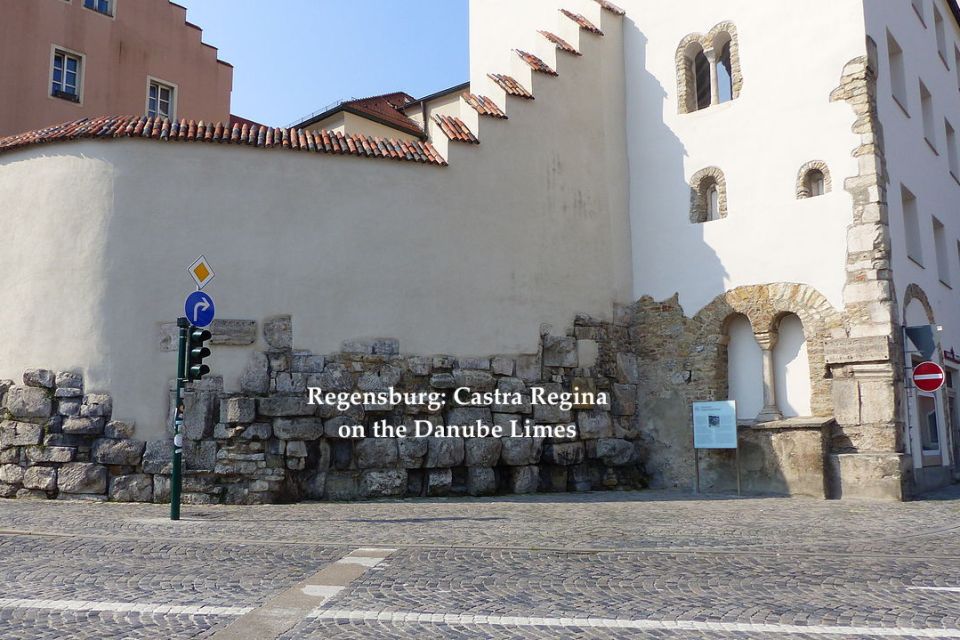
Northeast corner of old Roman fort, Regensburg, photo by Dr. Bernd Gross, Wiki CC3

Regensburg: remnants of Castra Regina on the Danube Limes

Above: former wall at the northeast corner of the Roman fort Castra Regina. Photo by Dr. Bernd Gross (image no. 7, Wiki CC3).

Regensburg is situated in central Bavaria, and is 1 and 1.5 hours from Nürnberg (Nuremberg) and München (Munich), respectively, with the train. While meandering through the Regensburg’s Old Town, it’s easy to forget most of this area was once occupied by a Roman fortress about 1800 years ago.

In 179 AD/CE, the Roman Empire established the fortress “Castra Regina”, or “fortress by the river Regen”, where the Regen enters the Danube river. The Danube became in effect a part of the Roman Empire’s northern frontier (“Danube Limes”). Emperor Marcus Aurelius recognized the need for extra security in the northern imperial province of Raetia where the Danube’s course reached its northernmost point. To ward off incursions by northern Germanic tribes, up to six thousand soldiers from the Third Italic Legion were stationed at the fortress.

At peak operation, the fortress encompassed an area 540 metres by 450 metres (24 hectares, or 60 acres) with a wall up to 10 metres (33 feet) high made of large sandstone blocks, 18 towers, 4 double-tower gates, and a wide trench. Within the grounds were barracks, headquarters building (principia), commanding officer’s own residence (praetorium), a military hospital (valetudinarium), granary (horrea), workshops, and stables. Civilians and support tradesmen built a settlement to the west of the fort. By the 5th-century, constant raids and migrations forced the Romans to abandon the area. A civilian settlement eventually grew over the fortress which is today’s Altstadt (Old Town)1.

The free-of-charge open-air museum includes restored remnants of the old Roman fortress complete with information displays in both English and German. The primary information location is at the parking garage at Dachauplatz (which is closed at night); the other three locations are accessible outdoors at any time.

The Porta Praetoria is one of multiple constituents in the tri-nation (AT DE SK) inscription for “Frontiers of the Roman Empire: Danube Limes” as UNESCO World Heritage Site (new, as of July 2021).

The map below shows the location of the Castra Regina encampment and locations of the “document Legionslagermauer” in the city’s Old Town. Click on the “arrow-window” icon at the upper-left corner of the map for additional details.

( Click here for images and more )