Fotoeins Fotografie

location bifurcation, place vs. home

Posts tagged ‘13. Bezirk’

25T74 Sisi got an imperial summer house because she disliked Vienna

E73, V21.

It’s late-19th century Vienna, and Emperor Franz Joseph I (FJ1) is in charge of the Austria-Hungary dual monarchy. He’s ordered and overseen big changes to the city landscape in Vienna. Problem is his wife Empress Elisabeth (Sisi) isn’t taking any liking to the city. To sweeten the deal (and stay close to Vienna), FJ1 commissions the construction of a quiet hidden “Palace of Dreams” in what is now the forested land near Lainz in western Vienna. It’s his present to his wife in 1886.

Today, the Hermes Villa is a part of the Wien Museum. While the grounds outside are free to walk around, there’s an admission charge to view the interior.


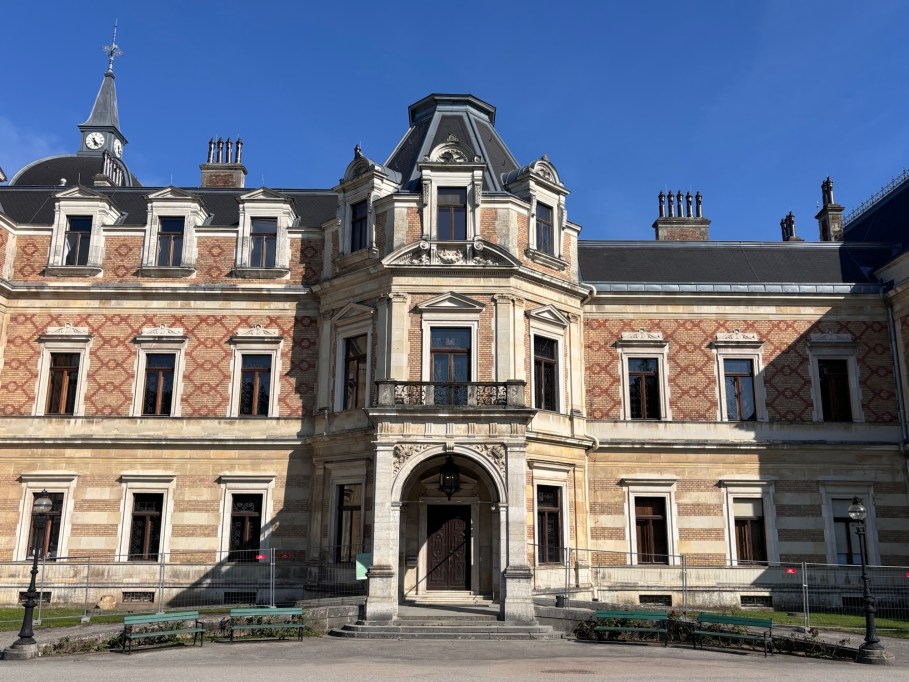
The north or main entrance leads to the museum inside. Emperor Franz Joseph I commissioned the architect Karl von Hasenauer for the design and construction of the villa.
Genovevabrunnen (Genoveva fountain), by Viktor Tilgner, 1885.
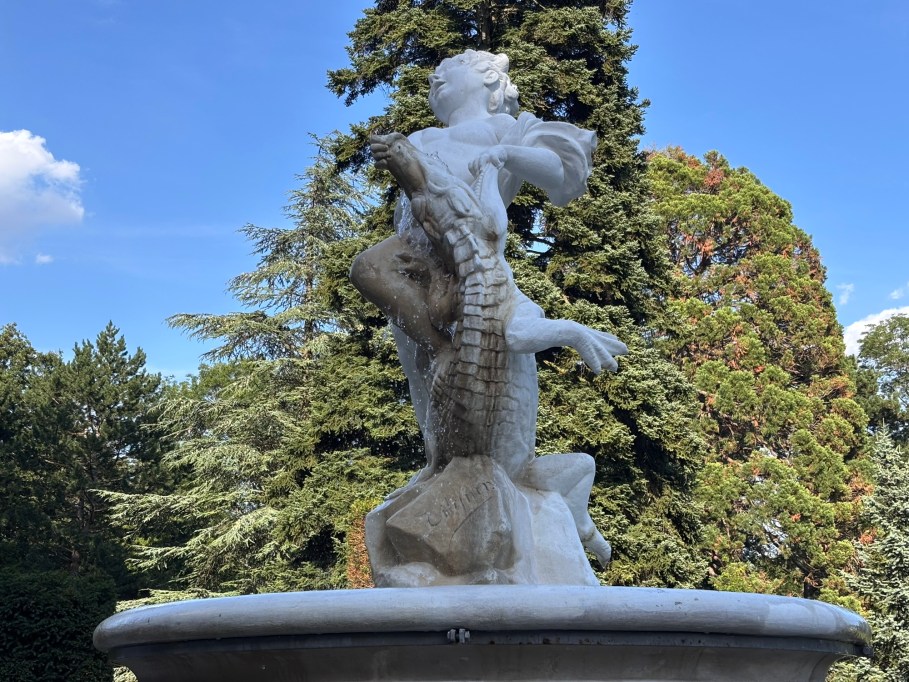
“Putto mit Krokodil” (child with crocodile), by Viktor Tilgner, 1886.
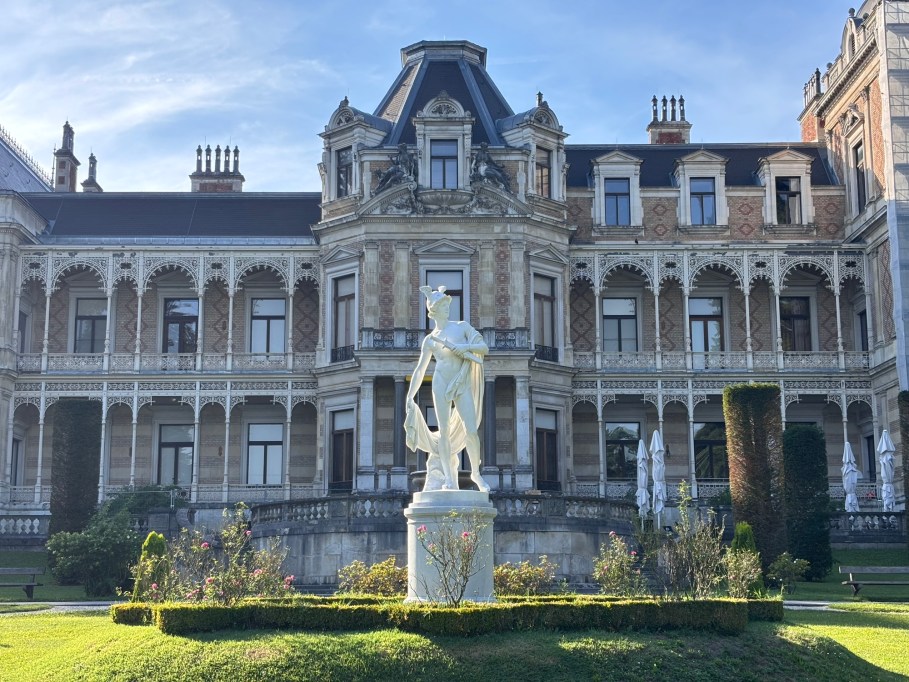
Hermes statue, by Berlin sculptor Ernst Herter, 1888.
The villa is named after this central sculpture.
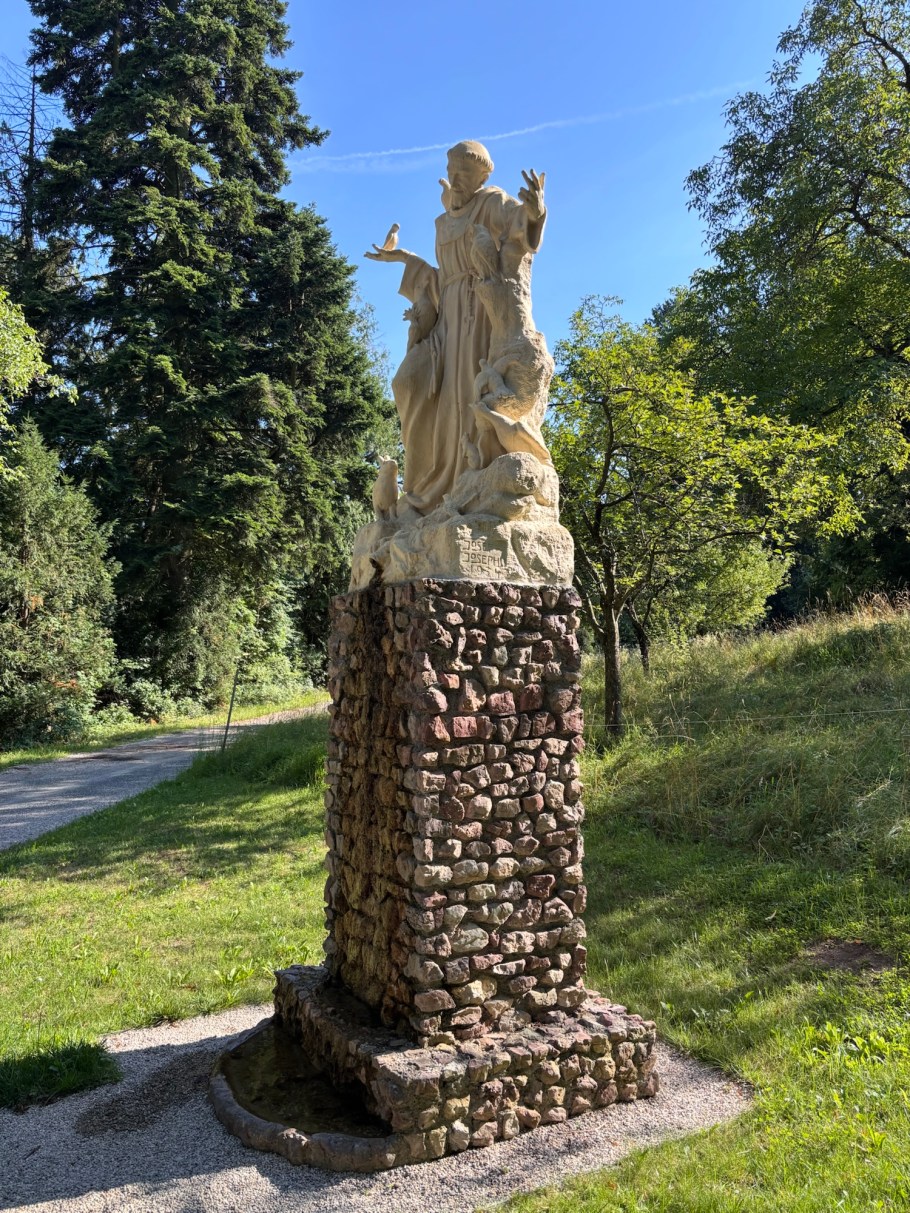
St. Francis of Assisi, by Josef Josephu, 1934. There’s another statue of St. Francis of Assisi behind the Minoritenkirche in central Vienna.
Patron saint of animals, on the 800th anniversary of his birth.
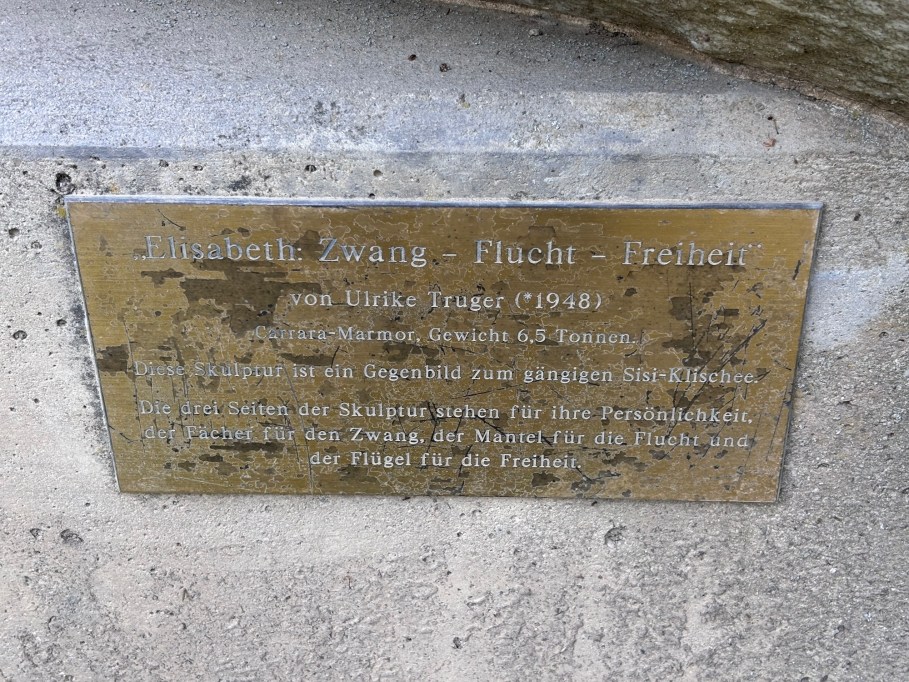
“Elisabeth: Zwang – Flucht – Freiheit”, by Ulrike Truger, 2006, to represent Empress Elisabeth. Wearing a coat, Elisabeth’s face is partly obscured by the fan in her left hand; the wings appear just below the fan.
Truger created this marble sculpture to counter against the Sisi cliché and to comment about how trapped she felt. Three aspects of the sculpture refer to her personality: a fan representing her obligation, a coat for her desire to escape, and wings for her freedom.

I made all images above with an iPhone15 on 20 July 2025. This post composed within Jetpack for iOS appears on Fotoeins Fotografie at fotoeins DOT com.

25T59 Tafelspitz: Vienna favourite at Plachutta Hietzing

E58, V06.

I’m in the mood for a slow sit-down meal of the highest order. Yeah, it’s gonna cost me, and it’ll be pasta and pesto or bread and cheese the next few nights, but it’s time here and now, that I say hello once again to Plachutta and their modern version of the imperial Tafelspitz.

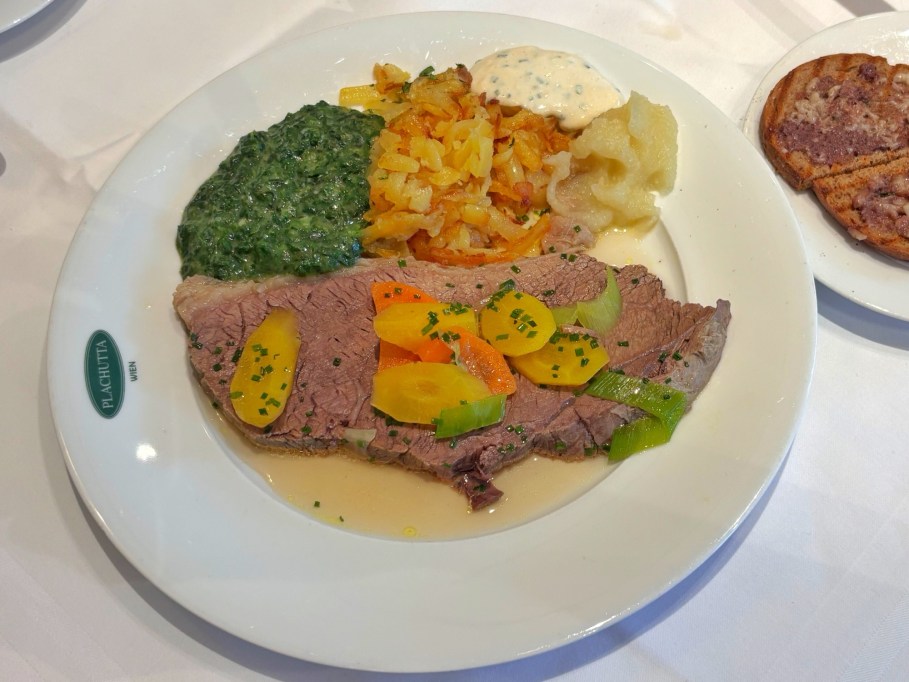
There are many beef cuts to choose from the menu, but I’ll go what brought me here the first time: the Tafelspitz cut. I provided a longer and more flavourful description here, but here are today’s highlights.


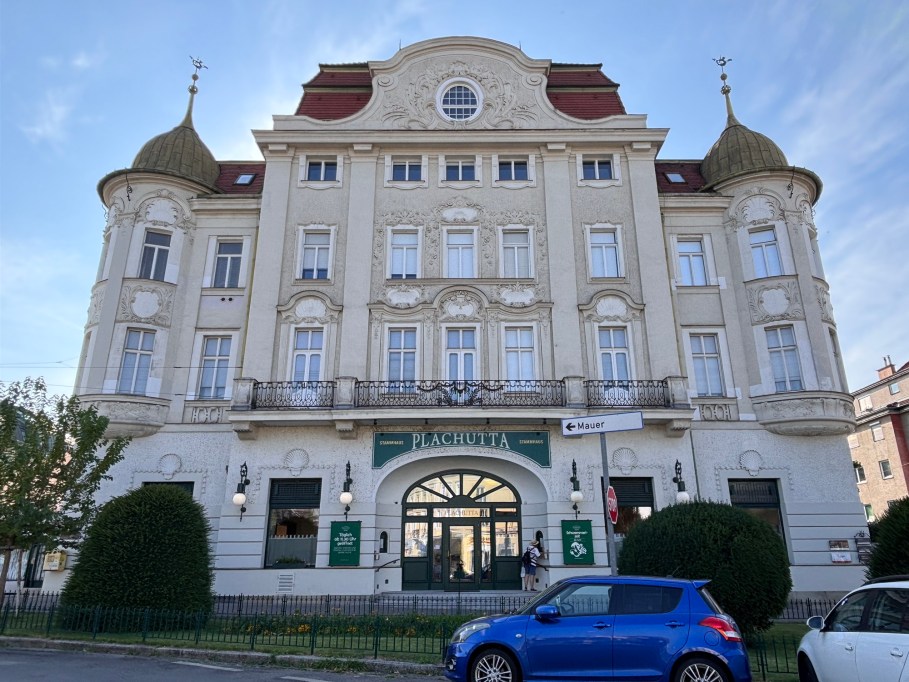
The Plachutta restaurant in Hietzing, Vienna’s 13th district. Take the U4 to Hietzing station and walk, or hop on tram 10 or 60 at Hietzing station for the 1 stop to Dommayergasse.
“An-eighth” (0.125L) glass of Gemischter Satz (centre), a local specialty that’s grown in vineyards within and around the city of Vienna. I also have a big bottle of carbonated mineral water. Yes, drunk separately; I’m no heathen.
Simple bread and rolls, with whipped garlic butter or regular butter.
The big pot, with side pots (top) with creamed spinach and fried potatoes; at lower right are chive cream sauce and apple horseradish sauce.
Hot savory beef broth ladled over a small bowl filled with ribbons of sliced pancake.
Beef marrow spread over toasted rye bread.
The slab of the slow-simmered rump-roast cut: simultaneously lean and fatty, moist, tender, not dry; cut root-vegetables; creamed spinach; fried potatoes; and big dollops of sauces.
Against better judgement (which is the moment I walked in the door), I get caramel ice cream to cool off a big warm hearty meal on a warm summer day. (There’s outdoor patio seating, but they’ve got the A/C working hard inside.)

I received neither support nor compensation for this piece. I made all images above with an iPhone15 on 5 July 2025. This post composed within Jetpack for iOS appears on Fotoeins Fotografie at fotoeins DOT com.

24T42 Hitzig in Hietzing

E41 V8

Sunny and solidly in the low-30s C (mid- to upper-80s F) today, and there’s more heat on the way for Vienna tomorrow. Meanwhile, I’m in the city’s 13th district, also known as Hietzing. I’m either walking the streets among villas, mansions, bungalows, and 20th-century apartments; or in narrow paths among graves in another more modest cemetery.


One of Otto Wagner’s architectural creations for the city railway: that beautiful station-font!
Towards the other end of Schönbrunn station.
Schönbrunn station: “Track 1, to trains in the direction of Heiligenstadt.”
Schönbrunn station: “Track 2, to trains in the direction of Hütteldorf.”
Imperial Court Pavilion at Hietzing: designed by Otto Wagner and solely for imperial use. The Emperor Franz Josef I, already wary of things “new”, only used the station twice. The pavilion interior is open to the public on weekends; more about the pavilion here.
The regulation of the Vienna river was completed in conjunction and in parallel with the city railway. Otto Wagner had a lot on his plate. This view is from street-level outside Hietzing station.
Gloriettegasse 20.
Present-day secondary school (GRG13) on Wenzgasse 7. This was the location Berta Karlik attended secondary school between 1919 and 1923, and later, joined the research staff at the University of Vienna.
Apartment building at Larochegasse 37.
Well-known in Vienna and Austria, stage- and screen-actor Hans Moser used to live in this villa at Hügelgasse 2, which today is the Embassy of the Republic of Azerbaijan 🇦🇿
Located just west of Hietzing station is Hans Moser Park. The building at right is the district hall for districts 13 (Hietzing) and 14 (Penzing). Image at 0.5x.
At the west side of Hans Moser Park is this memorial statue to Hans Moser (1880-1964).
I returned to Hietzing cemetery to look for the Knips family grave created by Josef Hoffmann. I quickly breezed through the cemetery to say ‘hello’ to …
… artist Gustav Klimt …
… and Otto Wagner.
Otto Wagner has his architectural fingerprints all over Vienna. It’s worth some time to look for some or all of these, if you’re wondering about his massive impact on the city’s evolution in the early 20th-century.

I made all images above with an iPhone15 on 18 Jun 2024. This post composed with Jetpack for iOS appears on Fotoeins Fotografie at fotoeins DOT com.

Vienna: Imperial Court Pavilion Hietzing, by Otto Wagner

Above/featured: Hofpavillon Hietzing in afternoon light, facing east with the departing eastbound U-Bahn U4 train. Photo, 15 May 2022.

Along Vienna’s U4 metro line, a dark-domed white cube-like structure seems to float over the tracks between Schönbrunn and Hietzing stations. Most may not realize the building’s relevance to the history of the city’s first railway, the city’s rapid urban evolution into the 20th-century, and the railway architect’s eventual “break away” transition from historicism to modernism.

Vienna was going to look very different after 1890. The city undertook its second and greatest expansion, absorbing 6 outer districts and ballooning the total population to almost 1.4 million (almost doubled in 10 years). The city’s administration recognized the challenge of efficiently transporting people between its new outer suburbs and the inner city. In 1894, Vienna appointed architect Otto Wagner with the complete design and construction of the new Wiener Stadtbahn metropolitan railway. The railway saw the creation of four new lines: the Danube canal line (Donaukanallinie), the “Belt” line (Gürtellinie), the suburb line (Vorortlinie), and the Vienna river valley line (Wientallinie). Today, the city’s U-Bahn U4 and U6 lines and the S-Bahn S45 line operate electrified over much of the original routing.

The Vienna valley line brought track and construction in front of Schönbrunn, the imperial summer palace for the ruling Habsburgs. The rail line’s new Schönbrunn station was located at the northeast corner of the palace grounds. But at the grounds’ northwest corner, Wagner created two stations: one for the public, and one for the Habsburgs. Built for the inauguration of the city railway on 1 June 1898, the imperial pavilion was set aside for the emperor, family, and staff. Emperor Franz Josef I only used the pavilion twice, as he was reluctant (hostile) to accept rapid changes brought by modernity.

Wagner created a domed-building whose interior was furnished with floral and vegetal elements in the Jugendstil (Art Nouveau) style, a painting with a bird’s eye view of the city over Schönbrunn, a private suite for the emperor; and whose exterior included the uniform green and white colours seen throughout the entire rail network, glass and wrought-iron elements, and a separate portal providing a covered entrance for the imperials. Out of the many station buildings Wagner designed for the entire system, the imperial pavilion at Hietzing is most associated with the “historical” architectural style. The building is now a part of the city’s Wien Museum after successful post-war efforts to save and restore the structure.

The informal name is the “Hofpavillon Hietzing” (Imperial Court Pavilion Hietzing), but the building’s formal name is “Pavillon des kaiserlichen und königlichen Allerhöchsten Hofes” (Pavilion of the Imperial and Royal Highest Court). In the images below are divided sections: “exterior”, “interior”, and “sketches”.


( Click here for images and more )

Vienna Hietzing Cemetery: F.Grillparzer, G.Klimt, K.Moser, O.Wagner

Previously, I provided short biographies for artist Gustav Klimt, artist and designer Koloman Moser, and architect Otto Wagner, and why they are important figures to the arts and culture scene in early 20th-century Vienna. These three figures are buried in Hietzing Cemetery in the 13th district of Hietzing at the city’s western periphery.

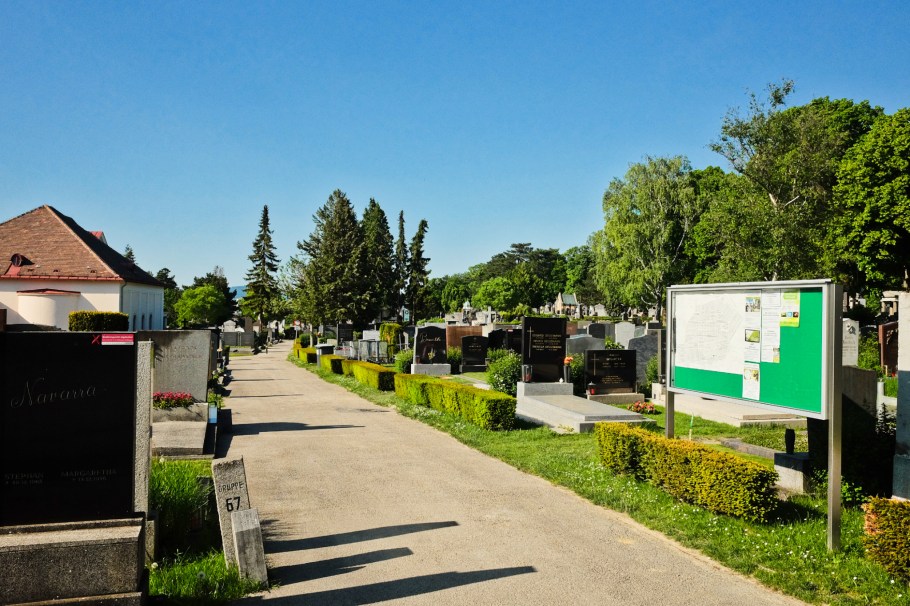
Located to the southwest of the former imperial summer residence Schönbrunner Schlosspark, Hietzing Cemetery is modest in size with an area of over 10 hectares (25 acres) and containing over 11-thousand graves. With the present site inaugurated in 1787, the cemetery has seen several expansion phases and survived damage from the Second World War.

I highlight the final resting places for Alban Berg, the Fröhlich sisters, Franz Grillparzer, Hans Hollein, Gustav Klimt, Koloman Moser, Strauss women, and Otto Wagner.

Friedhof Hietzing, Hietzing Cemetery, Friedhoefe Wien, Hietzing, Wien, Vienna, Austria, Oesterreich, fotoeins.com

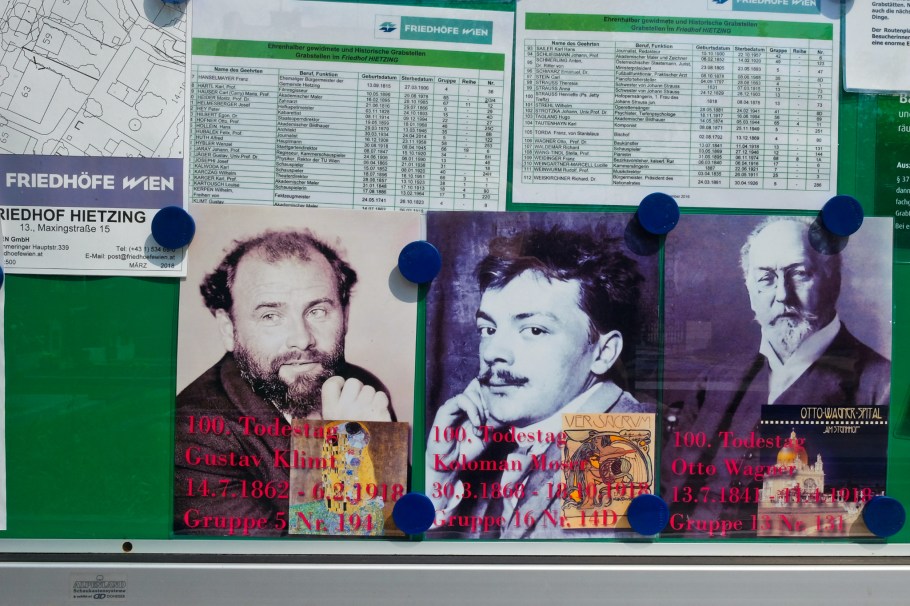
2018 was the 100th anniversary of the deaths of Gustav Klimt (1862–1918), Koloman Moser (1868–1918), and Otto Wagner (1841–1918). Photo, 16 May 2018.

13. Bezirk, Hietzing, Friedhof Hietzing, Hietzing Cemetery, Friedhoefe Wien, Hietzing, Wien, Vienna, Austria, Oesterreich, fotoeins.com

Inside the front entrance – 15 May 2022.

Friedhof Hietzing, Hietzing Cemetery, Friedhoefe Wien, Hietzing, Wien, Vienna, Austria, Oesterreich, fotoeins.com

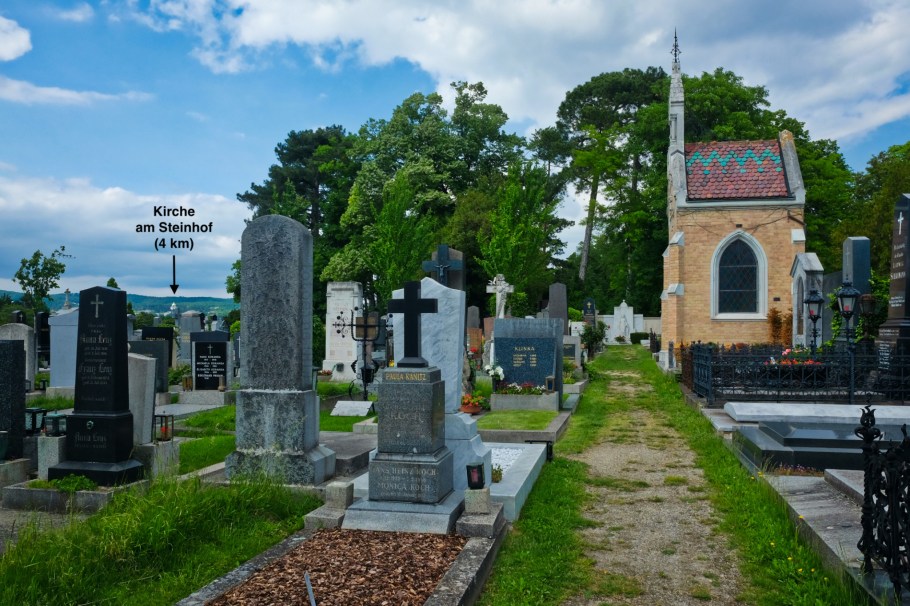
Visitors to the cemetery can look northwest to see the glowing golden dome of Otto Wagner’s Steinhof Church at a distance of 4 km (2.5 mi). Photo, 16 May 2018.


( Click here for images and more )