Fotoeins Fotografie

location bifurcation, place vs. home

Posts from the ‘Summer’ category

My Fuji X70: Kodacolor (XTrans2 recipe)

Above/featured: After Girard: Vancouver-Strathcona, 14 Oct 2021.

The Fujifilm X70 mirrorless fixed-lens prime camera has been a real boon to my approach to photography for personal projects both domestically and internationally. To satisfy my curiosity, I’ve provided examples of X70 images made with two Fujifilm analog-film simulation (film-sim) recipes:

•   Ektachrome 100SW (saturated warm), simulating images with the Kodak colour transparency or slide films produced between 1996 to 2002;
•   Kodachrome 64, simulating images with the Kodak colour film produced between the mid-1970s and 2009.

In this post, I examine the Kodacolor film-simulation, a reproduction of which Fuji X Weekly’s Ritchie Roesch describes as “producing a classic Kodak analog aesthetic.” According to Roesch, the digital film-simulation is closest to Kodacolor VR analog color film from the early-1980s, whose ISO200 version is still available for purchase as “ColorPlus 200” (Kodacolor 200).

The following film-simulation recipe creates images similar to the look of “Kodacolor VR 200 (film) that’s been overexposed.” My X70 settings are:

  • ‘Classic Chrome’ built-in film-sim
  • Dynamic Range: DR400
  • Highlight: +1 (Medium-High)
  • Shadow: +1 (Medium-High)
  • Color: -2 (Low)
  • Sharpness: 0 (Medium)
  • Noise Reduction: -2 (Low)
  • White Balance: 6300K; -3 Red, -2 Blue
  • ISO: Auto, up to 6400 for “grainy” appearance (or fixed to 1000)

The recipe above is for the X-Trans II sensor; the corresponding recipe for an updated or more recent sensor is found here. All other recipes sorted by specific sensor are found here.

The following images were made at locations throughout metropolitan Vancouver. Minor adjustments to brightness level, rotation, and geometric distortion have been applied from straight-out-of-the-camera (SOOC) to posting.


( Click here for images )
My Fuji X70: Ektachrome 100SW (XTrans2 recipe)

Above/featured:False Creek east, from Cambie Bridge – 12 Jul 2021.

A variety of film simulations in the form of recipes with different settings are applicable to Fujifilm cameras to create uniquely historical and/or vintage look to images. Fortunately, a number of recipes are available to apply onto Fuji cameras with X-Trans II sensors.

That’s where my Fuji X70 has entered the fun fray. Previously, I showed examples of images made with the Kodachrome 64 recipe, simulating images made with the Kodak analog colour film produced from the mid-1970s to its final run in 2009.

I wanted to try another film-simulation recipe: the Ektachrome 100SW (SW for ‘saturated warm’) described by Ritchie Roesch in Fuji X Weekly. Historically, the Kodak company produced the ‘Ektachrome’ line of colour transparency or slide films. From its introduction in 1996 to its termination in 2002, the ‘Ektachrome 100SW’ film with increased ISO sensitivity produced images with deeper colours and warmer colour balance.

At locations throughout metropolitan Vancouver over a period of four weeks in July and August 2021, here are images below straight-out-of-the-camera (SOOC) with the following settings:

  • ‘Velvia’ built-in film-sim
  • Dynamic Range: DR200
  • Highlight: +2 (High)
  • Shadow: +1 (Medium-High)
  • Color: -1 (Medium-Low)
  • Sharpness: 0 (Medium)
  • Noise Reduction: -2 (Low)
  • White Balance: Auto; +1 Red, -2 Blue
  • ISO: Auto up to 3200 (or fixed to 1000)

All recipes sorted by specific sensor are found here.


( Click here for images )

My Fuji X70: Kodachrome64 (XTrans2 recipe)

Above/featured: South portal, Lions Gate Bridge – 25 Jun 2021.

I wrote about how the Fujifilm X70 fixed-lens prime has been great for my photography. Fujifim prides itself on good to faithful reproductions of film simulations (film-sims). For the most part, I’ve used the default or “Standard” setting, equivalent to the “Provia” film-sim which is one of 11 film-sims built into the X70.

I learned about other film-sims, particularly those applicable to the older X-Trans II sensor that’s in my X70 camera. I’ve been interested in digital reproductions of “old” colour slide film, and seeing how images over a variety of subject matter appear with a film-sim that looks a little more like “old school film”. Ritchie Roesch describes in Fuji X Weekly the differences between the Kodachrome II and Kodachrome 64 film-sims; the former resembling the look of Kodak film from the 1960s to the mid-1970s and the latter echoing the final version of the film-type from the mid-1970s to 2009. Roesch provides additional historical context to the development of Kodachrome film here.

Here I’ve used the Kodachrome 64 film-sim recipe with the following settings:

  • ‘Classic Chrome’ built-in film-sim
  • Dynamic Range: DR400
  • Highlight: +2 (High)
  • Shadow: +1 (Medium-High)
  • Color: 0 (Medium)
  • Sharpness: 0 (Medium)
  • Noise Reduction: -2 (Low)
  • White Balance: Daylight; 0 Red, -3 Blue
  • ISO: Auto up to 3200 (or fixed to 1000)

All recipes sorted by specific sensor are found here.


( Click here for images )

Vancouver: summer cricket at Stanley Park

Above/featured: Grouse Mountain looms over a cricket match at Upper Brockton, with the bowler delivering from the mountain end to the pavilion end.

It’s not typical 21st-century sport in North America, but it is Canada’s first summer sport. Many of cricket’s practitioners in Vancouver’s picturesque Stanley Park have roots from India and Pakistan; among them the shouts of “shabash” are heard often during play.

In childhood, I was enamored with baseball. With its similar origins, I discovered cricket with time spent in Australia, New Zealand, the Bahamas, and South Africa. The natural connection is the former British Empire. I began with T20, the shortest format of the game; with curiosity and time, my hunger encompassed the 50-over one-day format (ODI). It’s my start with the short white-ball format that I’ve developed an appreciation for the long format of the game with red-ball Test cricket.

But is the cricket ground at Vancouver’s Stanley Park “the most beautiful cricket ground in the world”? (With Table Mountain as the backdrop, some might proclaim Newlands Cricket Ground in Cape Town, South Africa as the most beautiful/scenic.)


( Click here for images and more )

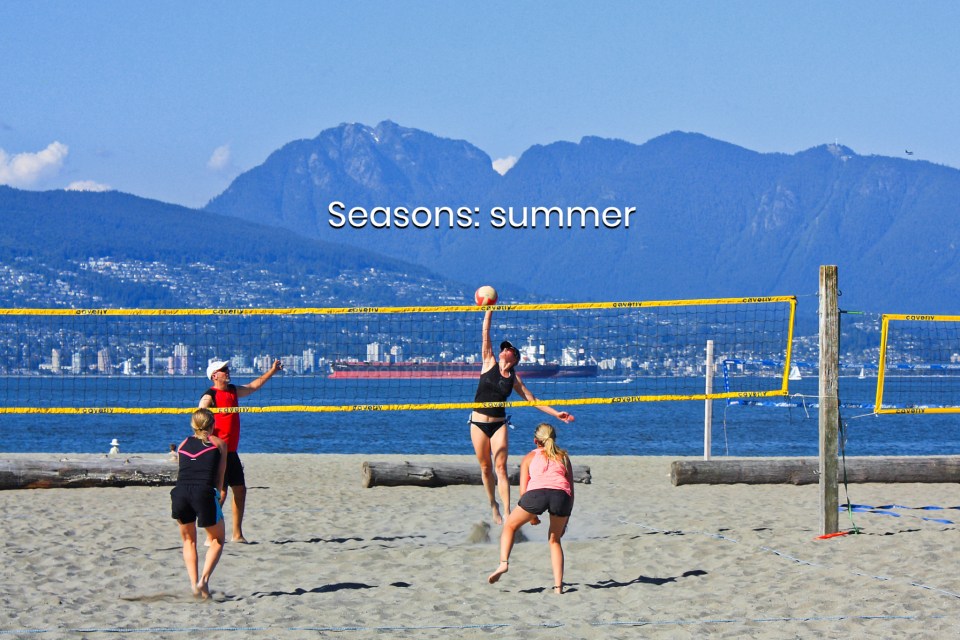
Two vs. two volleyball, Spanish Banks East, Spanish Banks, English Bay, Salish Sea, Vancouver, BC, Canada, fotoeins.com

Seasons: summer

Above/featured: Beach volleyball at Spanish Banks: Vancouver, Canada – 18 Jul 2013.

So then, July 2020 is the month of “seasons” for LAPC, and the theme begins in current (northern) summer.

For me, summer largely represents deep blues and greens, a time of year with long hot days and short comfortable nights. It’s an opportunity to observe early sunrises to the northeast, and relatively late sunsets to the northwest. In languages with which I’m most familiar, the word “summer” also appears as:

  • Chinese: 倏季
  • French: l’été
  • German: der Sommer
  • Spanish: el verano

( Click here for images and more )