Fotoeins Fotografie

location bifurcation, place vs. home

Posts from the ‘Spring’ category

Frankfurt & the Franks: Anne, Edith, Margot, Otto

Above: The Frank family in happier times; seen left-to-right are Margot, Otto, Anne, and Edith, respectively. Display at the Frank Family Centre at the Jewish Museum Frankfurt, 17 Jun 2023 (X70).

I hadn’t realized how long an impression would last, decades after having read in high-school the diary of a young girl stuck in hiding for years. Much later down the line and standing in front of a house in a quiet neighbourhood in a German city, I could almost hear the laughter of children in the backyard and the gentle rebuke of a mother to one of her daughters, years before one of the girls ever considered writing her thoughts down into a book.

The story of Anne Frank and her family are well known. Her father and businessman Otto Frank moved his family from Frankfurt am Main to Amsterdam in 1934 to escape increasing Nazi discrimination against Jews. Otto survived capture, deportation, and time in the camps; but his wife and two daughters did not. After liberation in 1945, Otto Frank returned to Amsterdam and wrote letters to relatives in Basel. He learned how the diary written by his daughter Anne had been carefully hidden; reading her daughter’s thoughts would change the remaining course of his life. In the early-1950s, he moved to Basel, Switzerland, to be closer to his sister’s family. He and his extended family spent time and energy for the rest of their lives dedicated to translation efforts and the distribution of Anne’s diary as a document of family memory, world history, and essential education; and to the collection of memories and belongings of lost family members. Otto died in 1980, and is buried in Birsfelden cemetery, just east of Basel proper.

Much of the story has been written about the Frank family’s time in Amsterdam, but I hadn’t been aware of the family roots in Frankfurt am Main, despite my countless times passing through and multiple stays in the city since 2001 when I moved to Heidelberg. I wanted to learn about their time in Frankfurt am Main, before the family left for Aachen and Amsterdam in 1933–1934. What follows below is my examination of some of the places and traces left behind by the Frank family in Frankfurt am Main.

ANNELIES Marie Frank, daughter: b/✵ 12 June 1929, Frankfurt am Main – d/✟ March 1945, Bergen-Belsen.
EDITH Frank (née Holländer), mother: b/✵ 16 January 1900, Aachen – d/✟ 6 January 1945, Auschwitz.
MARGOT Betti Frank, daughter: b/✵ 16 February 1926, Frankfurt am Main – d/✟ March 1945, Bergen-Belsen.
OTTO Heinrich Frank, father: b/✵ 12 May 1889, Frankfurt am Main – d/✟ 19 August 1980, Birsfelden.

( Click here for images and more )

Vienna Steinhof Church: city- & Wagner-landmark

Above/featured: East side of the church, in afternoon light. Photo on 28 May 2023, X70 with wide-field WCL-X70 lens attachment, image corrected for geometric distortion.

Building: Steinhof church, also St. Leopold Church, 1907 // Kirche am Steinhof, Kirche zum heiligen Leopold.
Address: Baumgartner Höhe 1, in Penzing, the city’s 14th district.

Up on the city’s Baumgartner Heights is an example of Europe’s first modernist church at Steinhof. Dedicated to St. Leopold, the structure is one of the city’s finest examples of turn-of-the-century architecture, and one of the world’s most important churches in the Jugendstil or Art Nouveau architectural style. The church was designed and built by architect Otto Wagner, inaugurated in 1907 for patients and staff within the surrounding hospital complex the Lower Austria state, sanatorium, and nursing home for the mentally ill (Niederösterreichische Landes-, Heil-, und Pflegeanstalt für Geistes- und Nervenkranke) which included over 30 buildings and room for over 2000 beds. The bright, airy, and spacious modern design was met at that time with skepticism and criticism by local church officials. Of utmost importance on Wagner’s mind were the hospital patients: his church design was about gentle solitude, not fire and damnation.

The church was a collaborative effort with other Viennese artists, including mosaics and stained glass by Koloman Moser, angel sculptures by Othmar Schimkowitz, and exterior tower sculptures by Richard Luksch. The church roof is topped with a dome covered in gold-plated copper plates, whose bright yellow appearance in daylight merits the nickname “Limoniberg” (lemon hill) that’s visible in different parts of the city. The Steinhof church is an example of a “Gesamtkunstwerk“, where every detail and fixture contributed to a “total and functional work of art”; an architectural masterpiece of the period; and one of Otto Wagner’s most important creations.

I included this building as part of my description of Otto Wagner’s architectural legacy in Vienna and of the recent centenary celebration in Vienna of the city’s 19th- to 20th-century architectural transition from historicism to modernism.


( Click here for images and more )

25 for 25: fotoeins fotos in 2025

Above/featured: “Göttin” (goddess), by AlfAlfA, also known as Nicolás Sánchez, for One Wall 2017. Photo, 17 Jun 2025 (P15).

In continuation of high spirits and enthusiastic support of leading choices, I’m very grateful to significant time spent:

  • in the Bay Area, to visit mum’s family in Sacramento and long-time friends in the South Bay;
  • in Vienna for the 4th consecutive summer; and
  • in Berlin for the 1st time in 4 years, as set up for a repeat in the new year.


( Click here for images and more )

My Berlin: Wrapped Reichstag after 30 years

Above: “Wrapped Reichstag 1995–2025” light show.

In 1995, the artist duo Christo & Jeanne-Claude carried out a bold but contentious project by covering Berlin’s landmark Reichstag parliament building. Plans for the project had taken over 20 years, even though the artwork had always meant to be temporary and all expenses had been covered without corporate sponsors. Over 5 million visited in a period of 12 days in the summer of 1995 to look at the undulating “silver dream” in the German capital city. The timing was ideal. After reunification of the two Germanys in 1990, the new home of the federal parliament would be Berlin’s Reichstag. Renovations to the building began in the autumn of 1995 with the federal parliament opening in the spring of 1999.

From 9 to 22 June 2025, the Reichstag building was illuminated nightly with a light show in a 30-year anniversary tribute to the famous 1995 artwork. In a 20- to 30-minute cycle, the light-show appeared to first envelop the building in silver fabric. The fabric cover flapped in artificial breeze, before the cover lost its shape and fell onto the ground at the base of the building. The free-of-charge light show began shortly after sunset at about 930pm and continued until 1am. Whatever Christo and Jeanne-Claude chose to cover and transform, their art works posed questions of perception, origins, shape, functionality, and permanence.

•   DW: Germany Arts
•   Visit Berlin


( Click here for images )

My Berlin: Dussmann Kulturkaufhaus, more than a bookshop

Pieces & places in Berlin

If I have 3 days or 7 weeks to spend in the German capital city, I make time to stop at Dussmann.

Conveniently located near Berlin’s Friedrichstrasse train station, the “department store of culture” offers more than simply German-language books to serve fiction read-needs or magazines to gauge what’s happening near and far. There’s a separate English language bookshop, as well as an enormous catalog of music, film, and television. The space is also large enough to hold some cultural events. Naturally, there’s a “BerlinShop” for my postcard and your souvenir requirements. And because it’s Berlin, they stay open past 11pm Monday to Saturday.

Dussmann is an important place and piece to the extensive conceptual mosaic I’ve created over the years with the amount of time spent in Berlin since 2002. I never regret any visit to Dussmann. I always regret what’s about to happen: my wallet gets a little lighter, and that I somehow have the massive fortitude to leave with “only” a handful of books.


Dussmann Kulturkaufhaus, Berlin, Deutschland, Germany, fotoeins.com

Completed in 1997, the lower 5 floors of the 8-storey building is all about the Kulturkaufhaus, whereas the upper 3 floors are reserved for office space which includes the Dussmann Group. Photo, 27 May 2025.

Dussmann Kulturkaufhaus, Berlin, Deutschland, Germany, fotoeins.com

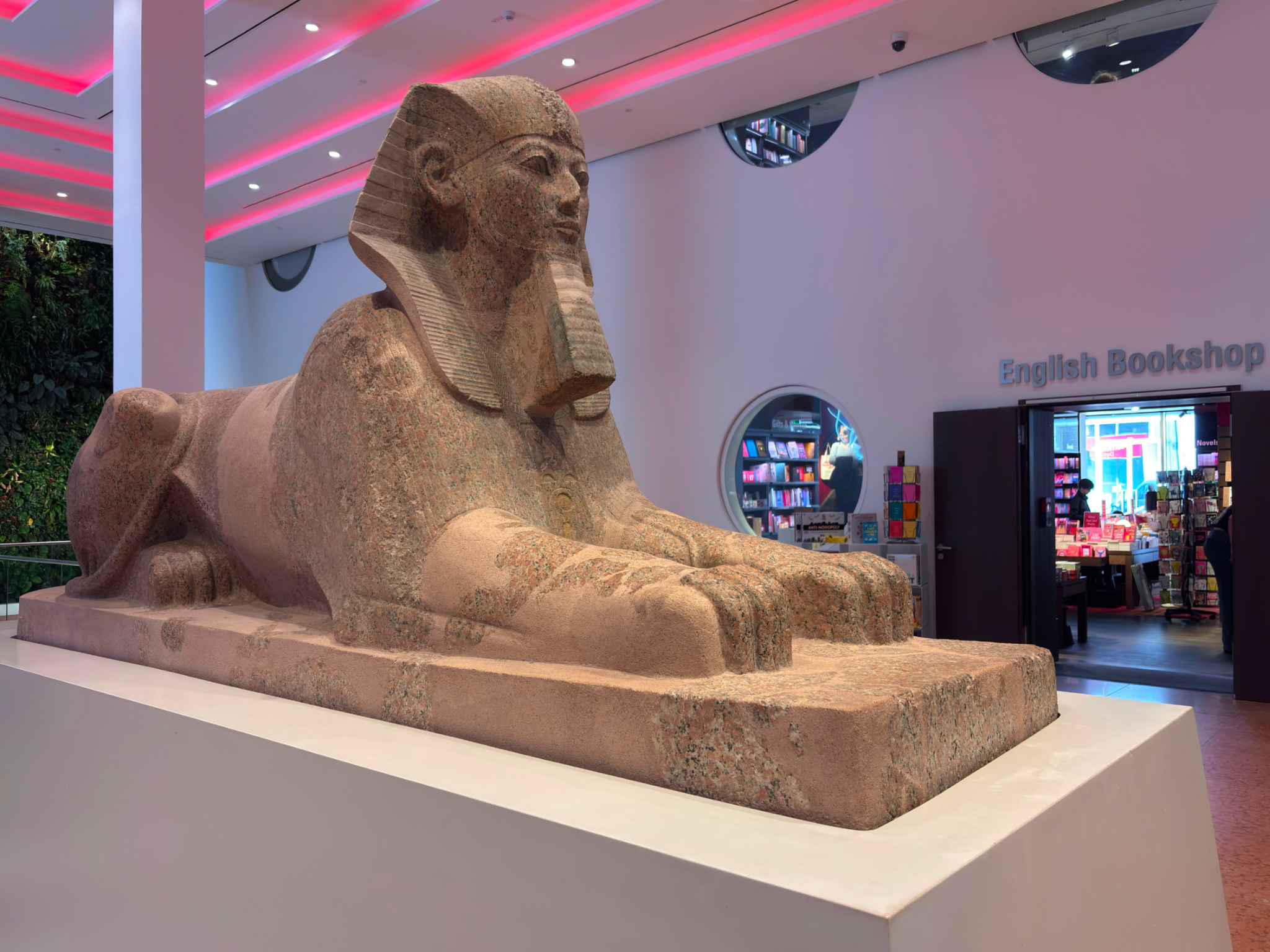
At the far end on the ground floor (Erdgeschoss) is the sphinx of Egypt’s Queen Hatshepsut (about 1475 BCE), on permanent loan from the Egyptian Museum of Berlin. The inscrutable statue greets visitors to the café below, as well as the English language bookshop at right. Photo, 27 May 2025.

Dussmann Kulturkaufhaus, Berlin, Deutschland, Germany, fotoeins.com

From the 2nd floor (erste Obergeschoss) this view along the central aisle shows how the combination of natural light from above, mix of artificial lighting and colours, and hanging leafage provides a welcoming atmosphere, which undoubtedly makes it easier for customers to spend. Photo, 30 May 2025.

Dussmann Kulturkaufhaus, Berlin, Deutschland, Germany, fotoeins.com

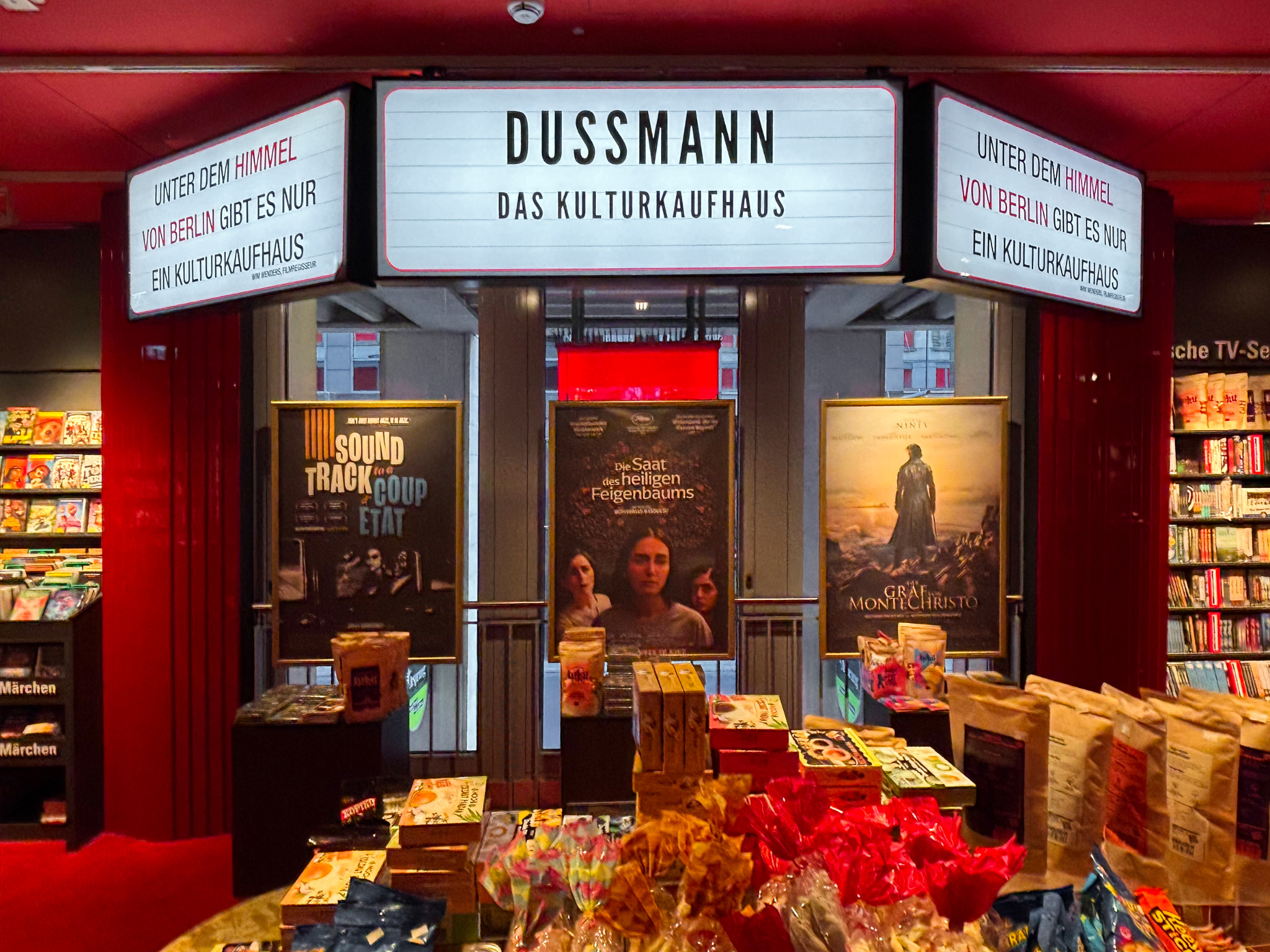
“Under Berlin’s skies, there’s only one Dussmann.” On the 2nd floor, the theatre banner-like display highlights the movie and television section, and if the quote is indeed from Wim Wenders, it’s an interesting play on the title “Der Himmel ĂĽber Berlin”, a film Wenders directed in 1987. In the television section, I found DVDs for early-seasons (series) of New Zealand’s “The Brokenwood Mysteries”, distributed in Germany as “Brokenwood – Mord in Neuseeland”. Photo, 30 May 2025.

Café Nénom, Dussmann Kulturkaufhaus, Berlin, Deutschland, Germany, fotoeins.com

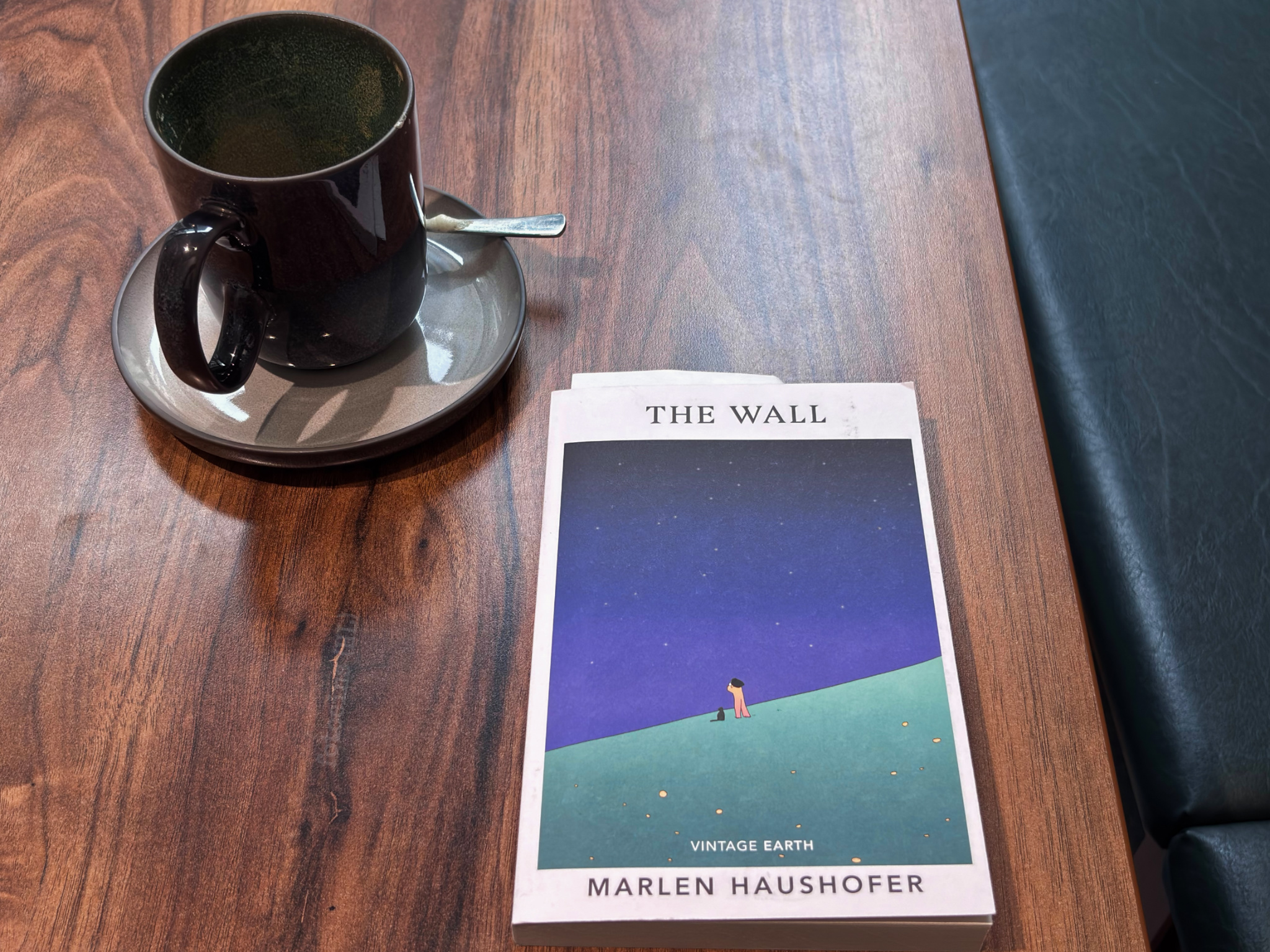
Afternoon break at CafĂ© NĂ©nom with coffee and book: “The Wall” (“Die Wand”), a work of fiction published in 1963 and written by Austrian Marien Haushofer. Photo, 27 May 2025.


Directions & Hours

•   BVG U-Bahn U6 train to Friedrichstrasse station.
•   S-Bahn Berlin train: S1, S2, S25, S26; S3, S5, S7, or S9 to Friedrichstrasse station.
•   Leaving Friedrichstrasse station, it’s a short 120-metre (400-ft) walk south to the shop.
•   BVG Tram M1 or 12 to stop “S+U Friedrichstrasse Bhf”.

Monday to Friday: 9h–0h; Saturday: 9h–2330h; Sunday (BerlinShop only): 13h-18h.

( View this location in OpenStreetMaps )

I received no prior support or subsequent compensation for this piece. I made all above images with a P15 on 27 and 30 May 2025. This post appears on Fotoeins Fotografie at fotoeins DOT com as https://wp.me/p1BIdT-wj0.