Fotoeins Fotografie

location bifurcation, place vs. home

Posts from the ‘Spring’ category

Einöden, Gasthof Hauserwirt, Wörgl, Tyrol, Tirol, Kufstein, Austria, Österreich, fotoeins.com

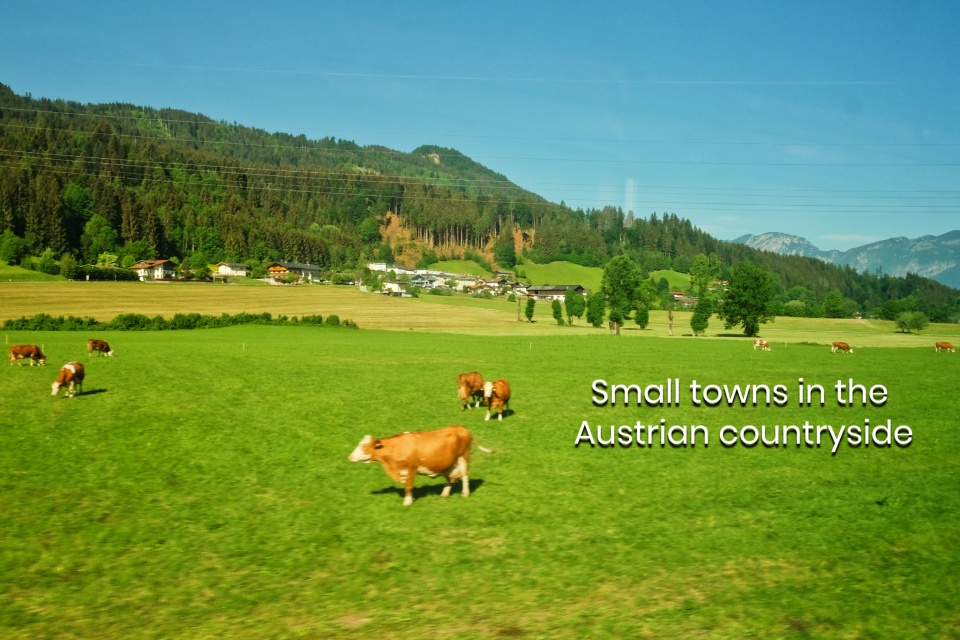
Small towns in the Austrian countryside

Above/featured: Bovine goodness with Gasthof Hauserwirt in the background, in Einöden at the outskirts of Wörgl – 13 May 2018.

Österreichische Dörfer auf dem Land

Spending a few weeks exploring Austria in spring between peak winter and summer seasons got me to examine a variety of artistic and cultural aspects, including:

•   a search for Erwin Schrödinger’s grave,
•   a century of Vienna Modernism,
•   a day-trip from Vienna to Bratislava with a boat on the Danube, and
•   looking for modern Salzburg beyond Mozart and The Sound of Music,

Because I’m all about trains and buses in Europe, there were many towns encountered: some passed by, and others planned and visited. The following examples of small towns in Austria includes a generous portion of mountains from the Austrian Alps.


( Click here for images and more )

Salzburg Walk of Modern Art (2018)

Above: “Sphaera” by Stephan Balkenhol: Salzburg Kapitelplatz – 22 May 2018.

Salzburg is a well-known historical city in north-central Austria next to the border with Germany. For a different way of examining the city that goes beyond the history of the Habsburgs and the music of Mozart, the Walk of Modern Art allows visitors and residents to walk through parts of the city for a mix of historical and contemporary perspectives at street-level and from the cliffs above. The art pieces are placed throughout the city’s Old Town to coincide with key landmarks and sights. The city of Salzburg also provides information about the walk. UNESCO inscribed Salzburg’s Old Town as World Heritage Site in 1996.

Thankfully, there’s more to Salzburg than “The Sound of Music” ().


( Click here for images and more )

Fuji X70, Fujifilm X70, Fujifilm, X70, Peak Design

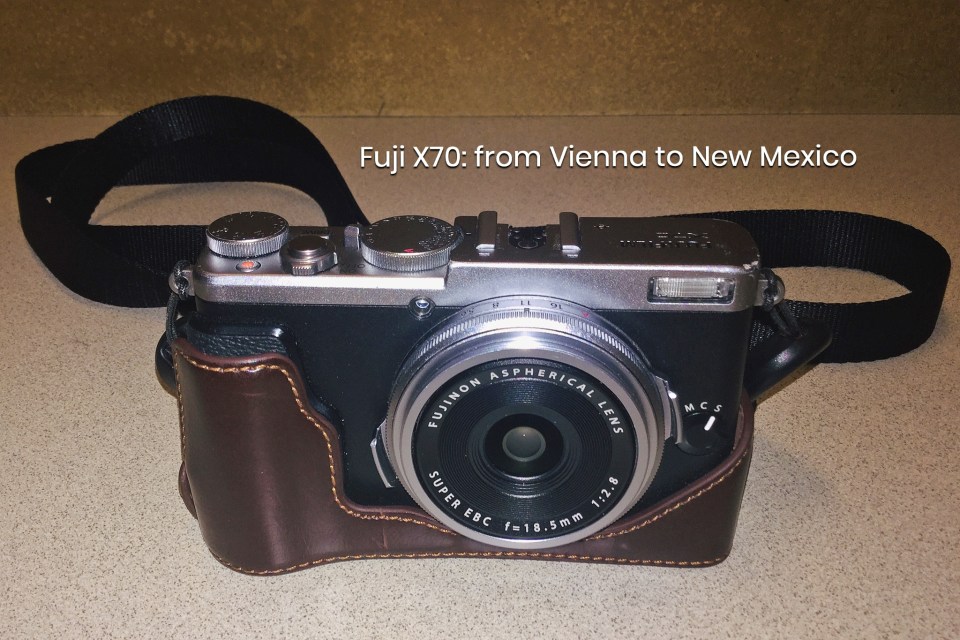
My Fuji X70: from Austria to the US Southwest

Instead of merely complaining about a desire to carry something lighter for day-to-day photography situations, I decided to do something about it a couple of weeks before my month-long visit to Austria in May 2018.

I looked online for a mirrorless compact camera, but I didn’t need the latest or a top-line model. I preferred an older model with a lot of online reviews and user comments, and I decided on a compromise among three criteria: cost, weight and size, and image quality.

( Click here for images and more )

Vienna: Disrupting Historicism with Modernism (1918–2018)

Above/featured: Modernism at Steinhof Church: building by Otto Wagner, angels by Othmar Schimkowitz, stained glass by Koloman Moser (HL).

Vienna is as much a present-day cultural capital city as she was for decades and centuries. Many will get a peek and taste of long-established aspects of the city by walking the streets of the Old Town for the atmosphere, chatting in cozy cafés with coffee and cake for the ambience, and swaying to the rhythms of the waltz under the spell ofOlbr the (blue) Danube.

The early years of the 20th-century were troubled by greater calls for more autonomy from multiple ethnic groups within the patchwork of the Austro-Hungarian empire, by destruction and loss of life from The Great War (World War I), and by subsequent dissolution of the Empire. The capital city became an open theatre for socioeconomic and political changes across all class divisions within an environment where rebellion and revolution were the big talking points against the dogma of long-held traditions. Deep longing for the stability of the old and familiar mingled with equally enthusiastic desire for the radical of the new and mysterious.

Many in the arts, design, and cultural scene were questioning the excessive persistence of past styles, and were seeking something new to better represent changes happening all around them in Vienna. In 1897, a group of artists and architects resigned from the established Künstlerhaus to form the Vereinigung Bildender Künstler Österreichs (Union of Austrian Artists), known also as the Vienna Secession. Architecture moved towards a sharper focus to geometry and abstraction, and art flowed to the decorative with organic floral-like designs in the Jugendstil, Art Nouveau’s chapter in German-speaking lands. To promote their new ideas, the Secession group produced an official magazine called Ver Sacrum (“sacred spring” in Latin, 1898) and constructed the Secession building (1897) as an exhibition hall to display their work. The Wiener Werkstätte (Vienna Workshops) was created in 1903 as an association of artists whose thinking and applied arts creations were a precursor to the Bauhaus movement. Members of the Werkstätte worked with Vienna’s architects to broaden and unite the various concepts for a complete artwork, or Gesamtkunstwerk, as applied to a living space: the house, its rooms and furnishings, the interplay of light and space, and the tools and utensils for every day aspects of living.


( Click here for images and more )

Innsbruck’s Hungerburgbahn, by Zaha Hadid

As much as the Austrian federal state of Tirol is about mountains, spending time in the capital city of Innsbruck is also about reaching those very heights. To that end, Iraqi-British architect Zaha Hadid left her mark in Innsbruck with her redesigned Bergisel Ski Jump which opened in 2002, and her “Shell and Shadow” design of the Hungerbergbahn stations which opened in 2007.


( Click here for images and more )