Fotoeins Fotografie

location bifurcation, place vs. home

Posts from the ‘Urban Photography’ category

Seattle: murals in West Seattle

Above/featured: Facing east at The Junction: SW Alaska Street at California Avenue SW. At left (northeast corner) is the red-brick Campbell Building from 1911, oldest in the neighbourhood and a designated City of Seattle historic landmark since 2017.

What: Paintings depicting the history of West Seattle.
Where: In and around West Seattle’s The Junction.
Why: Arts project with community and pride.

Technically, West Seattle is an area consisting of several neighbourhoods within the city of Seattle. Historically, West Seattle feels separate, a peninsula separated from the centre by the flow of water and peoples along the Duwamish river valley. West Seattle had incorporated as its own city in 1902, before agreeing to annexation by Seattle in 1907.

One key to West Seattle is “The Junction”: an intersection of 2 former streetcar lines “West Seattle” and “Fauntleroy”. As expected, commercial activity took root at the intersection and although streetcars have vanished, the nickname has remained as a simple useful designation.

A product of West Seattle, retired businessman Earl Cruzen (1920-2017) launched a local arts and community project in the late-1980s, inspired after visiting other towns in Washington as well as Chemainus on British Columbia’s Vancouver Island. Cruzen promoted the project with support among residents and business owners, generated fundraising efforts, and brought American and Canadian artists into the city to paint wall murals to highlight the history of people along the Duwamish river and the history of West Seattle. A total of 11 murals were painted, dedicated, and unveiled between 1989 and 1993.

Over time, the murals deteriorated and faded without touchup or maintenance. Members of the Southwest Seattle Historical Society engaged the community in 2018 with questions about the murals, and about raising money to support revitalizing the murals. In May 2018, Adah Cruzen honoured her late-husband with a gift of 100-thousand dollars to the West Seattle Junction Association to boost the restoration process.

So, what do the murals mean to the people of West Seattle?


( Click here for images and more )

Munich: Ghost station “Olympic Stadium”

In the vicinity of Munich’s Olympic Stadium is a train station overgrown with brush and weeds. The tracks stretch north and south, but go nowhere.

Munich played host to the Summer Olympics in 1972; physical reminders include the Olympiadorf (Olympic Village), Olympiapark, and the Olympiastadion (Olympic Stadium). In 1988, the train station “München Olympiastadion” closed to train service for the final time. Rail tracks which connected the station with the North Ring freight tracks were cut, isolating the station and leaving it to decay.

Since 2001, the Olympic Village has been listed as part of the heritage Olympiapark ensemble which includes the abandoned station. But will the station be left to decay? Or will the station be refurbished in some way to become a living memorial?

Historical maps of the MVV U- and S-Bahn system show how train service from central Munich to Olympic Stadium was utilized. S-Bahn train service carried passengers along the central trunk to Olympic Stadium via Hauptbahnhof, Laim, and Moosach; check out the system maps for June 1972 and June 1988.


( Click here for images and more )

Vienna Hietzing Cemetery: F.Grillparzer, G.Klimt, K.Moser, O.Wagner

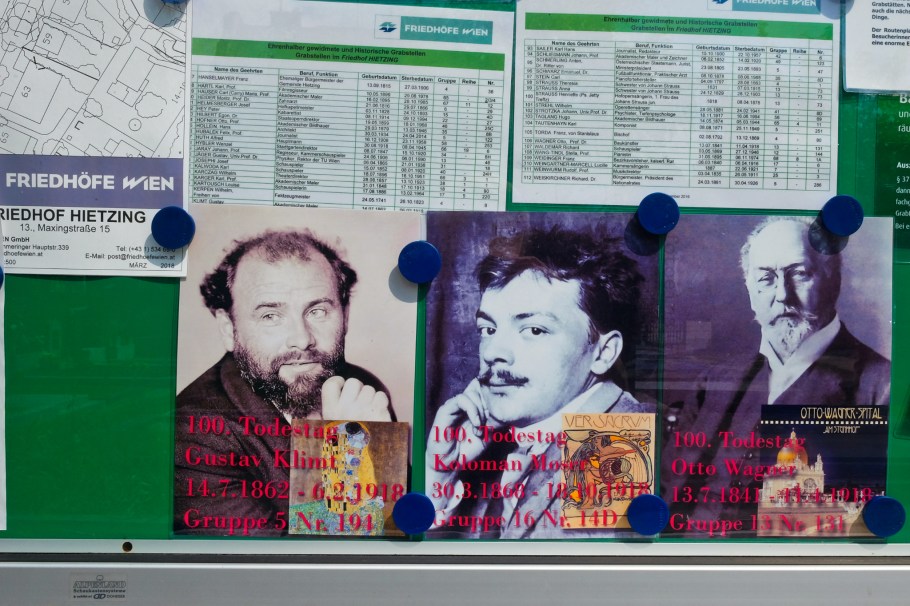
Previously, I provided short biographies for artist Gustav Klimt, artist and designer Koloman Moser, and architect Otto Wagner, and why they are important figures to the arts and culture scene in early 20th-century Vienna. These three figures are buried in Hietzing Cemetery in the 13th district of Hietzing at the city’s western periphery.

Located to the southwest of the former imperial summer residence Schönbrunner Schlosspark, Hietzing Cemetery is modest in size with an area of over 10 hectares (25 acres) and containing over 11-thousand graves. With the present site inaugurated in 1787, the cemetery has seen several expansion phases and survived damage from the Second World War.

I highlight the final resting places for Alban Berg, the Fröhlich sisters, Franz Grillparzer, Hans Hollein, Gustav Klimt, Koloman Moser, Strauss women, and Otto Wagner.

Friedhof Hietzing, Hietzing Cemetery, Friedhoefe Wien, Hietzing, Wien, Vienna, Austria, Oesterreich, fotoeins.com

2018 was the 100th anniversary of the deaths of Gustav Klimt (1862–1918), Koloman Moser (1868–1918), and Otto Wagner (1841–1918). Photo, 16 May 2018.

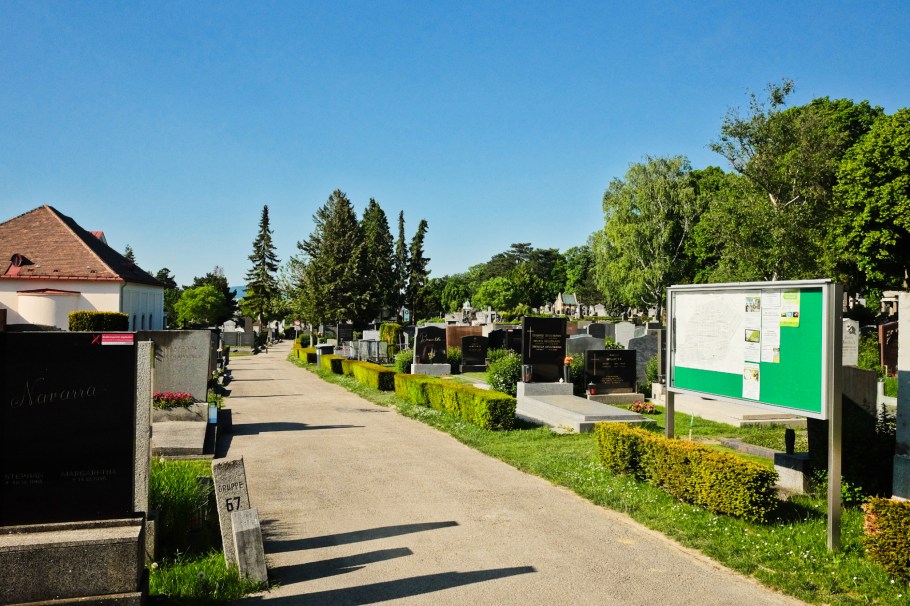
13. Bezirk, Hietzing, Friedhof Hietzing, Hietzing Cemetery, Friedhoefe Wien, Hietzing, Wien, Vienna, Austria, Oesterreich, fotoeins.com

Inside the front entrance – 15 May 2022.

Friedhof Hietzing, Hietzing Cemetery, Friedhoefe Wien, Hietzing, Wien, Vienna, Austria, Oesterreich, fotoeins.com

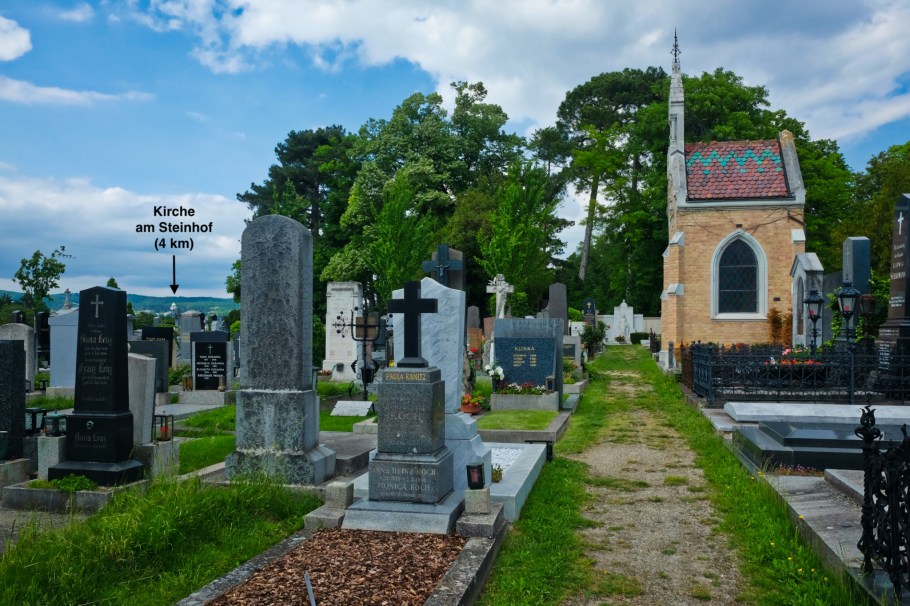
Visitors to the cemetery can look northwest to see the glowing golden dome of Otto Wagner’s Steinhof Church at a distance of 4 km (2.5 mi). Photo, 16 May 2018.


( Click here for images and more )

Strassenbetrieb, Müllkübel, Müllsprüche, Mistkübel, Abfallkörbe, Abfalleimer, Innsbruck, Tirol, Tyrol, Austria, Oesterreich, fotoeins.com

My Innsbruck: I do not refuse the humour

It’s not really low humour, and besides, I’m not one to reject humour.

As an encouragement for everyone to keep the environment clean (aside from personal and collective responsibility), the ubiquitous red garbage or waste bins throughout the city of Innsbruck are all tagged with a succinct sentence that’s amusing and punny. I don’t abide by the stereotype that the German language can’t be funny; instead, the stereotype persists because of lazy ignorant thinking.

Many small red waste-bins or garbage cans are located throughout the Tirolean capital. With a real chance to causing double takes, the different sayings on the bins is a mix of Austrian German and English, encouraging residents and visitors to use them as intended. The bins are emptied when city staff open them from underneath. This “attraction to waste” is not a unique phenomenon, as various other cities employ a similar trick; for example, in Hamburg and Berlin. But when a waste-bin urges people to feed it, I find it hard to look away.

From over 1200 submissions for a public city-wide competition for the best slogans, 20 were selected and unveiled in autumn 2010 (Innsbruck informiert, 2010: 15 Sept and 6 Oct). Theses mottos are on hundreds of bins in the city. Below are 17 out of 20 for a 85% completion rate, which is pretty good for a few days in and out of town.


( Click here for more )

Seattle’s 1st Starbucks, 1971–1976

Above/featured: Exhibition “Edible City: A Delicious Journey” at MOHAI – Seattle, 8 Jan 2017 (6D1).

What: 1st Starbucks, in the Rhode Island building at the corner of Virginia & Western.
Where: A restaurant now, but no historical plaque or sign.
Why: 1st location between 1971 to 1976, as historical exercise.

Many write about and refer to the “original Starbucks” location in downtown Seattle. If they’re referring to the present location in Pike Place, that Starbucks outlet while the world’s oldest is not the first or original location.

So, what happened to Starbucks’ very first shop from 1971 to 1976?


( Click here for images and more )