Fotoeins Fotografie

location bifurcation, place vs. home

Posts from the ‘Street Photography’ category

My Vienna: 22 urban frames for 2022

Above/featured: “The first Sunday.” Karlsplatz, 1st district – 15 May 2022.

Earlier in the year, I spent four weeks in Vienna, soaking in late-spring and early-summer weather in Austria’s capital city. I highlighted 3 images and scenes which in addition to time spent left personal impressions. Below, I highlight in a “last chance effort” an additional 22 visual examples of the urbanity in Wien, folding in splashes of colour, lines of focus, and accessibility to good timing.


( Click here for images and more )

4. Bezirk, Wieden, Wien, Vienna, Austria, Γ–sterreich, Fuji X70

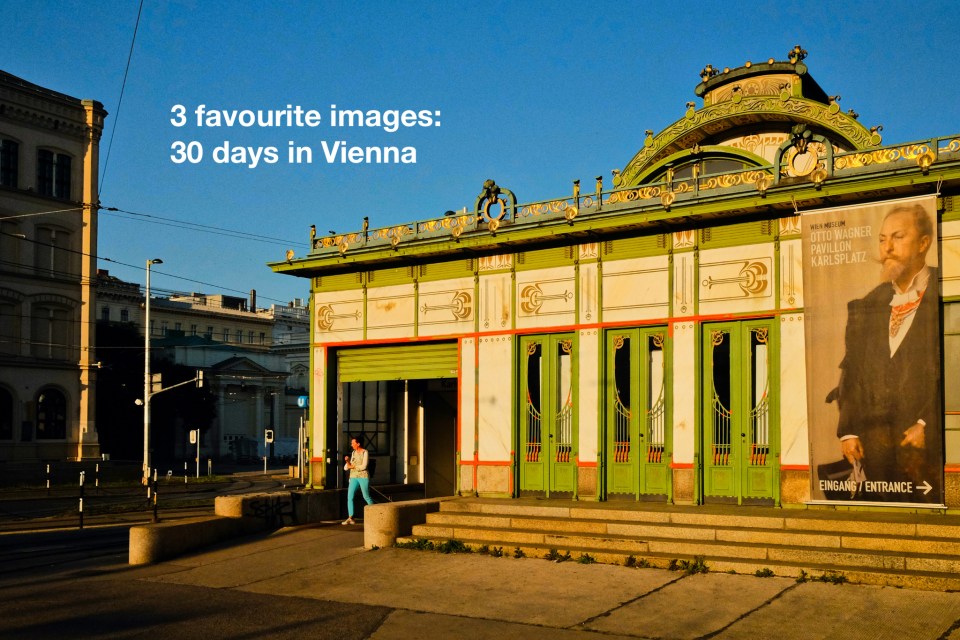
3 fave images, 30 days in Vienna

Featured: Karlsplatz (4.) – 15 May 2022.

I recently spent 30 days in Vienna, examining her history of art, architecture, music, and science. A nation’s capital city is also worthy of photographic examination, and there are many opportunities throughout the city to absorb Vienna’s unique urban charm and style. I snapped over 10-thousand images which will keep me busy “in the archive” for some time. The following three images stand out, at least for now. Perhaps, I’ll feel differently about them in 3 weeks, 3 months, or 3 years’ time.

( Click here for images and more )

My Fuji X70: Kodacolor (XTrans2 recipe)

Above/featured: After Girard: Vancouver-Strathcona, 14 Oct 2021.

The Fujifilm X70 mirrorless fixed-lens prime camera has been a real boon to my approach to photography for personal projects both domestically and internationally. To satisfy my curiosity, I’ve provided examples of X70 images made with two Fujifilm analog-film simulation (film-sim) recipes:

•   Ektachrome 100SW (saturated warm), simulating images with the Kodak colour transparency or slide films produced between 1996 to 2002;
•   Kodachrome 64, simulating images with the Kodak colour film produced between the mid-1970s and 2009.

In this post, I examine the Kodacolor film-simulation, a reproduction of which Fuji X Weekly’s Ritchie Roesch describes as “producing a classic Kodak analog aesthetic.” According to Roesch, the digital film-simulation is closest to Kodacolor VR analog color film from the early-1980s, whose ISO200 version is still available for purchase as “ColorPlus 200” (Kodacolor 200).

The following film-simulation recipe creates images similar to the look of “Kodacolor VR 200 (film) that’s been overexposed.” My X70 settings are:

  • ‘Classic Chrome’ built-in film-sim
  • Dynamic Range: DR400
  • Highlight: +1 (Medium-High)
  • Shadow: +1 (Medium-High)
  • Color: -2 (Low)
  • Sharpness: 0 (Medium)
  • Noise Reduction: -2 (Low)
  • White Balance: 6300K; -3 Red, -2 Blue
  • ISO: Auto, up to 6400 for “grainy” appearance (or fixed to 1000)

The recipe above is for the X-Trans II sensor; the corresponding recipe for an updated or more recent sensor is found here. All other recipes sorted by specific sensor are found here.

The following images were made at locations throughout metropolitan Vancouver. Minor adjustments to brightness level, rotation, and geometric distortion have been applied from straight-out-of-the-camera (SOOC) to posting.


( Click here for images )
Shantung Street, Portland Street, Mong Kok, Kowloon, Hong Kong, fotoeins.com

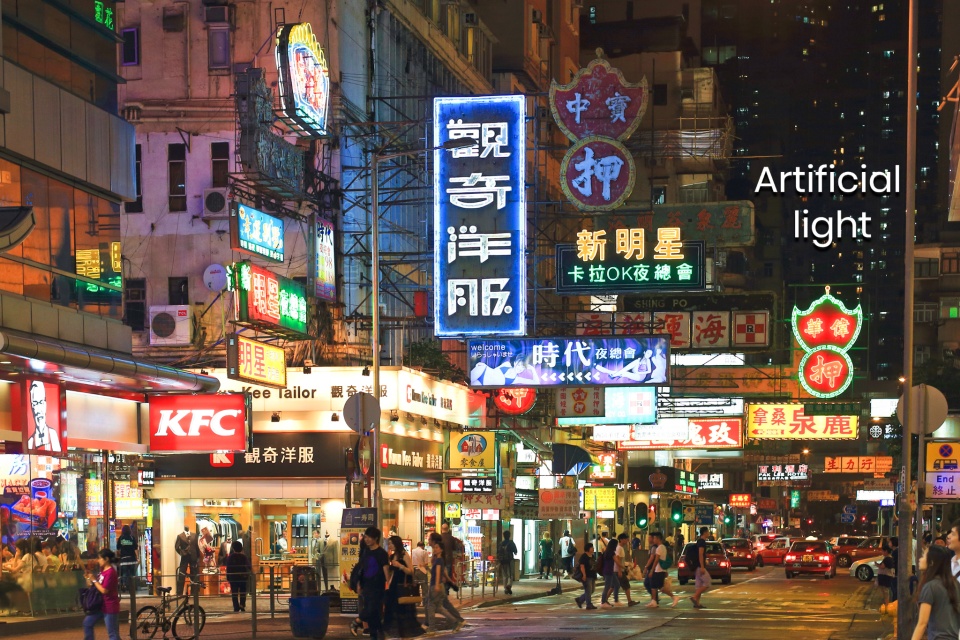
Artificial light

Above/featured: Shantung St. at Portland St., in Mong Kok, Kowloon: Hong Kong – 12 Jun 2012 (450D).

Like many, my preference in photography is for as much natural light as possible. However, there are always exceptions, and a big one is the introduction and/or necessity of artificial light within a scene or picture. Over the course of my photographic journey, I’ve come across some wonderful examples of artificial lighting. I hope you enjoy the examples I’ve provided below, including (my love of) neon signage.

( Click here for more images)

My Fuji X70: Ektachrome 100SW (XTrans2 recipe)

Above/featured:False Creek east, from Cambie Bridge – 12 Jul 2021.

A variety of film simulations in the form of recipes with different settings are applicable to Fujifilm cameras to create uniquely historical and/or vintage look to images. Fortunately, a number of recipes are available to apply onto Fuji cameras with X-Trans II sensors.

That’s where my Fuji X70 has entered the fun fray. Previously, I showed examples of images made with the Kodachrome 64 recipe, simulating images made with the Kodak analog colour film produced from the mid-1970s to its final run in 2009.

I wanted to try another film-simulation recipe: the Ektachrome 100SW (SW for ‘saturated warm’) described by Ritchie Roesch in Fuji X Weekly. Historically, the Kodak company produced the ‘Ektachrome’ line of colour transparency or slide films. From its introduction in 1996 to its termination in 2002, the ‘Ektachrome 100SW’ film with increased ISO sensitivity produced images with deeper colours and warmer colour balance.

At locations throughout metropolitan Vancouver over a period of four weeks in July and August 2021, here are images below straight-out-of-the-camera (SOOC) with the following settings:

  • ‘Velvia’ built-in film-sim
  • Dynamic Range: DR200
  • Highlight: +2 (High)
  • Shadow: +1 (Medium-High)
  • Color: -1 (Medium-Low)
  • Sharpness: 0 (Medium)
  • Noise Reduction: -2 (Low)
  • White Balance: Auto; +1 Red, -2 Blue
  • ISO: Auto up to 3200 (or fixed to 1000)

All recipes sorted by specific sensor are found here.


( Click here for images )