Above/featured: Vienna’s green vineyards on Nussberg, with Kahlenberg at centre in the background. Photo, 14 Jun 2023.
A year in review typically provides coverage spanning a period of six months or more; the period doesn’t even have to be a continuous stretch. But in this case, my highlights come solely from a period of six weeks in May and June. All else pales by comparison.
All of the images presented below have been corrected for geometric distortion and rotation, with further adjustments to image-crop, brightness, contrast, highlights, shadows, clarity, sharpness, vibrance, saturation, and colour levels. These images are as always best viewed on screens larger than a miniscule mobile.
Above/featured: Entrance into the Ferstel Passage (Ferstelpalais, Herrengasse 14). Photo, 2 Jun 2023 (X70).
The following structures in the city of Vienna share something (and someone) in common:
• Café Central,
• the University of Vienna,
• Votive Church, and
• the Museum for Applied Arts.
These buildings were all designed by Viennese architect Heinrich Ferstel. His architectural works left a deep and lasting impression on the city and her residents. What follows is a brief life summary and highlights from a number of his projects.
• born/✵ 7 Jul 1828 – died/✟ 14 Jul 1883.
• One of many architects contributing to the development of Vienna’s “Ringstrasse.”
• 1843–1847: student at Imperial & Royal Polytechnic Institute.
• 1850: completed studies at Architekturschule der Akademie der bildenden Künste (Architectural School, Academy of Fine Arts) under Carl Rösner, Eduard van der Nüll, August Sicard von Sicardsburg.
• 1866: appointed Professor of Architecture at Polytechnic Institute; subsequently, dean 1866–1870; rector 1880–1881 after institute became the Technical University in 1872.
• 1872: founded the Cottageverein (Cottage Association) for the construction of English-style family homes in the Währing district.
… Prolific Austrian architect. He (Ferstel) designed the twin-towered Gothic Revival Votivkirche (1856–1882) and various other Historicist buildings, including the vast Italian Renaissance Revival University (1873–1884) in Vienna. Much of his important work (where the influence of Semper is often clear) was done for the area adjoining the Ringstrasse, but he also designed many buildings throughout the Austro-Hungarian Empire. An advocate of housing reform, he admired English low-density developments, which influenced the Cottageverein (Cottage Association), Vienna (1872–1874), responsible for building small single-family houses. Ferstel also promoted the laying out of the Türkenschanzpark, a public park on English lines (from 1883) …
Above/featured: Taunusanlage train station, Frankfurt am Main – 18 Jun 2023.
The Fujifilm X70 mirrorless fixed-lens prime camera has added a lot to my approach to photography for projects in domestic and international scope. To satisfy my curiosity about Fujifilm’s analog-film simulation (film-sim) recipes, I’ve provided examples of X70 images with the following recipes:
Here I show images made with the “Kodak Color Negative” recipe, which Ritchie Roesch describes in Fuji X Weekly:
… The aesthetic that I was hoping to achieve with this recipe was Kodak Portra 400. I don’t believe that I succeeded in faithfully mimicking that (sometimes there’s a similarity); however, it does seem to produce a Kodak-like color negative film look, perhaps more like Ultramax, but not exactly that, either. Whatever it does or doesn’t resemble, I personally really like the aesthetic produced by this recipe …
The recipe is for X-Trans II sensors and the built-in availability of “Classic Chrome”. The settings on my X70 are:
“Classic Chrome” built-in film-sim
Dynamic Range: DR200
Color: +2 (High)
Sharpness: -1 (Medium-Soft)
Highlight: -2 (Soft)
Shadow: -1 (Medium-Soft)
Noise Reduction: -2 (Low)
White Balance: Incandescent; +6 Red, -7 Blue
ISO: Auto, up to 3200
I assigned this recipe for my “indoor” setting as 1 of the 7 camera’s custom presets, but the recipe’s versatility allowed for additional tests at outside locations. The following JPG images are “almost” straight-out-of-the-camera: only minor adjustments to brightness level and a crop to a predefined image size have been applied, with no corrections to colour, contrast, geometric distortion, or rotation. The blue (“cool”) colour-cast is very real, which is especially evident on images made outdoors under sunny conditions.
Above/featured: Kühnplatz in the 4th district – 22 May 2022.
I never knew my grandparents, except for brief glimpses of mum’s mum, 阿婆, who died before I entered secondary school.
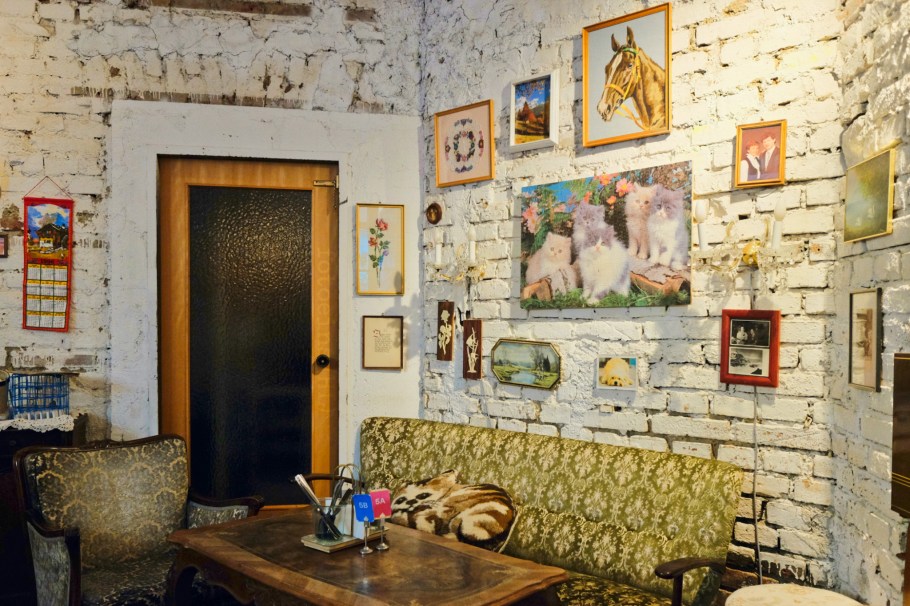
On a warm June day in 2022, I’m sitting in the basement of someone’s family home, lovingly decorated over decades by Omas and Opas. In Vienna’s 4th district, the idea behind Vollpension cafe is retirees do all the baking.
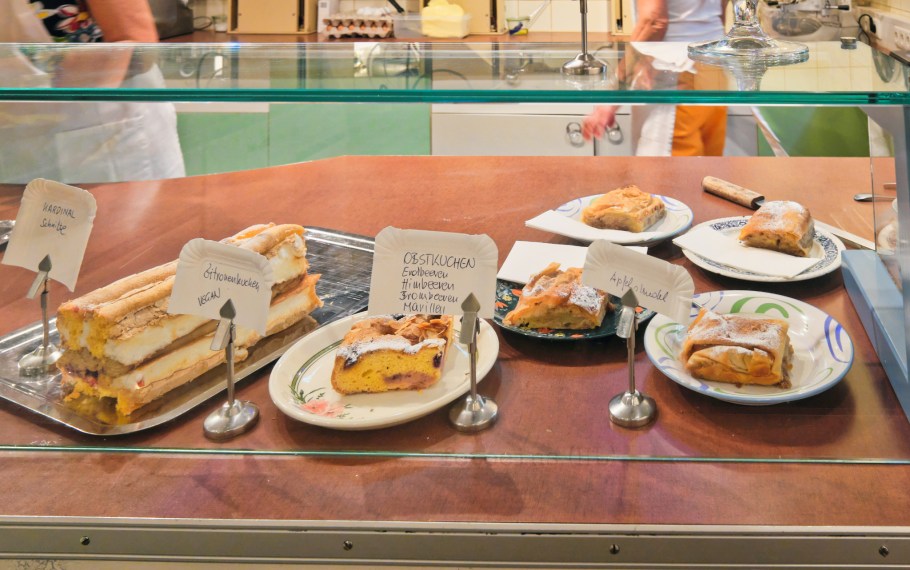
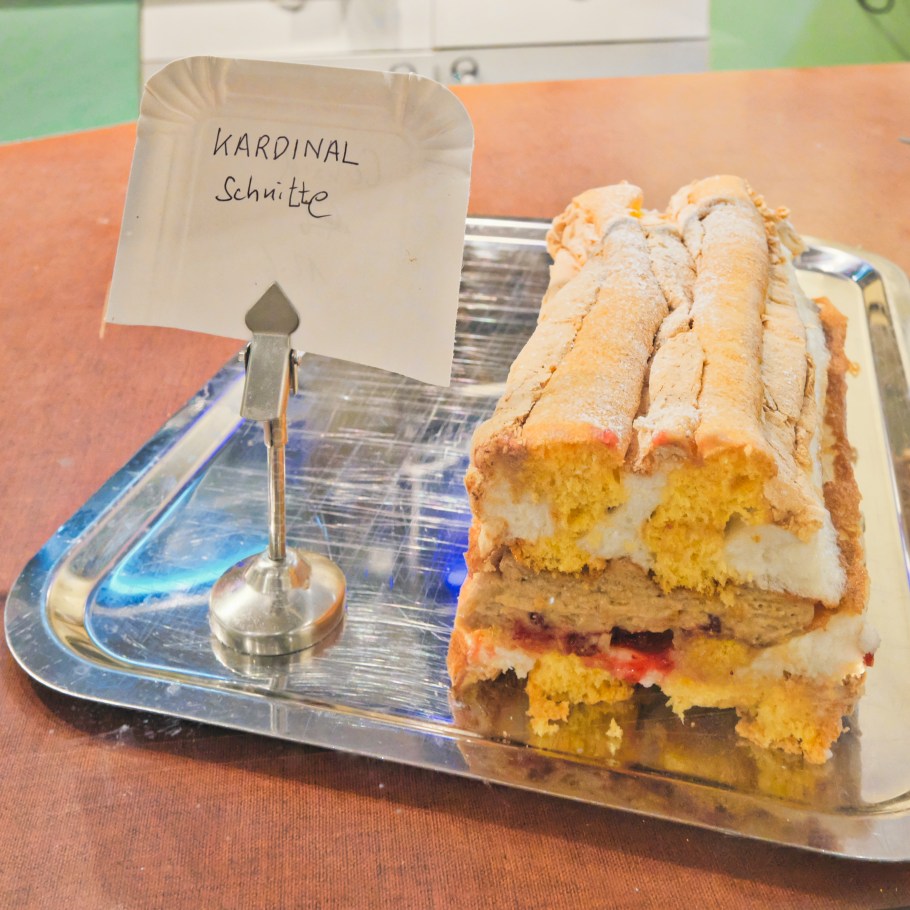
Upon arrival, a host seats me at a table where I’m presented with a “menu card” listing combination- and timing-options. Unlike other cafes in the city, one does not hang out or loiter here for hours, and that means there’s a maximum stay-duration for a specified combination purchase; that’s fine by me, as I choose one of the cake-and-beverage options. The server leaves to retrieve my cool drink, while I go up to the front counter and gauge the remaining options on Sunday mid-afternoon. I want something light on this warm late-spring day: Kardinalschnitt, made with sponge cake, meringue, and fruit jam. I order a slice of Kardinalschnitt mit Schlagobers (with whipped cream). Behind the counter is a kindly Oma to whom I relay in passable German I came all the way from Canada’s west coast to see this place. That impressed her enough that she asks me to come back for a 2nd but smaller piece.
There’s a good mix of ages among the staff. I chat briefly with one of the servers about what it’s like to work here at the café, the guests they’ve seen from different countries, and their favourite cake. Among some of the retired pensioners in house today, I have an additional conversation with a gentleman who has spent time with his family in Vancouver, Canada.
At the outset, some Viennese or Austrians might not seek this place out, although I can tell from surrounding conversations how much Viennese-German is being spoken. At any rate, this place works for me, and if I barely knew my grandparents, I can perhaps get a good taste and long look at life with Austrian grandparents, here at Vollpension in Vienna.
( Towards the end of this post is a 1-minute iPT6-video with a look inside the café. )
Inside Vollpension (X70).
Table 5 (X70).
Tables 6 and 7 (X70).
Table 8 (X70).
Front counter with daily offerings (X70).
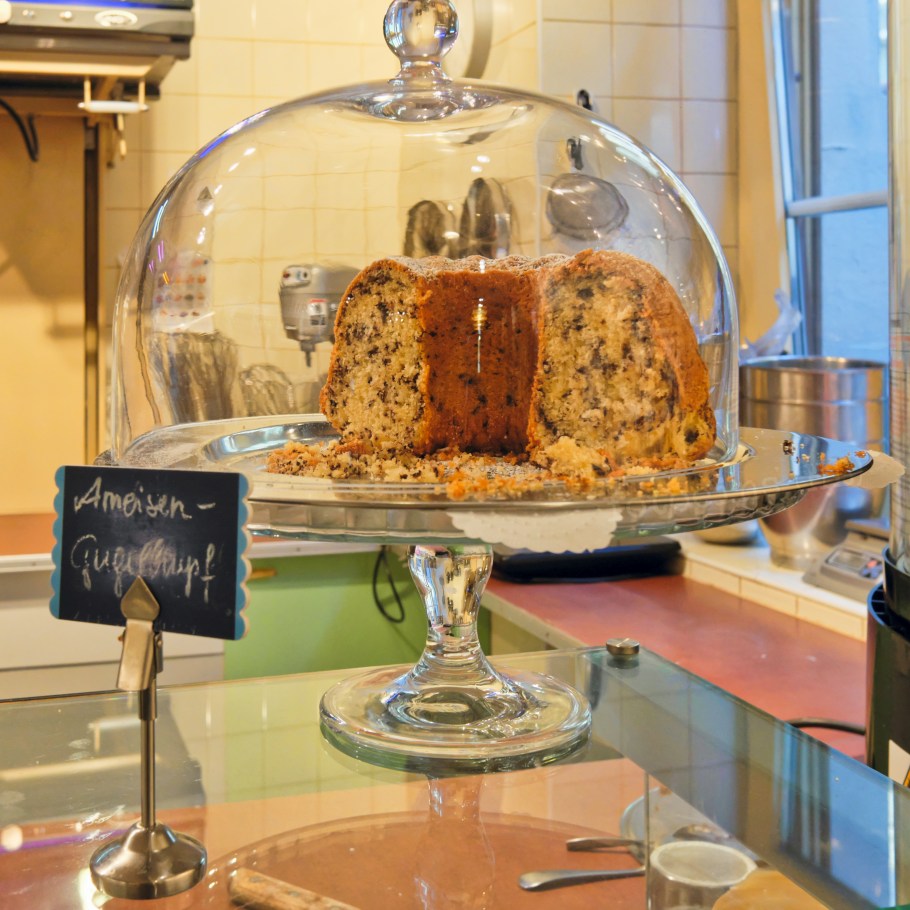
Ameisen-Gugelhupf / Bundt cake with chocolate chips. No “Ameisen” (ants) were harmed or included in the cake-making process (X70).
Topfentorte / cream-cheese torte (X70).
Kardinalschnitte, made with sponge cake, meringue, and fruit jam (X70).
2nd, complimentary, but smaller slice of Kardinalschnitte, accompanied by cool unsweetened non-alcoholic lemon spritzer (X70).
Directions
Vollpension is centrally located on Schleifmühlgasse 16 with a second location at the MUK Wien (Music & Arts University of Vienna). Smaller versions of Vollpension might “pop up” elsewhere in the city during the summer season.
Public transport with Wiener Linien: in between U1/(U2)/U4 Karlsplatz and U4 Kettenbrückengasse; bus 59A to stop Schleifmühlgasse; or tram 1, 62, or Badener Bahn to stop “Paulanergasse.”
My independent visit to Vollpension was neither requested nor supported. I made all images above on 22 May and 12 Jun 2022 with an Apple 6th-generation iPod Touch (iPT6) and Fujifilm X70 fixed-lens prime (X70). This post appears on Fotoeins Fotografie at fotoeins DOT com as https://wp.me/p1BIdT-n7U.
Above/featured: Examples of the “Ringstraßenstil” historicism style at Maria Theresa Square, with Maria Theresa Monument at left and the Museum of Natural History at right. Photo, 15 May 2022 (X70).
• Can a street alone define its surrounding architecture?
• Do the buildings themselves establish the street’s visual impression?
• Is Vienna (un)fairly defined by the Ringstrasse and the inner city?
The answers, as always, are a little complicated.
Like many, I’m also fond of Vienna’s Ringstrasse (Ring Road), as a kind of “hello” and re-introduction to the city after my first visit in 2002. At 5 kilometres in length, the Ringstrasse is one of the longest streets in Europe, longer than the nearly 2-km Champs-Élysées in Paris and longer than the 4.5-km Nevsky Prospekt in St. Petersburg. The boulevard is surrounded by Prachtbauten (buildings of splendour), constructed in the architectural style of “historicism,” a big nod to classic “forms” reflecting structural “functions”. The late-19th century “Ringstrassenstil” (Ring Road architectural style) continued the practiced habit of choosing a historical style which best identified with the purpose of the building. For example, the Neo-Baroque architectural style is represented in the Civic Theater; the Neo-Classical style in the Parliament and New Palace; the Neo-Gothic style in City Hall and the Votive Church; and the Neo-Renaissance style in the museums, palatial mansions, Opera House, and the University.
On Christmas Day 1857, the Wiener Zeitung newspaper published an imperial decree written 5 days earlier (on 20 December) by Habsburg emperor Franz Joseph I. He ordered the demolition of the inner-city wall and the subsequent creation of a circular boulevard, bordered by grand buildings and filled with green spaces. The large outward extension of the inner city changed and influenced the urban development of Vienna, still seen to this very day.
It is my will that the extension of the inner city of Vienna should proceed as soon as possible, providing for appropriate connections between the city and the suburbs as well as the embellishment of my imperial residence and capital. To this end, I authorise the removal of the walls and fortifications of the inner city as well as the ditches around it …
– Emperor Franz Joseph I: 20 Dec 1857, published 25 Dec 1857.
On 1 May 1865, Emperor Franz Josef unveiled the Ringstrasse in an official ceremony, even though large areas remained under construction. Ringstrasse structures included the religious and the secular, as well as the public and the private. The Ringstrasse symbolized the power of the imperial state, and the growth of a new arts and culture scene with the increasing popularity of coffee houses.
It’s also important to note the architectural impact made by the Jewish middle- and upper-class to integrate within the Habsburg empire. For example, the families Ephrussi, Epstein, and Todesco commissioned architect Theophil Hansen to construct palatial mansions as visible manifestations and partial realization of the dream of many Viennese Jews: assimilation into and emancipation within Viennese society. (Viennese journalist and political activist Theodor Herzl might have had a different opinion about that.)
For residents and long-term visitors today, it’s entirely possible to fit into the unintended shape and mentality of the “modern” city: that the inner-city wall was simply replaced by a different wall of “economic class”, that the architectural callback to historicism “freezes” the inner-city in time, and that like many, I can live, traverse, and work in the outer districts and avoid entering the inner city.
For short-term visitors today, the Ringstrasse buildings form a golden shiny “ring” around the “fingers” of the U1 and U3 metro lines traversing through the UNESCO World Heritage inscribed inner-city. For these visitors, all that’s needed for their limited time in Vienna is the inner city.






 Fotoeins Fotografie