New Zealand: sounds of a sunset on the South Island
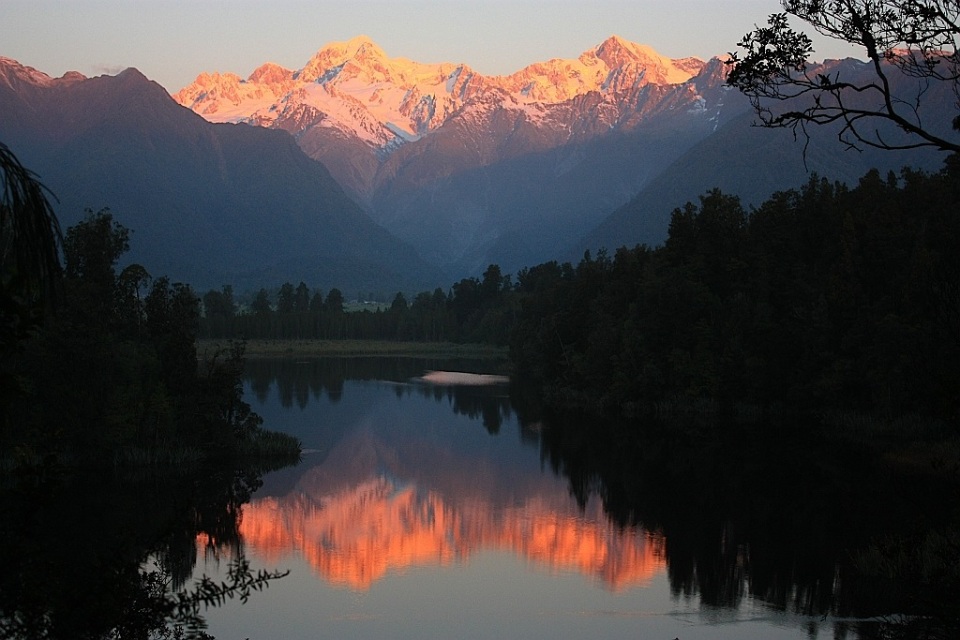
What does a sunset sound like?
Does the question make any sense at all?
How can a sunset “sound” like anything?
I used to think that way, until I visited the South Island in New Zealand.
Links to photography blogs, information, sites
What does a sunset sound like?
Does the question make any sense at all?
How can a sunset “sound” like anything?
I used to think that way, until I visited the South Island in New Zealand.
The calendar page flips over to the 14th of July (2012).
I’ve spent a quiet week with friends in Wellington, New Zealand, and it’s time I head south to see Te Wai Pounamu or the South Island for the first time. My first destination is Christchurch, and I could fly there. But I’m in no hurry, and I want to experience the scenery route with a ferry across Raukawa Moana, otherwise known as Cook Strait.
I’ve arranged passage from Wellington on the North Island (Te Ika a Maui) to Christchurch on the South Island with ferry- and coach-service with KiwiRail. The journey begins with the Interislander ferry whose arrival is timed to match the departure time of the Coastal Pacific train leaving Picton for Christchurch.
Devastating bushfires in the 2020 Australian summer (December 2019-March 2020) wiped out a significant fraction of flora and fauna on Kangaroo Island. For many plant and animal species, recovery will require years to decades.
Kangaroo Island in South Australia was named for the large number of kangaroos, which were a source of fresh meat for the crew of the British ship HMS Investigator in 1802. The ship was captained by Matthew Flinders, who was tasked to chart the southern Australian coastline. Desperate without fresh supplies for months, Flinders named the island in gratitude for the abundance of roo meat.
Then again, the indigenous name for the island is “Karta” or “Island of the Dead.” That’s a little sinister, as something must have happened; either the aborigine population left the island or they died out.
But life bounces back, and there’s plenty of it on this island.
There are plenty of sheep where on grassy meadows, seals at Kingscote Jetty, young and adult seals relaxing and sleeping in the sun at Admirals Arch, free-climbing koala bears and free-roaming kangaroos at the Hanson Bay Wildlife Sanctuary, Ligurian honey bees at Clifford’s Honey Farm, and a lone echidna by the side of a dirt road in the middle of the island.
In making these photos, I used my long-zoom lens; no animals were harmed, poked, prodded, or ridiculed in the process.
Above: Black Cat catamaran.
It’s a cool grey morning in Christchurch, and I’m waiting outside the Canterbury Museum for a ride to Akaroa. Will the conditions improve by the time I arrive?
I’ve signed up with French Connection for the shuttle between Christchurch to Akaroa along State Highway 75. As the bus rolls onto the Banks Peninsula, the undulating hills gently rise and fall around the entire horizon. Some of the secluded bays and harbours look steep enough to have been carved by mini-glaciers. It makes a lot of sense, as Akaroa means “long harbour” in Kāi Tahu Māori.
It’s easy to forget Akaroa has French history and roots, but I realize I’m standing on top of an extinct volcano which last saw activity about 6 million years ago. Over time, weather eroded and gradually removed the top layers of the volcano. The post-glacial meltdown about 15,000 years ago saw the sea-levels rise and subsequently inundated the former caldera. It’s not the only extinct volcano around, as the nearby Lyttleton harbour was formed in a similar way.
I decide to go with a nature cruise on Black Cat cruises, and the catamaran heads out with six passengers and two crew. Within 30 minutes of leaving the dock in Akaroa, the skies clear as the breeze breaks and moves the clouds aside. Finally, in the open waters of the Pacific, the boat bobs gently in the light swell.
It’s a perfect sunny winter day, complete with the appearance of a pod of Hector’s dolphins and a couple of yellow-eyed penguins (hoiho).
But all too quickly, the cruise returns to the calm waters of the inner harbour, and the ship comes to a halt back in Akaroa. I’ll doze on the ride back to Christchurch, with lingering memories of the former volcano, and the dolphins who said hello to us earlier in the day.

Akaroa is a small, quiet, charming town with colonial-architecture of both English and French stylings. Located about midway down the east coast of New Zealand’s South Island, Akaroa can be reached by car from Christchurch in about an hour. For many, the trip will definitely take longer with required stops in Birdings Flat, Little River, Hilltop, and Duvauchelle.
In the race to claim sovereignty over New Zealand (even though the Maori were present for much longer), Akaroa was claimed by both English and French in 1840. Upon their arrival on the ship Britomart, the English won the “claims race” by a couple of weeks (or a couple of years, depending upon the definition of “claim”).
However, the French influence remains strong on this side of the planet. Even if the antipode to Akaroa lies near France, you’ll see from the photos below that the signs do not lie and help keep alive the spirit of the little French town or “la petite ville française”.
It doesn’t stop with just European history. A daytrip to Akaroa isn’t complete with a trip out into the harbour.
 Fotoeins Fotografie