I’m standing in the warm ocean breeze, with rustling palm trees and crashing ocean surf for company. My friend appears from around the corner, and she tosses me a look before breaking out to a smile; I must be sporting a ridiculous gobsmacked expression.
New land laid with volcanic lava takes days, weeks, even years; but breaking the land down takes millions of years. Even with abundant foliage as partial deterrents, the absolute power of moving water and the unstoppable process of erosion must produce the inevitable; the hardest of rock gets pounded into submission, broken and ground down to fine particles of sand. But all that fun geology is forgotten in this rural idyll next to the open ocean, and it’s a big reason why about 600 people make this place their home.
On the Big Island of Hawaii, the drive on the number 19 Mamalahoa Highway north from the state capital city of Hilo turns northwest along the Hāmākua Coast. The scenery becomes a mix of grassy meadows along the descending flank of the Mauna Kea volcano, accompanied by deep gulches and steep cliffs dropping into the Pacific Ocean.
The word Laupāhoehoe means “a flat or tip of smooth lava” for the tip of land that sticks out into the water. At its peak in the late 19th- and early 20th-century, more than two thousand people lived in the town, self-contained with a school, stores, and a hospital. Taro root farms, cane plantations, and the Laupāhoehoe Sugar Factory (1880) provided employment and the local economy. Factory operations ceased in the mid-1990s, bringing a century of sugar-making along the island’s east coast to an end.
On 1 April 1946, a strong earthquake occurred inn the Aleutian islands on the Alaska coast. The resulting tsunami swept across the Pacific Ocean, and arrived at Hawaii at about 7am local time1. Waves up to 15 metres (50 feet) high hit the Big Island, creating widespread damage and killing over 150 people in total. At Laupāhoehoe, multiple waves struck, wiping out the only rail link to Hilo, and causing property damage; over 20 died, drowned, or went missing. After the tsunami, the school and houses moved back and further up the slope. The loss and subsequent abandonment of the rail line connection to Hilo meant a loss of transport, shipping, and tourism; the town population never recovered to the numbers in its heyday. The 1946 tsunami’s reach, power, and resulting destruction raised calls for an early warning system, and by 1949, the Pacific Tsunami Warning Centre was in operation in Hawaii.
Near the shoreline is a memorial to those who perished in 1946. Not far from the memorial, someone has jammed a fishing pole between rocks next to the breakwater. Life continues here, slowly and surely. The warm breeze still comes onshore, fallen palm fronds lay scattered on the beach, and ocean meets beach in a wet foamy crash.

Memorial to the perished at the 1946 tsunami (picture by
Wmpearl for Wikipedia, CC1 license).

From Laupāhoehoe Point: east-southeast towards Welokā (centre) and Pāpa’Aloa. (centre-right)

Built in 1983 by the US Army Corps of Engineers, this breakwater consists of concrete tetrapod wave-breakers.
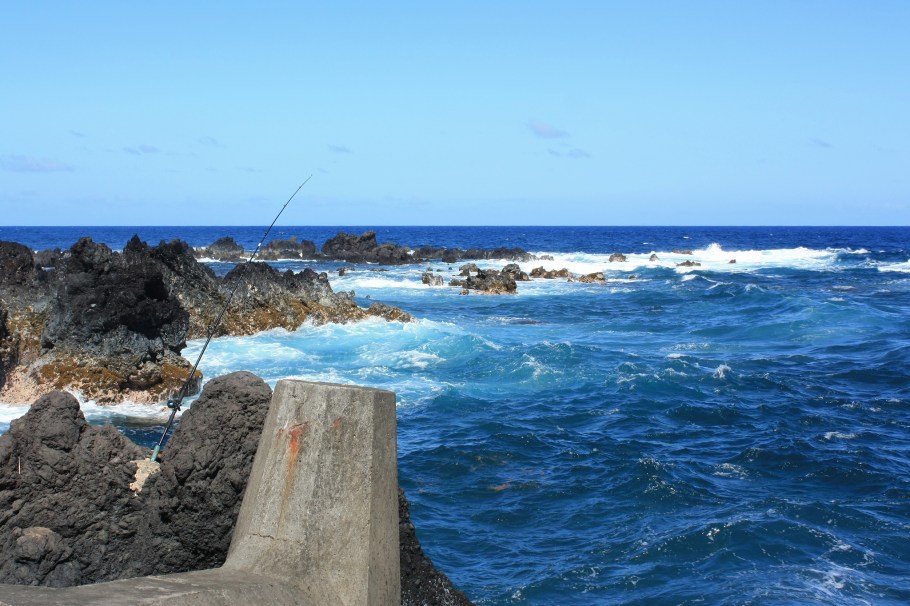
Life in the harbor.

1With Google Maps, the distance from Scotch Cap at the southwest tip of Unimak Island in the Alaskan Aleutian Islands to the northern tip of the Hawaiian island of Oahu is about 3700 kilometres (2300 miles). After the 1946 earthquake in Alaska, tsunami waves arrived at Hawaii about 5 hours after the earthquake, making the “surface speed” 740 kilometres per hour (460 miles per hour) which is consistent with general speed estimates. The Pacific Tsunami Warning Center created a model animation for the 1946 earthquake, and the video animation is on YouTube.
With one exception, I made the other photos on 21 January 2012 at the beginning of my year-long RTW. Thanks to MK for guiding me to new and unseen (for me) parts of the Big Island. This post appears on Fotoeins Fotografie at fotoeins.com as http://wp.me/p1BIdT-9jx.
19.993280
-155.240789


 Fotoeins Fotografie