Fotoeins Fotografie

location bifurcation, place vs. home

Posts from the ‘Night Photography’ category

My Fuji X70: Monochrome Red (XTrans2 recipe)

Above/featured: Gateway Gardens station, Frankfurt am Main – 11 May 2023.

The Fujifilm X70 mirrorless fixed-lens prime camera has added a lot to my approach to photography for projects in both domestic and international scope. To satisfy my curiosity about Fujifilm’s analog-film simulation (film-sim) recipes for varying “looks” and “palettes” applied to images, I’ve provided examples of X70 images with these recipes:

•   CineStill 800T
•   Ektachrome 100SW (saturated warm)
•   Fujichrome Slide
•   Kodachrome 64
•   Kodacolor
•   Kodak Platinum 200

I examine the Monochrome+R film-simulation recipe, which Ritchie Roesch describes in Fuji X Weekly:

… Back when I shot black-and-white film, I usually used a color filter to manipulate the shades of grey, and for landscape photography the Red filter was my most-used option. You cannot use these filters on your Fujifilm camera, but Fujifilm does provide you with three faux filters: +Y, +R, and +G. These mimic the aesthetic of using a Yellow, Red, or Green filter (sort of). In my opinion, +R doesn’t actually replicate the use of a Red filter very well; it’s more like an Orange filter. This recipe is intended to produce a look more similar to a Red filter on black-and-white film, which means that it will darken blues and lighten reds.

This recipe is for the X-Trans II sensor. My X70 settings are:

  • “Monochrome+R” built-in film-sim
  • Dynamic Range: DR400
  • Color: —
  • Sharpness: +1 (Medium-Hard)
  • Highlight: -1 (Medium-Soft)
  • Shadow: +2 (Hard)
  • Noise Reduction: -2 (Low)
  • White Balance: Fluorescent1 (day); -4 Red, +7 Blue
  • ISO: Auto, up to 6400

I had assigned this recipe as “general black and white”, with which I experimented in a variety of locations and settings. The following images are almost straight-out-of-the-camera; only adjustments to brightness level and size (2048 by 1365 pix) have been applied, with no corrections to colour, contrast, geometric distortion, or rotation.

( Click here for images )

My Fuji X70: CineStill 800T (XTrans2 recipe)

Above/featured: Archangel Michael dispatching the devil: St. Michael’s Church, Vienna – 1 Jun 2023.

The Fujifilm X70 mirrorless fixed-lens prime camera has added a lot to my approach to photography for projects in domestic and international scope. To satisfy my curiosity about Fujifilm’s analog-film simulation (film-sim) recipes for varying “looks” and “palettes” applied to images, I’ve provided examples of X70 images with these recipes:

•   Ektachrome 100SW (saturated warm)
•   Fujichrome Slide
•   Kodachrome 64
•   Kodacolor
•   Kodak Platinum 200

Here I show images made with the “CineStill 800T” recipe, which Ritchie Roesch describes in Fuji X Weekly:

… CineStill 800T is Kodak Vision3 500T motion picture film that’s been modified for use in 35mm film cameras and development using the C-41 process. Because it has the RemJet layer removed, it is more prone to halation. The “T” in the name means tungsten-balanced, which is a fancy way of saying that it is white-balanced for artificial light and not daylight. … Even though the film that this recipe is intended to mimic is Tungsten-balanced, the recipe can still produce interesting pictures in daylight. It’s a versatile recipe, but it definitely delivers the best results in artificial light.

The recipe is for the X-Trans II sensor; the settings on my X70 are:

  • “Pro Neg Std” built-in film-sim
  • Dynamic Range: DR400
  • Color: -1 (Medium-Low)
  • Sharpness: 0 (Medium)
  • Highlight: +2 (High)
  • Shadow: +1 (Medium-High)
  • Noise Reduction: -2 (Low)
  • White Balance: 4300K; -3 Red, -3 Blue
  • ISO: Auto, up to 3200

I assigned this recipe for the “nighttime” setting as 1 of the 7 camera’s custom presets, but I also experimented in daylight at a variety of locations. The following JPG images are “almost” straight-out-of-the-camera; only adjustments to brightness level and a crop to a predefined image size have been applied, with no corrections to colour, contrast, geometric distortion, or rotation. I agree with Roesch’s statement about getting “best results” after dark in artificial light, but I got some interesting images in daylight as well.

( Click here for images )

Vienna: Lichtzeichen testament to Jewish presence

Above/featured: Lichtzeichen number 10 (Stumperschul) in the city’s 6th district. Photo, 28 May 2022.

From a distance, the light seems suspended in mid-air.

Closing the distance widens my realization: it’s an illuminated sculpture that has a curved warped shape on top. That’s also when understanding narrows into sharp focus when I stand directly underneath: the shape “straightens” out, revealing itself as a Star of David.

Lichtzeichen Wien (LZ) consists of 26 structures in the Vienna region, marking former locations of synagogues, schools, temples, and prayer rooms destroyed by the Nazis in the pogrom of November 1938. During the night of 9–10 November 1938, the Nazi regime organized and carried out a systematic attack against the Jewish population in Germany and Austria. The rampage in Vienna continued for several days; most of the city’s synagogues, temples, and prayer-halls were destroyed.

Launched by the Jewish Museum Vienna and Austrian artist Brigitte Kowanz, an urban memorial project by joint collaboration of the Jewish Museum Vienna and the University of Applied Arts Vienna consists of identical columns, designed by artist Lukas Kaufmann. The commemorative project is called “Ot” (אות), which means “symbol” in Hebrew. Each “light column” sculpture stands about 5-metres high with a star of David, and includes the name of the former Jewish structure and an accompanying QR-code. Official unveiling of the memorial project occurred in 2018 on the 80th anniversary of the 1938 pogrom.

I visited and photographed all 26 Lichtzeichen locations in Vienna over a period of three summers in 2022, 2023, and 2024.


( Click here for images and more )

Wien Museum, Otto Wagner Pavillon Karlsplatz, 4. Bezirk, Weiden, Wien, Vienna, Austria, Österreich, fotoeins.com

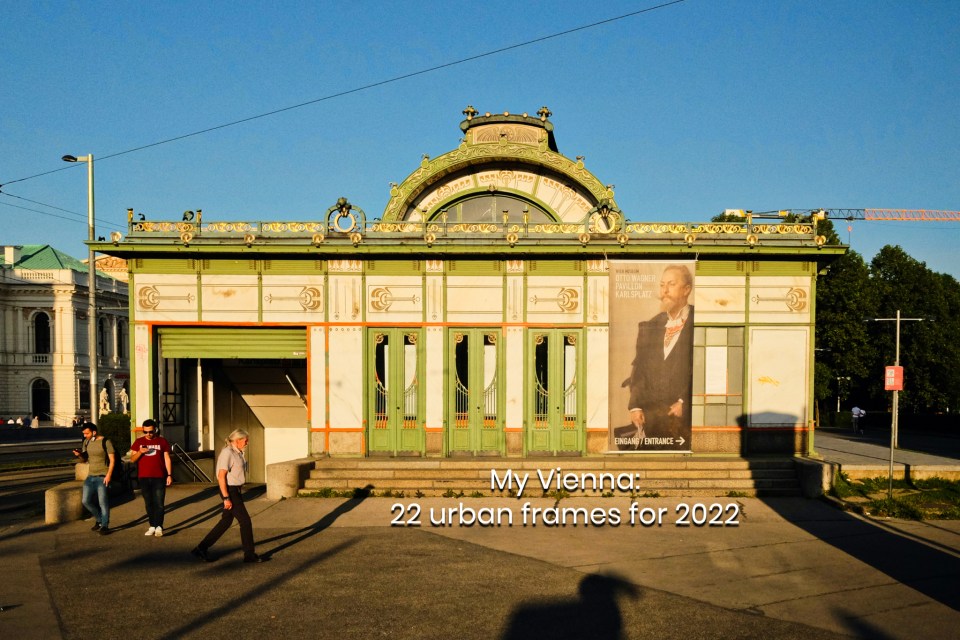
Vienna: 22 urban frames for 2022

Above/featured: “The first Sunday.” Karlsplatz, 1st district – 15 May 2022.

Earlier in the year, I spent four weeks in Vienna, soaking in late-spring and early-summer weather in Austria’s capital city. I highlighted 3 images and scenes which in addition to time spent left personal impressions. Below, I highlight in a “last chance effort” an additional 22 visual examples of the urbanity in Wien, folding in splashes of colour, lines of focus, and accessibility to good timing.


( Click here for images and more )

My Berlin: the buried Bibliothek at Bebelplatz

On a clear cool late-autumn morning, a young child is looking through an opening in the cobblestone plaza. She looks up to the man standing next to her.

“Daddy, why is there a glass window? What happened here?”

The thing to keep in mind is that this square in Berlin is called Bebelplatz (BAY-buhl-platz), and not Babbleplatz. It’s easy to make the mistake. After all, a great repository of books was once created inside the building seen above, in what was once home of the Königliche Bibliothek or Royal Library.

But then came along a large racist blather.

Accompanied by a big ugly fire.

( Click here for images and more )