Fotoeins Fotografie

location bifurcation, place vs. home

Posts from the ‘Night Photography’ category

My Berlin: Wrapped Reichstag at night, 30 years on

Above: “Wrapped Reichstag 1995–2025” light show.

In 1995, the artist duo Christo & Jeanne-Claude carried out a bold but contentious project by covering Berlin’s landmark Reichstag parliament building. Plans for the project had taken over 20 years, even though the artwork had always meant to be temporary and all expenses had been covered without corporate sponsors. Over 5 million visited in a period of 12 days in the summer of 1995 to look at the undulating “silver dream” in the German capital city. The timing was ideal. After reunification of the two Germanys in 1990, the new home of the federal parliament would be Berlin’s Reichstag. Renovations to the building began in the autumn of 1995 with the federal parliament opening in the spring of 1999.

From 9 to 22 June 2025, the Reichstag building was illuminated nightly with a light show in a 30-year anniversary tribute to the famous 1995 artwork. In a 20- to 30-minute cycle, the light-show appeared to first envelop the building in silver fabric. The fabric cover flapped in artificial breeze, before the cover lost its shape and fell onto the ground at the base of the building. The free-of-charge light show began shortly after sunset at about 930pm and continued until 1am. Whatever Christo and Jeanne-Claude chose to cover and transform, their art works posed questions of perception, origins, shape, functionality, and permanence.

•   DW: Germany Arts
•   Visit Berlin


( Click here for images )

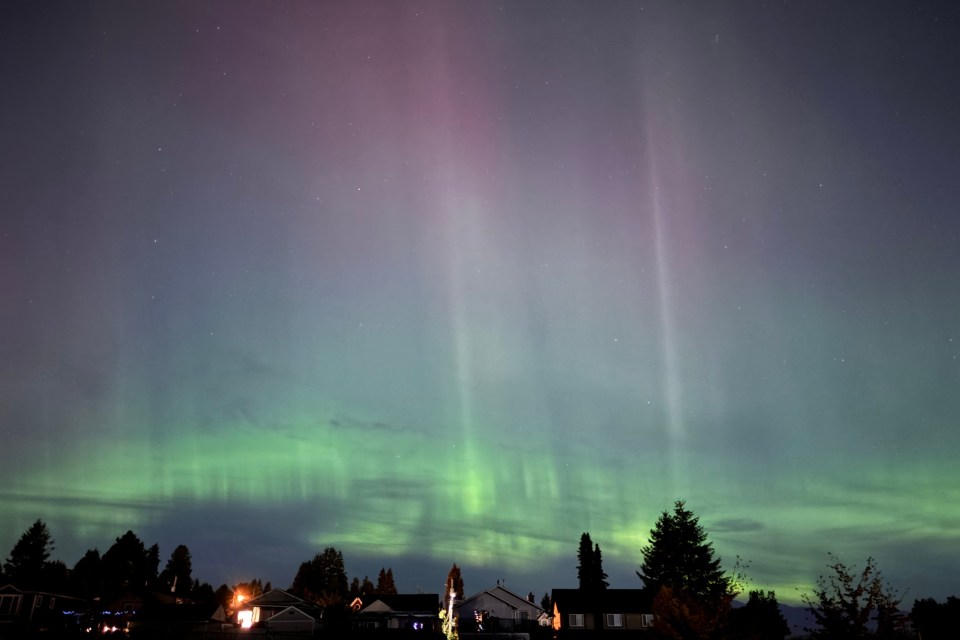
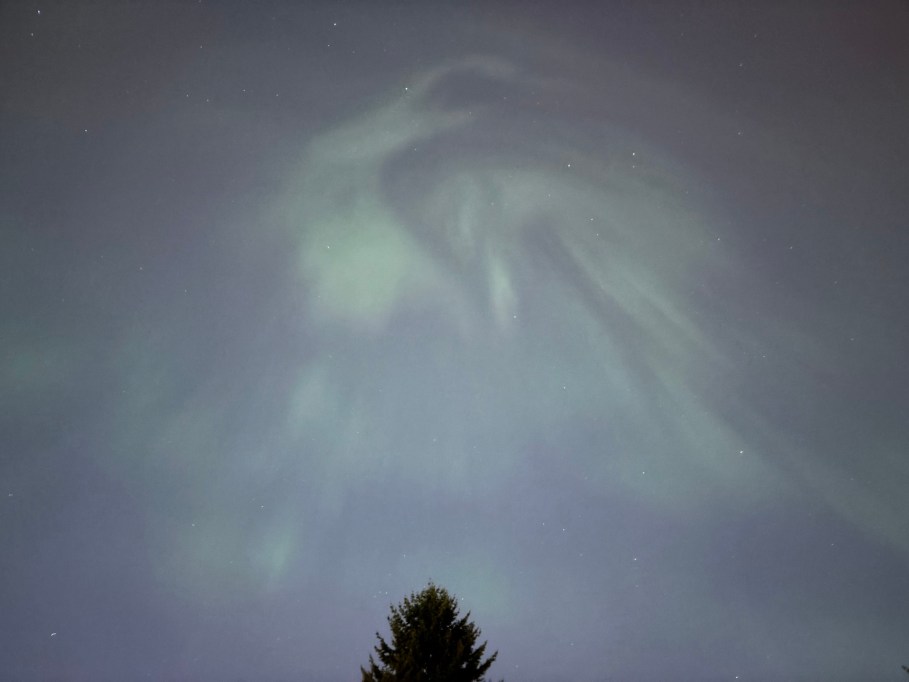
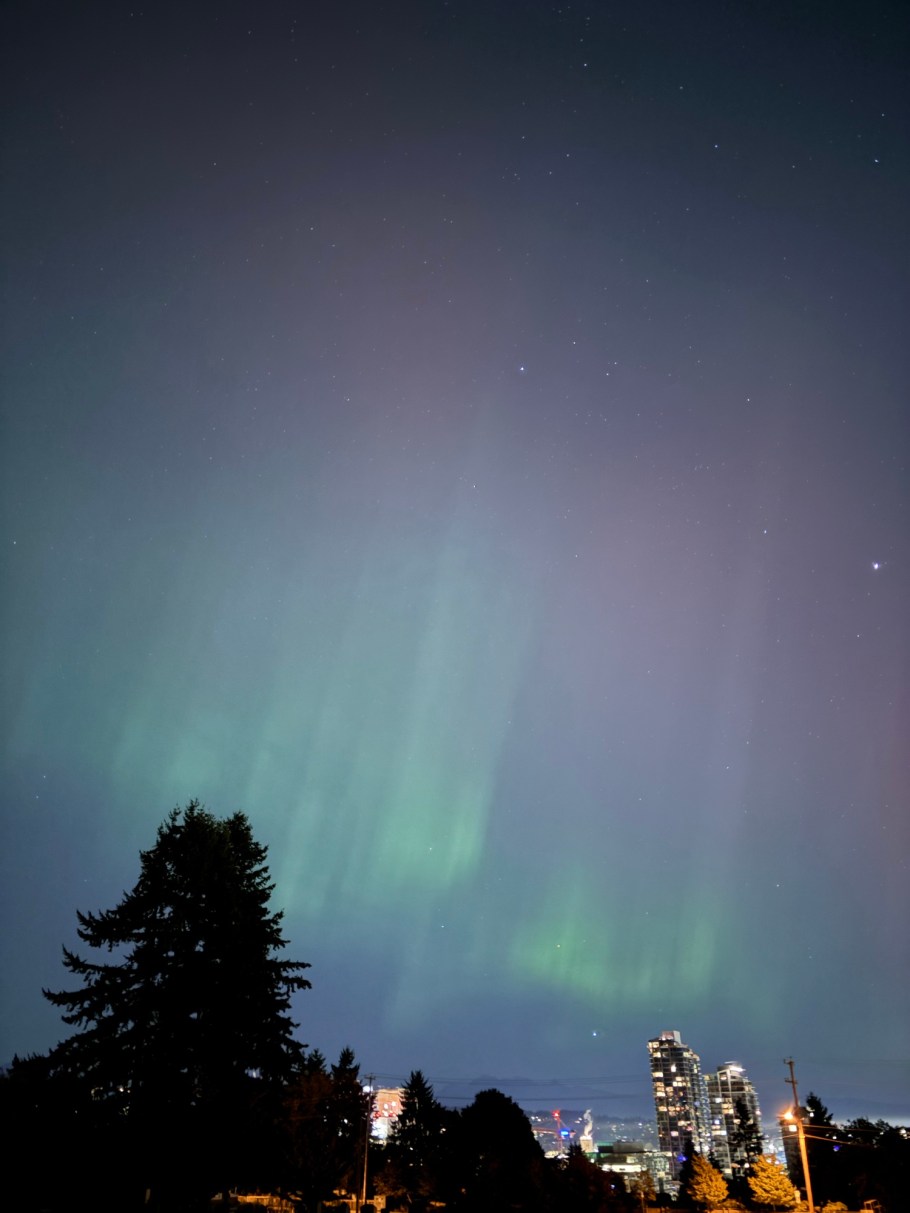
Aurora borealis, 49°N (11 Oct 2024)

Northern lights over New West

Notices quickly went out, even saw alerts from scientists whom I follow on social media. Big solar storm detected, big aurora display expected.

The colours: reds & blue-greens for oxygen & nitrogen, respectively.

Structure: pillars, curtains, wavy strands.

Location: New Westminster, BC 🇨🇦 ; 49.2° North, 122.9° West.

Time: from about 12am to 1am PDT (7 to 8h UTC), on 11 October 2024.


Northwest horizon, 0003h PDT. Visible: Vega (Lyra), Draco, Ursa Minor.
Northwest horizon, 0004h PDT.
East horizon, 0010h PDT. Visible: Jupiter, Aldebaran (Taurus), Pleiades, Cetus, Orion.
Overhead “radiant”, 0016h PDT.
Northeast horizon, 0027h PDT. Visible:
East horizon (towards the Port Mann Bridge), 0030h PDT.
Northeast horizon, 0039h PDT.
Northern horizon, 0045h PDT.

I made all photos above with an iPhone15 on 11 Oct 2024. This post composed with Jetpack for iOS appears on Fotoeins Fotografie at fotoeins DOT com.

24T22 A look at Hamburg port-harbour (T18)

E21 (E17)

Travel day 22 is wiped out because not only is there heavy rain, but I need to put down a hacking cough that’s clung on the last couple of days. Thankfully I had the foresight of getting a comfy apartment weeks ago, and picking up groceries at the nearby shop and some medicine at the apothecary yesterday.

This is an opportunity to look back at the evening return on travel day 18 of the Halunder Jet catamaran, from Heligoland to Hamburg.

The cool open breezes over the North Sea have been left behind for the Elbe. The return voyage brings us back into Hamburg’s river harbour and its bustling port facility by the fading light of a warm late-spring day. From childhood proximity to the Port of Vancouver, I’ve always been fascinated by the sights, shapes, and sounds from a harbour and port facility.

The city-state of Hamburg celebrated the 835th anniversary of its harbour in 2024.


The port of Hamburg is Germany’s largest seaport facility. By TEUs (20-foot container equivalent units), Hamburg is 3rd in Europe, after Antwerp and Rotterdam; and in the world’s top-20.
2009 container ship “Le Havre Express” (IMO 9332872, MMSI 636093082) registered in Monrovia, Liberia.
2017 container ship “Delphis Riga” (IMO 9780665, MMSI 477234800) registered in Hong Kong.
2010 Concordia-class cruise-ship “Costa Favolosa” (IMO 9479852, MMSI 247311100) registered in Genoa, Italy. Maximum passenger and crew totals at almost 5000.
From left to right a sweeping view of St. Michael’s Church, St. Pauli’s Landungsbrücken (“jetties”) public ferry docks, and Elbe Philharmonic Hall.

I made all images above with an iPhone15 on 25 May 2024 (T18). This post composed with Jetpack for iOS appears on Fotoeins Fotografie at fotoeins DOT com.

A mobile test

This Heading is H4

I’ve always wondered what it’d be like to create a post on mobile, independently of laptop or desktop. The present example is a text block that goes before an image.

“The Sappers were here” (www); photo on 13 Apr 2024 (iP15). Example of inserted image block.

This is an example of a text block after an image; in this case, it’s at night across Brunette Avenue from Sapperton SkyTrain station in New Westminster, BC.

While I might add a few thoughts about image and context of its time and place, further lack of customization (e.g., access to shortlink, modified edit-defaults via desktop, etc.) emphasizes the simplicity to the swift overall process of content creation and snobbery by sidestepping users’ own creative process to content creation.


I made the image above with an iPhone15 on 13 April 2024. Composed entirely within Jetpack for iOS, this post appears on Fotoeins Fotografie at fotoeins DOT com as https://wp.me/p1BIdT-siu.

My Fuji X70: Monochrome Red (XTrans2 recipe)

Above/featured: Gateway Gardens station, Frankfurt am Main – 11 May 2023.

The Fujifilm X70 mirrorless fixed-lens prime camera has added a lot to my approach to photography for projects in both domestic and international scope. To satisfy my curiosity about Fujifilm’s analog-film simulation (film-sim) recipes for varying “looks” and “palettes” applied to images, I’ve provided examples of X70 images with these recipes:

•   CineStill 800T
•   Ektachrome 100SW (saturated warm)
•   Fujichrome Slide
•   Kodachrome 64
•   Kodacolor
•   Kodak Platinum 200

I examine the Monochrome+R film-simulation recipe, which Ritchie Roesch describes in Fuji X Weekly:

… Back when I shot black-and-white film, I usually used a color filter to manipulate the shades of grey, and for landscape photography the Red filter was my most-used option. You cannot use these filters on your Fujifilm camera, but Fujifilm does provide you with three faux filters: +Y, +R, and +G. These mimic the aesthetic of using a Yellow, Red, or Green filter (sort of). In my opinion, +R doesn’t actually replicate the use of a Red filter very well; it’s more like an Orange filter. This recipe is intended to produce a look more similar to a Red filter on black-and-white film, which means that it will darken blues and lighten reds.

This recipe is for the X-Trans II sensor. My X70 settings are:

  • “Monochrome+R” built-in film-sim
  • Dynamic Range: DR400
  • Color: —
  • Sharpness: +1 (Medium-Hard)
  • Highlight: -1 (Medium-Soft)
  • Shadow: +2 (Hard)
  • Noise Reduction: -2 (Low)
  • White Balance: Fluorescent1 (day); -4 Red, +7 Blue
  • ISO: Auto, up to 6400

I had assigned this recipe as “general black and white”, with which I experimented in a variety of locations and settings. The following images are almost straight-out-of-the-camera; only adjustments to brightness level and size (2048 by 1365 pix) have been applied, with no corrections to colour, contrast, geometric distortion, or rotation.

( Click here for images )