
Fotoeins Fotografie

location bifurcation, place vs. home

Posts from the ‘Mountains’ category

Freistaat Bayern, The Free State of Bavaria

Bavaria: 100 years of statehood (2018)

Featured image: The blue and white diamonds (fusils) are a familiar Bavarian symbol, adopted in the late 13th-century by the Wittelsbach family who ruled Bavaria from 1180 to 1918.

As a product of the coastal and mountainous Canadian Southwest, I always feel the pull exerted by the Bavarian Alps regardless of where I am in Germany; it’s been this way over the past 18 years. But there’s more to Bavaria than fairytale castles, Oktoberfest, and BMW, although they’re spot on for the Wurst (sausage). And frankly, there’s a ton more to Germany than Bavaria, but that’s one of many reasons for this entire blogsite after all.

Located in southeast Germany, Bavaria includes more than a half-dozen World Heritage Sites, the pre-Easter Fasching/Fastnacht festival, the sight of Audis on the Autobahn, over one thousand years of wine-making in Franconia, and violin-making since the late 17th-century, among many things to explore, eat, and experience.
( Click here for more )

Zugspitze: spotting the Alps across 5 nations

“If I’m at the highest point in Germany, can I see Italy?”

Over the years, I’ve seen at various times the claim made about seeing Italy from the tallest mountain in Germany.

I’m startled by the winter morning sun, streaming through the window into my hotel room in Garmisch-Partenkirchen. I rise slowly from the bed, barely able to keep my eyes open. I shuffle across the room, and pull the small linen drapes aside. It’s blue everywhere, and there isn’t a cloud in the sky. My eyes are now wide open, heart pumping with excitement, because I know skies are gonna be clear up top. Later I learn forecast conditions for the Zugspitze summit are excellent: mostly sunny, visibility out to 160 kilometres (100 miles) with a high temperature of -8C/+18F. Cold, but very doable. It’s also why I have with me 70-300 glass for the long zooms.

Below I show photographs with sightlines and their corresponding average azimuths*: east-southeast (107 degrees), southeast (138 degrees), south (175 degrees), southwest (210 degrees), west-southwest (250 degrees). I label specific mountain peaks of interest in addition to the flag of the country where the mountain is located. In a few cases, mountains lie along the border between two nations in which case I provide two country flags. For the labeled peaks, I’ve also provided further information about mountain heights and sightline distances in the map below.

Spoiler alert: not only am I able to spot mountains in Italy, but also other peaks in Austria, Switzerland, and Liechtenstein.

* Azimuths are measured with north at 0 degrees, east at 90, south at 180, and west at 270 degrees.


( Click here for images and more )

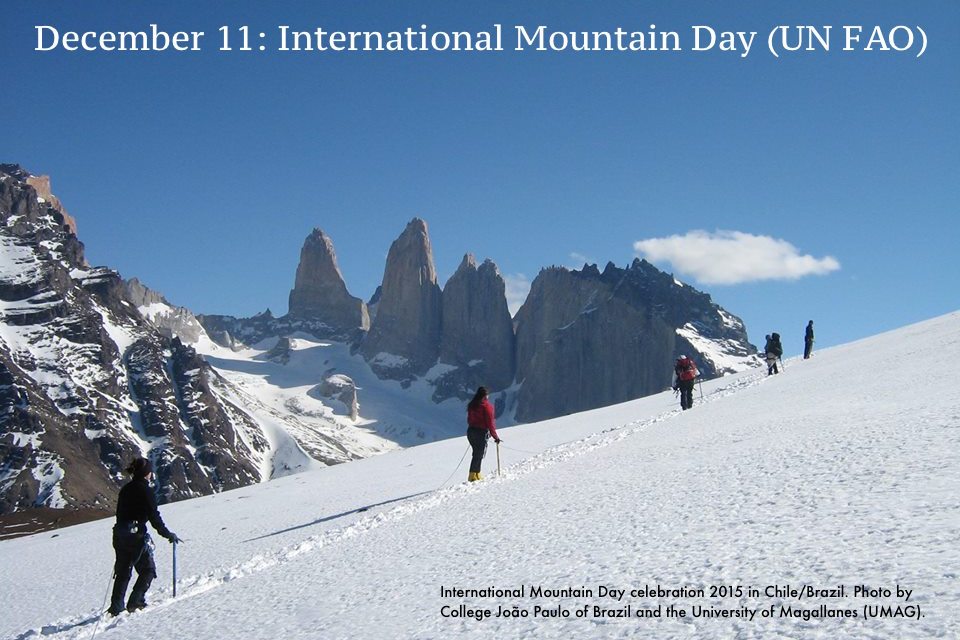
UN FAO International Mountain Day. International Mountain Day celebration 2015 in Chile/Brazil: photo by College João Paulo of Brazil and the University of Magallanes (UMAG).

11 December: International Mountain Day

Since 2003, December 11 is International Mountain Day as designated by the United Nations General Assembly. Annually, the Food and Agriculture Organization of the United Nations (FAO) observes the day:

… to create awareness about the importance of mountains to life, to highlight the opportunities and constraints in mountain development and to build alliances that will bring positive change to mountain peoples and environments around the world.

•   Mountains cover almost one-quarter (22 percent) of the Earth’s surface.
•   Mountains host about 50 percent of the world’s biodiversity hotspots.
•   Up to 80 percent of the world’s freshwater supply comes from mountains.
•   One in eight people (13 percent) around the world lives in the mountains.
•   Mountain tourism accounts for almost 20 percent of the worldwide tourism industry.

The following provides a glimpse to the mountain environments around the world and to the challenging conditions our ancestors would have faced and endured.


( Click here for images and more )

UNESCO World Heritage Sites (WHS) Worldwide

Since 1995, I’ve been fortunate to experience significant travel: first as green graduate student on my first (of many) trips to Chile; followed by the opportunity to live and work in 3 countries on 3 continents inside a span of 10 years. I didn’t give much thought about their relative importance at the time, but I’m lucky to have visited a number of UNESCO World Heritage Sites (WHS).


( Click here for images and more )