Fotoeins Fotografie

location bifurcation, place vs. home

Posts from the ‘Mountains’ category

My Mittenwald: mountains, masks, music, Mahlzeit!

Above/featured: From the regional train: facing southwest over Schöttlkarstrasse and the eastern end of the Wettersteinwand at right.

In 1786, the German writer Johann Wolfgang von Goethe described the alpine town of Mittenwald as “lebendes Bilderbuch” – a living picture-book. Images and descriptions in print and provided by visitors became a real draw and lure. Funny thing is I’d stayed in nearby Garmisch-Partenkirchen several times, and I hadn’t taken the easy 20-minute train hop to Mittenwald.

I took care of that with two visits within a span of 15 months: with snow and without snow.

Wandering through Mittenwald is pure delight because of abundant fresh mountain air, picturesque surroundings, and the compact nature of the town. The description becomes a common refrain for alpine towns.

Mid-winter is special with the combination of seeing mountains freshly frosted with snow, people of all ages wearing masks and costumes during carnival season, houses painted in colourful “Lüftlmalerei”, and the town’s special place in music history. When the warm sun dominates in spring and summer, it seems like an endless vista of blue skies along with green meadows and mountains to accompany your time outside on walks and hikes in the area.


( Click here for images and more )

1-day drive, US: Santa Fe to Taos

Above/feature: In the background at right-centre is the sacred Pueblo Peak (Taos Mountain) with a light dusting of autumn snow.

The following takes place entirely on travel day 8 in our visit of the American Southwest.

In a daylong trip from Santa Fe, we’re in Taos for the first time where we meet with nature photographer Jim O’Donnell, whose writings also appear locally in The Taos News. We also marvel in the hamlet of Embudo the collection of paraphernalia associated with American automobile culture at the Classic Gas Museum.

Our drive is on the Low Road, there and back. It’s no real surprise we’re in the Taos area longer than anticipated, but we leave the area a little earlier to catch a couple of sights back in Santa Fe as we must depart the following day for Arizona. It’s curse and benefit, wanting (or needing) to stay in one place for an extended duration with the anticipation of a return, because there’s much more to see and learn.


( Click here for images and more )

1-day drive, US: Georgia O’Keeffe country

Above/featured: Ghost Ranch: Chimney Rock is in shadow at centre-right. Photo location: 36.31882 North, 106.48006 West.

This is the start of a series on day trips and drives from our time in the American Southwest. The following takes place entirely within travel day 7, within New Mexico between Santa Fe and Abiquiú.

Georgia O’Keeffe (1887-1986) is known as one of the best known modern American artists. Born in Wisconsin and educated in Chicago, her art came to light in New York City where her name and work became prominent. While teaching in Texas, she visited New Mexico for the first time in 1917. She fell in love with the landscape of New Mexico on subsequent visits in the early 1930s, and in 1949 she moved to the Abiquiú area where she would live for the rest of her life.

As fans of her art, we’re taking the day to drive up from Santa Fe to the town of Abiquiú. We wanted to see Georgia O’Keeffe country: the landscapes from which she drew inspiration, and the land that nurtured her spirit and fuelled her creativity.

Before our guided tour of O’Keeffe’s Abiquiú home, we stop at the Purple Adobe Lavender Farm next door to have a look. We like it so much we return after the guided tour to the farm’s café for a snack. We then make the short drive northwest onto the Ghost Ranch property to check out the ancestral lands of the Navajo Apache and Tewa pueblos. O’Keeffe recognized the importance some of that history, as she related in an 1967 interview for the Los Angeles Times’ “West” magazine:

When I think of death I only regret that I will not be able to see this beautiful country anymore, unless the Indians are right and my spirit will walk here after I’m gone.

On our return drive to Santa Fe, the sun sets over our section of the Southern Rocky Mountains, and I swear the late-afternoon breeze whispers the spirits of the Chama river, Georgia O’Keeffe, and all the souls who’ve inhabited the area.

( Click here for images and more )

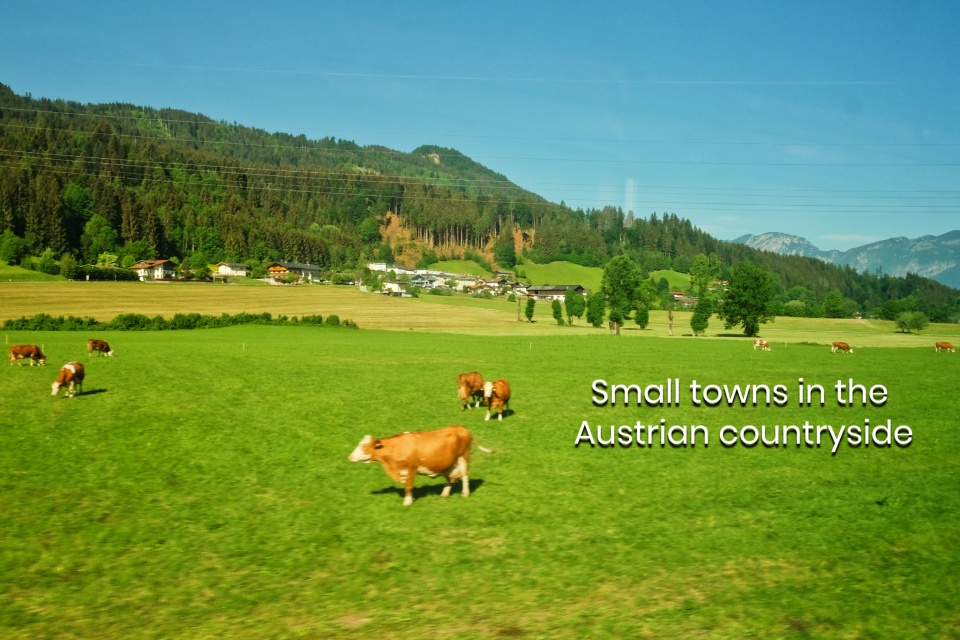
Einöden, Gasthof Hauserwirt, Wörgl, Tyrol, Tirol, Kufstein, Austria, Österreich, fotoeins.com

Small towns in the Austrian countryside

Above/featured: Bovine goodness with Gasthof Hauserwirt in the background, in Einöden at the outskirts of Wörgl – 13 May 2018.

Österreichische Dörfer auf dem Land

Spending a few weeks exploring Austria in spring between peak winter and summer seasons got me to examine a variety of artistic and cultural aspects, including:

•   a search for Erwin Schrödinger’s grave,
•   a century of Vienna Modernism,
•   a day-trip from Vienna to Bratislava with a boat on the Danube, and
•   looking for modern Salzburg beyond Mozart and The Sound of Music,

Because I’m all about trains and buses in Europe, there were many towns encountered: some passed by, and others planned and visited. The following examples of small towns in Austria includes a generous portion of mountains from the Austrian Alps.


( Click here for images and more )

Albuquerque: highlights in the Duke City

To begin our journey through the American Southwest, one of our first destinations was the International Balloon Fiesta. The largest balloon festival in North America is held every October in Albuquerque, the most populous city in the American state of New Mexico. Located roughly in the centre of the state and bisected by two major interstate highways I-25 and I-40, Albuquerque has seen its fair share of human activity and history:

  • Inland trade road between Meso-America and southern Rocky Mountains, c. 1000 AD/CE.
  • El Camino Real de Tierra Adentro established between Mexico City and Santa Fe for the colony of New Spain.
  • City founded 1706 AD/CE, in a wooded area along the east bank of the Rio Grande river.
  • City named after Viceroy of New Spain who was the 10th Duke of Alburquerque; 1st ‘r’ dropped to ease spelling and pronunciation.
  • City population: over 560-thousand, metro area over 910-thousand.
  • City elevation, average: 1.6 kilometres (1.0 mile).
  • City shaped by Spanish presence, railroad, University of New Mexico, Route 66, Sandia National Laboratories, TV- & film-production.

Having arrived from our respective cities at sea-level, we needed about a day or two to adjust to 20% less atmosphere# at the city’s mile-high elevation. Not only did the balloon festival exceed our expectations, we’re happy to share some of our favourite moments and places in and around “The Duke City”. With a limited number of days in the city, a rental car is the easiest way of getting around the city.

( Click here for images and more )