Fotoeins Fotografie

location bifurcation, place vs. home

Posts from the ‘Personal’ category

Interview with astros: Aisha Mahmoud-Perez

The Traveling Astronomer

Once, I was an astronomer, spending time thinking about and working on the formation and evolution of dwarf galaxies.

Astronomers lead busy lives, including teaching and mentoring, research-specific small- and large-scale data programming, and the near endless cycle of paperwork including research plans, funding proposals, budget reports, and paper manuscripts for peer-reviewed journals. Much of the time also involves travel – conferences, workshops, and collaboration meetings around the world, as well as visits to telescopes at observatories in remote locations around the world to collect data for projects.

I liked the travel part more than I enjoyed astronomy. When I’d said farewell to astronomy, I’d accumulated over one million miles with American Airlines, and countless more with Air Canada, the old Canadian Pacific, Lufthansa, the old Northwest (now Delta), and United Airlines. Weary feet and tired wings aren’t surprising outcomes; I know there are still many journeys and destinations left to come.

The best of Palestine and Puerto Rico

In September 2006, I moved to La Serena, Chile to work at the Gemini Observatory. The following January a number of undergraduate students from Chile, U.S., and Puerto Rico arrived at the neighbouring astronomical observatory to spend the Chilean summer on research experience. After meeting these students over the years, I’m happy to remain in contact with a number of them.

I’m pleased to introduce Aisha Mahmoud-Perez. She is one of the most unique people I’ve had the pleasure of knowing and calling friend. With a Puerto Rican mother and Palestinian father, she successfully blends into her life the influences of two vibrant colourful cultures and two fiery independent dispositions. She loves meeting new people, learning new languages (she’s presently at five), and she loves food, travel, and knitting. She completed her M.Sc. in astronomy and astrophysics at McMaster University in Hamilton, Canada, and she is now presently back in northwest Arkansas.


I remember the hectic schedules as a former and recovering astronomer. How do you strike a balance between the professional “necessity” of traveling for research with the personal “necessity” of traveling for your own satisfaction?

AM: “As an astronomer in the making, I find it hard to reach that perfect balance between doing research and research related activities and simply taking a week off to travel, but it is certainly not impossible. In mid-June this year (2014), I traveled to Chile for a collaboration trip lasting almost 3 weeks. Most of that time was spent working, but I’d take afternoons off to walk around town and weekends off to wander around the country. I found I was more productive at work after I’d taken some time to discover places on my own.”


With your Palestinian and Puerto Rican heritage, and a large fraction of your time in America, you’ve been exposed to and influenced by a rich cross-section of different cultures. How do these influences inform your travels? What have you learned about the differences and similarities among people?

AM: “I feel very lucky to have been raised under two very different cultures. There was never a dull moment in my house. Every day I discovered how beautifully different my parents were from each other – the saga still continues today – and how much they learned from those differences. Those differences helped me to be more open and to embrace different cultures with passion and enthusiasm. I also learned that those differences I talk about are superficial – one prefers tea over coffee, prefers to dress in a specific way, or prefers Abdel Halim Hafez over Marc Anthony – and that deep down we really love and feel the same way, regardless of where we’re born.”


What and where in the Middle East would you recommend people see and experience for something that’s uniquely Middle East? What and where in Puerto Rico would you recommend people see and experience for something uniquely Puerto Rican?

AM: “As far as the Arab Middle East goes… GO NOW, ā€˜YALLA’! The Arab world, from Morocco to Iraq, is extremely diverse: the colours, the smells, the food, even the local dialect of Arabic is different. But there is one thing I believe unites the Arab World and that’s their hospitality. I’ve met some of the most welcoming and warmest people in these lands. I’d say a truly unique Middle Eastern experience is to ā€œbe yourselfā€ and engage with locals. Perhaps what’s a bit closer to me is if you wander around Palestine, make sure to visit the city of Nablus and try their famous ā€˜knafeh’ – a delicious cake with a gooey cheese filling. No worries, you will find more many who’ll be more than glad to take you to a place to try ā€˜knafeh’!

Hebron, West Bank, Palestine - by Aisha Mahmoud

“Kunafeh”, in Hebron, West Bank, Palestine (AM)

Puerto Rico, on the other had, is a complex melting pot between North American and Latin American culture. Given our all-year-long summer, Puerto Rico is a constant party. But, perhaps, our biggest spectacle or where one can experience true ā€˜puerto-rican-ness’ is during Christmas. The streets fill with Christmas music all day long, moms and grandmas cook traditional dishes and you truly feel the happiness and the excitement of the people in the air. Do note however that Puerto Rican Christmas songs are not your typical Christmas song, e.g. ā€œyour guests come, eat, pig out, drink, and then they ask you if you have an aspirinā€ (No hay Cama Pa’ Tanta Gente by El Gran Combo). Also, Christmas starts right after Thanksgiving and ends the second week of January. Happy Island!”

Nablus, West Bank, Palestine - by Aisha Mahmoud

“Family”, in Nablus, West Bank, Palestine (AM)

What place or country has left the most lasting impact with you? What are those impressions?

AM: “For me, that place is Chile. Even if you love traveling, it is always challenging to go abroad either as a tourist or to stay there for a longer period. In Chile, I never had that feeling of being an ā€œoutsiderā€. Chileans welcomed me like one of them right away: very warm and friendly people! Their food is amazing as well!”

ValparaĆ­so, Chile - by Aisha Mahmoud

“Barrios”, in ValparaĆ­so, Chile (AM)

Where is one place or country in the world would you like to live or travel? What are your reasons?

AM: “I can’t pick just one. One of my travel goals is to visit the entire Arab world. Out of all the nations in the Arab world, I’ve visited five; only 17 more countries to go! I was mostly raised in Puerto Rico and was involuntarily away from the Arab World for a long time. I think that that’s why I find the Arab world so enchanting and I still want to visit and be charmed by all of it.”


Follow Aisha

at her website | on Twitter | on Instagram

The photos above were made by and kindly provided by Aisha Mahmoud. This post appears on Fotoeins Fotopress at fotoeins.com at http://wp.me/p1BIdT-5oE.
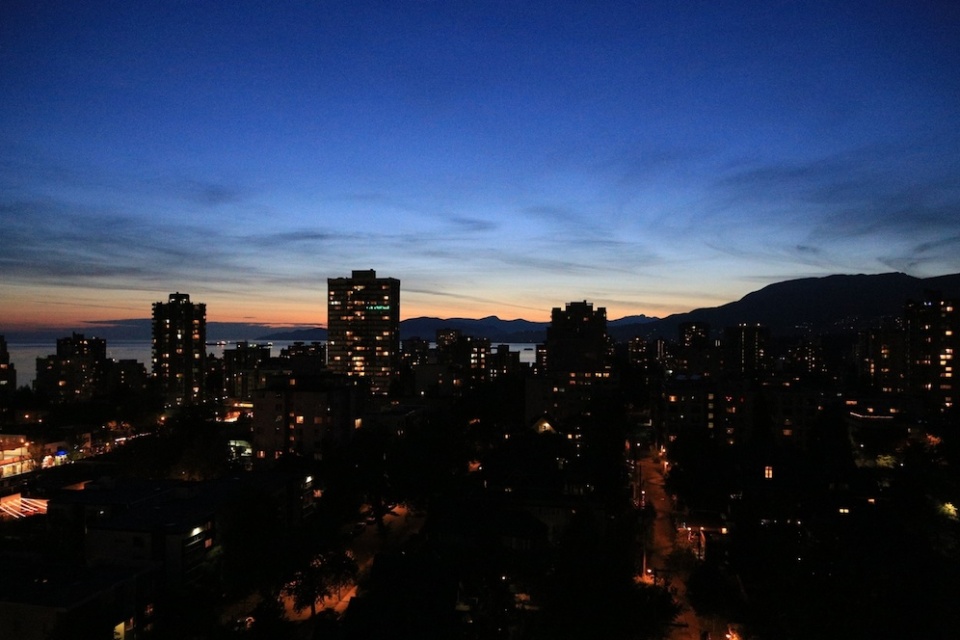
Sunset over the Salish Sea (English Bay), from St. Paul's Hospital, Vancouver, BC, Canada - 8 Aug 2014, fotoeins.com

His final sunset over the Salish Sea

Every day felt like a bonus, a sweet taste of daily magic.

Over the time he spent in the hospital, Dad charmed the staff by chatting with them in broken English; it was a way for him to express some measure of control. As expected with decreasing hemoglobin levels, his body continued the downward slide. His mind and spirit departed at the beginning of the third week; he had become unresponsive. Over the next five days, his body remained, the breathing steady, though shallow and sometimes laboured. He was calm, at peace, and thanks to the meds, without pain.

From the top of St. Paul’s Hospital in Vancouver, Canada, I photographed this post-sunset scene on 8 August 2014, with fading light peeking up and over the cirrus, high over the Salish Sea (English Bay) and the downtown peninsula. I’m sure he sensed the daily change in light, even though he could no longer see by the end.

Hours later the following morning, Dad breathed his last and slipped away for good. He marked his 82nd birthday six weeks earlier.

The long road for him has ended; another chapter and another journey begins.


Warmest thanks to the staff at St. Paul’s Hospital, and particularly, the men and women who work enthusiastically and gracefully in the hospital’s Palliative Care Unit. This post appears on Fotoeins Fotopress at fotoeins.com as http://wp.me/p1BIdT-5vy.

Vancouver: the forgotten’s fireworks from St. Paul’s

2 August 2014.

I’m in one of the city’s hospitals, visiting my father who’s in very bad shape.

I’ve helped feed him dinner of roast pork, peas, and gravy, a direct sensory reminder of his past as ‘line cook’ in a downtown diner nearby. He eats with great enthusiasm, the most I’ve seen him eat in weeks. Dinner’s done, and he’s worn out. I suggest we go “around the corner” with him in a wheelchair to watch the evening’s fireworks, but he gently declines. A twinge reflects the growing reality of him never seeing fireworks again, but the feeling is moderated by resolved acceptance and mild resignation.

I go out into the corridor where people have already gathered by the windows next to the elevators. From the heights of the hospital, there are spectacular views of the downtown peninsula, towards Burrard Inlet, English Bay, and the waters of the Salish Sea. What sacred spirits have come and gone, then and the now.

Waiting patiently to catch a brief glimpse of fireworks are other hospital patients, their family, and various hospital staff taking breaks in their work schedule. It’s a four-day holiday weekend here in the province of British Columbia, and early August weather is summertime hot under the dome of clear blue skies.

Judging by the look in some people’s eyes, I empathize with feelings which must remain unspoken: “I’d rather be outside, laughing and having a good time, surrounded by family and friends.”

I thought about making a few photographs of the fireworks through the large windows, but something pulls me back, and I decide not to image the fireworks directly.

My thinking about this situation quickly clarifies. What I’ll do is record people watching the fireworks through the windows of the hospital’s upper floors.

They are not forgotten. It’s my promise to capture with a camera’s all-seeing eye an elemental and universal desire for something beyond the ephemeral and temporal, something that approaches a kind of eternity.

( Click here for images )

Cerro Tololo Interamerican Observatory, CTIO, Cerro Tololo, Región de Coquimbo, Chile, fotoeins.com

Chilean Andes: morning send-off with Atacama minions

Above/featured: Morning fog in the valleys below, facing north-northeast from Cerro Tololo Observatory – 9am CLDT (12pm UTC), 22 Sept 2011.

Late-2011: Cerro Tololo Observatory, Región de Coquimbo, Chile.

The morning creeps gently forward, up and over the desert sky. Sounds? What sounds? What scarce sounds there are, they pierce the silence with soft whistles and drawn-out wails. Alternating light and dark horizontal streamers, known also as “the rays of God,” mark the first light of dawn. Small clumps break loose, as the overnight shroud of valley fog pulls back slowly from view.

The sun climbs higher, the shadows grow shorter, the cotton patch dissolves. It isn’t long until a spectacular sight is revealed. This is what you get from a height of 7500 feet above sea level.

Dry river beds twist and sweep and stretch along canyon floors. Cactus and desert scrub carpets the surrounding hills in faded greens and dusty browns. To the east rise jagged rocky teeth capped with white frosting, fixing the location of the Andes along the Chilean spine.

In this desolate and isolated part of the world, I’ve often wondered about the few brave souls who make this place their home. They’re prospectors, miners, even some farmers, all of whom carry their burden for financial endeavour. People have been digging around in these parts for centuries, whether it’s plant, mineral, or some kind of monetary paydirt.

But there’s another human enterprise with different rewards, a quest that asks questions on a much larger scale.

How do planets take shape?
How do stars form?
How are galaxies assembled?
Is there life elsewhere in the universe?

These issues occupy astronomers from all over the world. Many astronomers go up onto mountains, just like this one, onto the summit of Cerro Tololo, peering into the skies. The telescopes point straight up, reaching out like outstretched hands, wanting more.

( Click here for images and more )

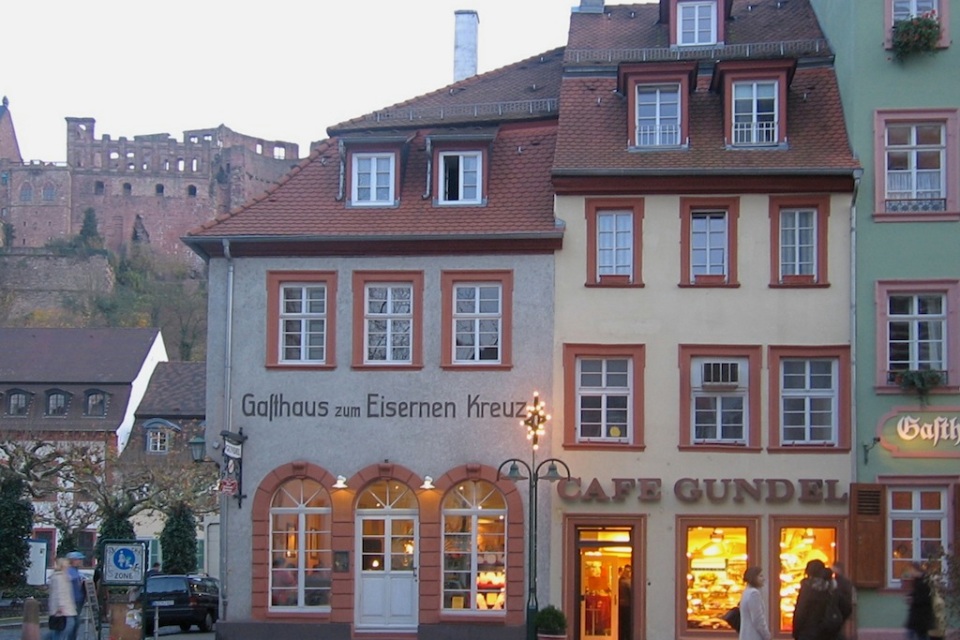
Cafe Gundel, Hauptstrasse (Karlsplatz), Heidelberg, Germany

My Heidelberg: 1st sweet taste at CafĆ© Gundel

In 2001, I moved across the big Atlantic pond from Canada to Germany. Knowing only “bitte” (please) and “danke” (thank you), I flew sight unseen to Frankfurt am Main, followed by a shuttle-bus to the German university town of Heidelberg. I would live and work in Heidelberg for two years, and I couldn’t have known the experience would change my life.

Heidelberg is a favourite “hometown” which includes many memories of firsts.


( Click here for more )