Fotoeins Fotografie

location bifurcation, place vs. home

Posts from the ‘Germany’ category

Deutschland Ticket, for Canadian visitors (2024)

How-to buy guide, effective May to August 2024.

( 2025 note: On 18 September 2025, Bavarian state broadcaster BR24 reported the monthly price for the Deutschland-Ticket will go up by 5€ to 63€ , starting 1 January 2026. The price had already gone from 49€ to 58€ for the 2025 calendar year. My summer 2025 purchase went the same way as in 2024, whose details are described below. )

89 days within Europe includes by necessity substantial travel by train within Germany. I’ve already booked in advance a number of intercity express segments, but what about local transport and regional trains?

The “Deutschland Ticket” (D-Ticket) is a rail ticket for one person and costs 49€ per month on a rolling subscription. The ticket is generally valid for local transport (bus, tram, U-Bahn, S-Bahn, intracity ferry) and regional rail (RB, most RE, IRE), but not for long-distance IC and ICE routes. Intended primarily for commuters, visitors to Germany can also purchase these tickets.

It’s early-April 2024, and I’m about to buy the D-Ticket for 49€ for the entire month of May. The ticket’s “rolling subscription” means if I do nothing else before 10 May, I’ll also automatically purchase a D-Ticket for the month of June for 49€. I’ll need the D-Ticket for May, June, July, and August; but I can only buy one month at a time.

I choose Munich’s MVV-App, based on successes reported by other travellers. I’m only using the Munich app for ticket purchase, and I’m not planning to use public transport within Munich. To buy a D-Ticket, customers are neither limited by their choice of app/method, nor by the base/location where the app is based. My question is whether a Canadian-based credit card is an acceptable form of payment by the processing company in Germany for a German-based app.

Read more

My Berlin: Minkowski space in Heerstrasse cemetery

Waldfriedhof Heerstrasse (Heerstrasse forest cemetery)

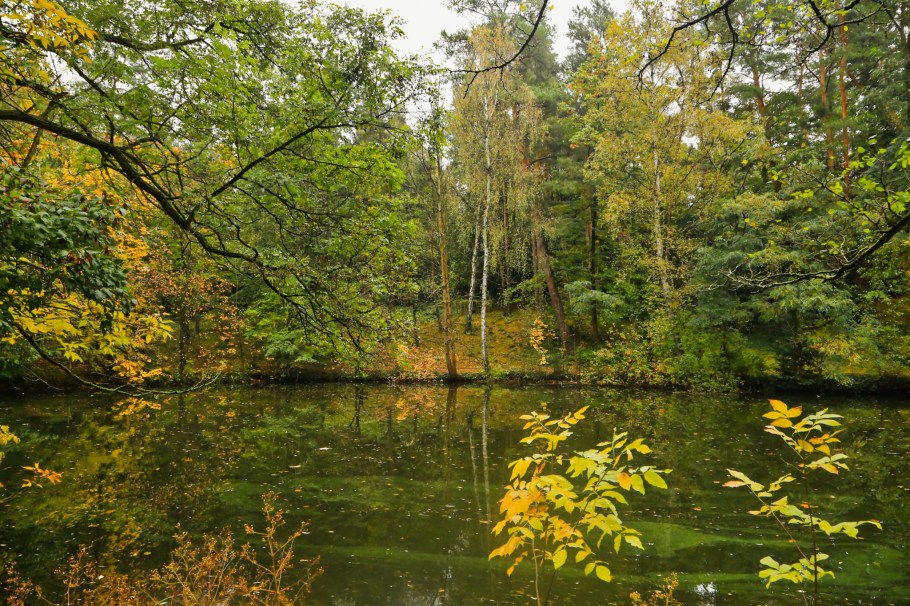
Is this a small park with plenty of trees, hilly terrain, and a small lake? Or is this simply a forest cemetery, a final resting spot for many prominent Berliners?

As part of an ongoing search for gravesites for physicists and mathematicians in Germany, I visited Berlin’s Friedhof Heerstrasse, near the city’s Olympic Stadium. Within the cemetery is Sausuhlensee lake, which settled into a former glacial gully, around which much of the cemetery came into being in 1924. Named after the early 20th-century Heerstrasse estate district whose residents were to be buried here, the cemetery stretches out over an area of almost 15 hectares (37 acres).

I found the grave for physicist Hermann Minkowski, but among the buried there are other “Promis” (prominent).

Friedhof Heerstrasse, Westend, Berlin, Germany, Deutschland, fotoeins.com

Forested park, forest cemetery.

Friedhof Heerstrasse, Westend, Berlin, Germany, Deutschland, fotoeins.com

The calm waters of Sausuhlensee lake on an autumn afternoon.


( Click here for images and more )

Nussberg, 19. Bezirk, Döbling, Wien, Vienna, Austria, Österreich, fotoeins.com

23 for 23: Foto(ein)s in 2023

Above/featured: Vienna’s green vineyards on Nussberg, with Kahlenberg at centre in the background. Photo, 14 Jun 2023.

A year in review typically provides coverage spanning a period of six months or more; the period doesn’t even have to be a continuous stretch. But in this case, my highlights come solely from a period of six weeks in May and June. All else pales by comparison.

All of the images presented below have been corrected for geometric distortion and rotation, with further adjustments to image-crop, brightness, contrast, highlights, shadows, clarity, sharpness, vibrance, saturation, and colour levels. These images are as always best viewed on screens larger than a miniscule mobile.


( Click here for images and more )

My Fuji X70: Kodak Color Negative (XTrans2 recipe)

Above/featured: Taunusanlage train station, Frankfurt am Main – 18 Jun 2023.

The Fujifilm X70 mirrorless fixed-lens prime camera has added a lot to my approach to photography for projects in domestic and international scope. To satisfy my curiosity about Fujifilm’s analog-film simulation (film-sim) recipes, I’ve provided examples of X70 images with the following recipes:

•   CineStill 800T
•   Ektachrome 100SW (saturated warm)
•   Fujichrome Slide
•   Kodachrome 64
•   Kodacolor
•   Kodak Platinum 200
•   Monochrome Red

Here I show images made with the “Kodak Color Negative” recipe, which Ritchie Roesch describes in Fuji X Weekly:

… The aesthetic that I was hoping to achieve with this recipe was Kodak Portra 400. I don’t believe that I succeeded in faithfully mimicking that (sometimes there’s a similarity); however, it does seem to produce a Kodak-like color negative film look, perhaps more like Ultramax, but not exactly that, either. Whatever it does or doesn’t resemble, I personally really like the aesthetic produced by this recipe …

The recipe is for X-Trans II sensors and the built-in availability of “Classic Chrome”. The settings on my X70 are:

  • “Classic Chrome” built-in film-sim
  • Dynamic Range: DR200
  • Color: +2 (High)
  • Sharpness: -1 (Medium-Soft)
  • Highlight: -2 (Soft)
  • Shadow: -1 (Medium-Soft)
  • Noise Reduction: -2 (Low)
  • White Balance: Incandescent; +6 Red, -7 Blue
  • ISO: Auto, up to 3200

I assigned this recipe for my “indoor” setting as 1 of the 7 camera’s custom presets, but the recipe’s versatility allowed for additional tests at outside locations. The following JPG images are “almost” straight-out-of-the-camera: only minor adjustments to brightness level and a crop to a predefined image size have been applied, with no corrections to colour, contrast, geometric distortion, or rotation. The blue (“cool”) colour-cast is very real, which is especially evident on images made outdoors under sunny conditions.

( Click here for images )

My Fuji X70: Monochrome Red (XTrans2 recipe)

Above/featured: Gateway Gardens station, Frankfurt am Main – 11 May 2023.

The Fujifilm X70 mirrorless fixed-lens prime camera has added a lot to my approach to photography for projects in both domestic and international scope. To satisfy my curiosity about Fujifilm’s analog-film simulation (film-sim) recipes for varying “looks” and “palettes” applied to images, I’ve provided examples of X70 images with these recipes:

•   CineStill 800T
•   Ektachrome 100SW (saturated warm)
•   Fujichrome Slide
•   Kodachrome 64
•   Kodacolor
•   Kodak Platinum 200

I examine the Monochrome+R film-simulation recipe, which Ritchie Roesch describes in Fuji X Weekly:

… Back when I shot black-and-white film, I usually used a color filter to manipulate the shades of grey, and for landscape photography the Red filter was my most-used option. You cannot use these filters on your Fujifilm camera, but Fujifilm does provide you with three faux filters: +Y, +R, and +G. These mimic the aesthetic of using a Yellow, Red, or Green filter (sort of). In my opinion, +R doesn’t actually replicate the use of a Red filter very well; it’s more like an Orange filter. This recipe is intended to produce a look more similar to a Red filter on black-and-white film, which means that it will darken blues and lighten reds.

This recipe is for the X-Trans II sensor. My X70 settings are:

  • “Monochrome+R” built-in film-sim
  • Dynamic Range: DR400
  • Color: —
  • Sharpness: +1 (Medium-Hard)
  • Highlight: -1 (Medium-Soft)
  • Shadow: +2 (Hard)
  • Noise Reduction: -2 (Low)
  • White Balance: Fluorescent1 (day); -4 Red, +7 Blue
  • ISO: Auto, up to 6400

I had assigned this recipe as “general black and white”, with which I experimented in a variety of locations and settings. The following images are almost straight-out-of-the-camera; only adjustments to brightness level and size (2048 by 1365 pix) have been applied, with no corrections to colour, contrast, geometric distortion, or rotation.

( Click here for images )