Fotoeins Fotografie

location bifurcation, place vs. home

Posts from the ‘UNESCO World Heritage’ category

World Heritage Sites designated and inscribed by UNESCO

25T51 Potsdam: Sanssouci World Heritage Site

E50, B45.

Potsdam’s Sanssouci (“care free”) palace and park are very popular places for visitors in summer. However, a couple of days with severe thunderstorms and high winds in the past week forced the closure of the entire grounds, as announced earlier today on their website and as seen with signs on their locked gates. Downed branches and tree segments needed clearing. By mid-afternoon, some of the grounds opened to foot traffic, bicycles, and motor vehicles. It’s no surprise there were far fewer number of visitors observed on the grounds today.

In 1990, selected gardens and palaces in Potsdam including Sanssouci were inscribed by UNESCO as a single item onto their list of World Heritage Sites.


Locked gate on the grounds’ southern perimeter in morning hours.
Orangerieschloss: 1851 to 1860/1864, by Stüler and Persius.
Neue Kammern: 1748 by Knobelsdorff; first an
orangery, then guest palace.
Hauptallee, facing west to Neues Palais.
From Hauptallee up to Sanssouci palace.
Weinbergterrasse (vineyard terrace), facing north to Sanssouci palace.
Weinbergterrasse (vineyard terrace), facing south to the Great Fountain.
On the terrace steps, up to the palace.
The final spots for Friedrich the Great (below) and his beloved dogs (above center).
Grave for Friedrich the Great (1712-1786) who ruled as Prussia’s monarch from 1740 until his death. Yes, those are spuds on the plaque; legend has him responsible as the first to getting potatoes into German hands and bellies.
The visual jewel that is the centre portion of Sanssouci Palace.

I made all images above with an iPhone15 on 27 June 2025. This post composed within Jetpack for iOS appears on Fotoeins Fotografie at fotoeins DOT com.

Vienna Ringstrasse & Architectural Historicism

Above/featured: Examples of the “Ringstraßenstil” historicism style at Maria Theresa Square, with Maria Theresa Monument at left and the Museum of Natural History at right. Photo, 15 May 2022 (X70).

•   Can a street alone define its surrounding architecture?
•   Do the buildings themselves establish the street’s visual impression?
•   Is Vienna (un)fairly defined by the Ringstrasse and the inner city?

The answers, as always, are a little complicated.

Like many, I’m also fond of Vienna’s Ringstrasse (Ring Road), as a kind of “hello” and re-introduction to the city after my first visit in 2002. At 5 kilometres in length, the Ringstrasse is one of the longest streets in Europe, longer than the nearly 2-km Champs-Élysées in Paris and longer than the 4.5-km Nevsky Prospekt in St. Petersburg. The boulevard is surrounded by Prachtbauten (buildings of splendour), constructed in the architectural style of “historicism,” a big nod to classic “forms” reflecting structural “functions”. The late-19th century “Ringstrassenstil” (Ring Road architectural style) continued the practiced habit of choosing a historical style which best identified with the purpose of the building. For example, the Neo-Baroque architectural style is represented in the Civic Theater; the Neo-Classical style in the Parliament and New Palace; the Neo-Gothic style in City Hall and the Votive Church; and the Neo-Renaissance style in the museums, palatial mansions, Opera House, and the University.

On Christmas Day 1857, the Wiener Zeitung newspaper published an imperial decree written 5 days earlier (on 20 December) by Habsburg emperor Franz Joseph I. He ordered the demolition of the inner-city wall and the subsequent creation of a circular boulevard, bordered by grand buildings and filled with green spaces. The large outward extension of the inner city changed and influenced the urban development of Vienna, still seen to this very day.

It is my will that the extension of the inner city of Vienna should proceed as soon as possible, providing for appropriate connections between the city and the suburbs as well as the embellishment of my imperial residence and capital. To this end, I authorise the removal of the walls and fortifications of the inner city as well as the ditches around it …

– Emperor Franz Joseph I: 20 Dec 1857, published 25 Dec 1857.

On 1 May 1865, Emperor Franz Josef unveiled the Ringstrasse in an official ceremony, even though large areas remained under construction. Ringstrasse structures included the religious and the secular, as well as the public and the private. The Ringstrasse symbolized the power of the imperial state, and the growth of a new arts and culture scene with the increasing popularity of coffee houses.

It’s also important to note the architectural impact made by the Jewish middle- and upper-class to integrate within the Habsburg empire. For example, the families Ephrussi, Epstein, and Todesco commissioned architect Theophil Hansen to construct palatial mansions as visible manifestations and partial realization of the dream of many Viennese Jews: assimilation into and emancipation within Viennese society. (Viennese journalist and political activist Theodor Herzl might have had a different opinion about that.)

For residents and long-term visitors today, it’s entirely possible to fit into the unintended shape and mentality of the “modern” city: that the inner-city wall was simply replaced by a different wall of “economic class”, that the architectural callback to historicism “freezes” the inner-city in time, and that like many, I can live, traverse, and work in the outer districts and avoid entering the inner city.

For short-term visitors today, the Ringstrasse buildings form a golden shiny “ring” around the “fingers” of the U1 and U3 metro lines traversing through the UNESCO World Heritage inscribed inner-city. For these visitors, all that’s needed for their limited time in Vienna is the inner city.


( Click here for images and more )

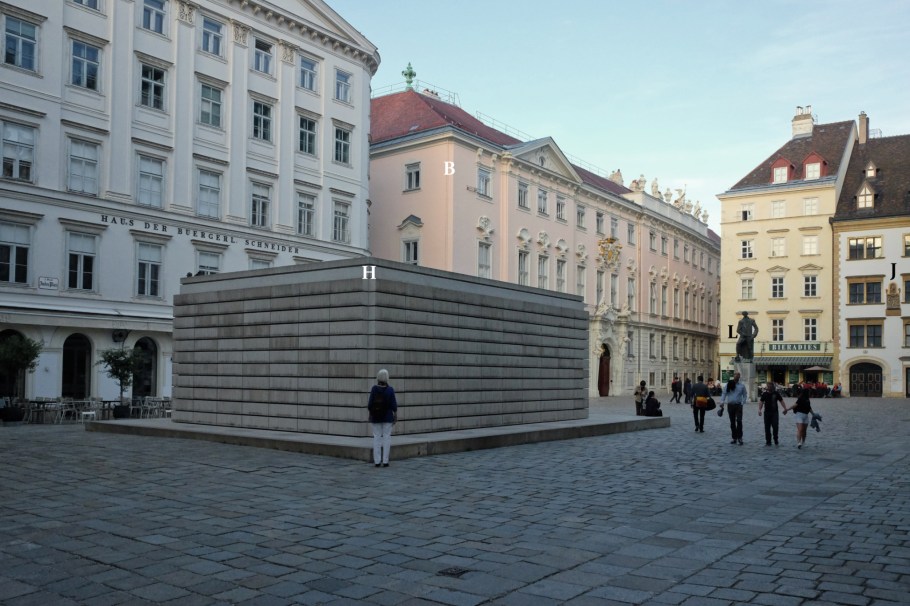
Vienna Judenplatz: centuries & memories of the Jewish community

Above/featured: Judenplatz at night. The Holocaust memorial is in the foreground at centre. In the background are “To the little trinity” at centre and Misrachi House (Museum Judenplatz) at right. Photo, 10 Jun 2022.

At Judenplatz are clear visual reminders of the city’s first Jewish community in medieval times.

The first Jewish community in Vienna settled around present-day Judenplatz in the Middle Ages with mention in written documents dated mid- to late-13th century AD/CE. Daily Jewish life thrived around the Or-Sarua Synagogue, the Jewish School, and the Mikveh ritual bath. The community along with the surrounding Jewish neighbourhood came to an end with the Pogrom of 1421. Catholic Habsburg Duke Albrecht II rolled out a decree (Wiener Geserah, Vienna Gesera) which legitimatized the expulsion, incarceration, torture, and murder of some 800 Jewish residents; accompanied by destruction and forced takeover of buildings and property.

Below I highlight remnants and traces to the medieval Jewish community at this square in central Vienna.

Judenplatz, Vienna, Wien, Oesterreich, Austria, fotoeins.com

Facing northwest: B, Bohemian Chancellery; H, Holocaust Memorial; L, Lessing monument; M, Misrachi House; T, To the little Trinity. Photo, 20 May 2018.

Judenplatz, Vienna, Wien, Oesterreich, Austria, fotoeins.com

Facing southeast: B, Bohemian Chancellery; J, Jordan House; H, Holocaust memorial; L, Lessing monument. Photo, 20 May 2018.


( Click here for images and more )

Vienna’s districts 1 to 23: my highlights

Above/featured: Aspern lake at the Aspern Seestadt housing development in the 22nd district. At right in the background to the north are the Danube Tower and northern hills. Photo, 7 Jun 2022.

From early-2002 to mid-2003, I lived and worked in Heidelberg, and I travelled to Vienna at least six times across all seasons for collaboration work between MPIA and the University of Vienna. Unfortunately, I didn’t own a camera, and I have zero images from that time. “Oiiida.”

After a 15-year pause, I returned to Vienna for one week in May 2018 for the 100-year anniversary of Vienna Modernism. I brought 2 cameras, and I made a few photographs here and there. I’ve always needed more, and four years later in May 2022, I stayed in Vienna for four weeks.

The historic bread- and pastry-making company, Anker, once had a motto known among the Viennese:

Worauf freut sich der Wiener, wenn er vom Urlaub kommt? Auf Hochquellwasser und Ankerbrot.
To what do the Viennese look forward after returning from vacation? Spring water and Ankerbrot.

For all of us who’re visitors to Vienna, I put forward the modified question:

Worauf freut sich ein(e) Besucher(in), wenn man nach Wien kommt?
To what does a visitor look forward in Vienna?

There are many answers for many people. There’s art, coffee, Jugendstil, music, wine; these are only five in a lengthy list. Vienna is more than a desirable visitor location; the city reclaimed the top spot in the The Economist’s EIU Global Liveability Index for 2022.

I got to explore at least one point of interest in each of the city’s 23 Bezirke or districts. Not only did I spend a lot of time in the inner city or 1st district, but I also made my fair share in the 6th, 9th, 18th, and 19th districts. Below I provide from each of the city’s 23 districts a couple of personal highlights which may be of interest to both resident and visitor. There are more interesting locations, about which I’ll describe separately.


( Click here for images and more )

Palacio de Cibeles, Fuente de Cibeles, Plaza de Cibeles, Paseo del Prado, Madrid, Spain, España, fotoeins.com

Madrid: Paseo del Prado, new UNESCO WHS

Congratulations to Madrid and Spain!

In the Spanish capital city, the Paseo del Prado and the adjacent Parque del Retiro were inscribed together as a new UNESCO World Heritage Site on 25 July 2021. The Paseo del Prado is a wide tree-lined boulevard populated with big fountains, beautiful architecture, and buildings dedicated to scientific research and to collections of world-class art. As prototype to the Hispanic “alameda” found throughout Latin America towns and cities, Paseo del Prado is an display of vision and desire for an idyllic society within the (former) Spanish Empire.


Palacio de Cibeles, Fuente de Cibeles, Plaza de Cibeles, Paseo del Prado, Madrid, Spain, España, fotoeins.com

Plaza de Cibeles: Palacio de Cibeles (palace 1919); Fuente de Cibeles (fountain 1780, moved 1895).

Banco de España, Plaza de Cibeles, Paseo del Prado, Madrid, Spain, España, fotoeins.com

Plaza de Cibeles: Banco de España (1891).

Palacio de Linares, Casa América, Plaza de Cibeles, Paseo del Prado, Madrid, Spain, España, fotoeins.com

Plaza de Cibeles: Palacio de Linares (1877), host to Casa América.

Museo Nacional del Prado, Diego de Velázquez, Aniceto Marinas, Paseo del Prado, Madrid, Spain, España, fotoeins.com

Diego de Velázquez statue (1899) by sculptor Aniceto Marinas, in front of the Prado Museum (1819).


I made all images above on 9 May 2009 with a Canon EOS450D (Rebel XSi). This post appears on Fotoeins Fotografie at fotoeins DOT com as https://wp.me/p1BIdT-lhx.