Fotoeins Fotografie

location bifurcation, place vs. home

Posts from the ‘Arts’ category

Haus Meissen, Meissener Porzellan, Staatliche Porzellan-Manufaktur Meissen, Meissen, Sachsen, Saxony, Germany, fotoeins.com

Meissen: centuries of porcelain-making tradition

In a present-age of speed, screens, and instant gratification, there are reasons to hold onto something tangible in your hands, something as simple as a cup, a plate, a bowl; all high-quality products made in the slow time-honoured way developed over centuries as an important local and, now national, cultural tradition.

First time porcelain production began in China going back at least 1000 years BCE with the subsequent centuries yielding hard durable highly-valued products in white, blue-and-white, and green. With European naval powers reaching Asia in the 16th and 17th-centuries, porcelain found new customers and high demand as “white gold” on par with gold and silver. Admiration and envy got many in Europe to thinking: all we need are some chalky deposits, some water, and some big hot ovens, and we’ll be rich … apart from chemistry, the correct firing or curing temperatures, experimentation, and skill. Until the early 18th-century all porcelain came from China, which is how the present-day phrase “(fine) china” arises.

The European debut to porcelain-making began in 1710 in Albrechtsburg castle in Meissen. When the big guy (who pays your wages or is holding you prisoner) says: “go ye therefore and make me some ‘gold'”, one tends to heed those orders. Frequently in need of funds, Augustus the Strong imprisoned and ordered the alchemist Johann Friedrich Böttger to produce “gold”, but with mathematician and physicist Ehrenfried Walther von Tschirnhaus’ guidance, the two gentlemen did the next best thing and produced Europe’s first “white gold.” Porcelain manufacturing moved from the castle to the present location outside of Meissen’s old town in 1863.

We enter the Meissen Couture and its porcelain museum for a look behind the scenes. Why worry about modern techniques like 3-d printing when you’ve got motivated people willing to put in the hours; their hearts, minds, and souls into their craft? The basic creative instinct and personal touch live on in the town of Meissen in Germany’s Saxony.

( Click here for images and more )

Weimar: Duchess Anna Amalia Library, UNESCO WHS

As one of over ten buildings, residences, and properties making up what is called “Classic Weimar”, the Duchess Anna Amalia Library (Herzogin Anna Amalia Bibliothek) has been a UNESCO World Heritage Site since 1998.

To consolidate her love of books into a larger holding space, Duchess Anna Amalia commissioned in 1761 the State Architect to rebuild and convert the Renaissance-style French (Green) Castle into a library, which opened in 1766. Becoming one of the most important libraries in the country, the collections included some of the finest written and produced in German literature, art and culture, history, and architecture. Johann Wolfgang von Goethe himself was Library Director between 1797 and 1832.

The library has had its fair share of names: initially called the Ducal Library (Herzogliche Bibliothek); in 1815 renamed as the Grand Ducal Library (Großherzoglichen Bibliothek); in 1918 renamed as the Thuringia State Library (Thüringische Landesbibliothek); in 1969 renamed as the Central Library of German Classics (Zentralbibliothek der deutschen Klassik); and in 1991, renamed as Duchess Anna Amalia Library (Herzogin Anna Amalia Bibliothek) in honour of the library’s founder.

An electrical short from aging damaged wiring sparked a fire on 2 September 2004; the fire held on for over two days before the final hotspot was put out. Over 100 thousand books were damaged or destroyed by fire, water, and smoke. The fire was the largest to strike a German library in post-war history. Subsequent donations and volunteers poured into Weimar from throughout Germany and Europe to help with rescue and preservation efforts. After conclusion of extensive restoration work to the building, the interior Rococo Hall, and to thousands of rescued books, the library was reopened on 24 October 2007, the birthday of the library’s namesake (Anna Amalia born 24 October 1739).

( Click here for more )

New Zealand, true-colour image from NASA Terra satellite, December 2002.

New Zealand: Māori anthems Pokarekare Ana, E Ihowa Atua

New Zealand is located in a part of our planet that’s about as far as one can go. The country provides easy inspiration with her striking scenery and friendly people. Memories remain sharp and fresh after multiple visits to Wellington and Auckland, as well as a solid three weeks in early-winter on the South Island. Truth is: I’ve got a real big soft spot for “Aotearoa“. The more time I spend in country, the more the land reveals deeper insights about her culture and language.

New Zealand recognizes three official languages: English, Māori, and New Zealand Sign Language (NZSL). Of immediate connection to this land are two Māori songs, “Pokarekare Ana” and “E Ihowa Atua”, which are the unofficial and official national anthems, respectively.

( Click here for more )

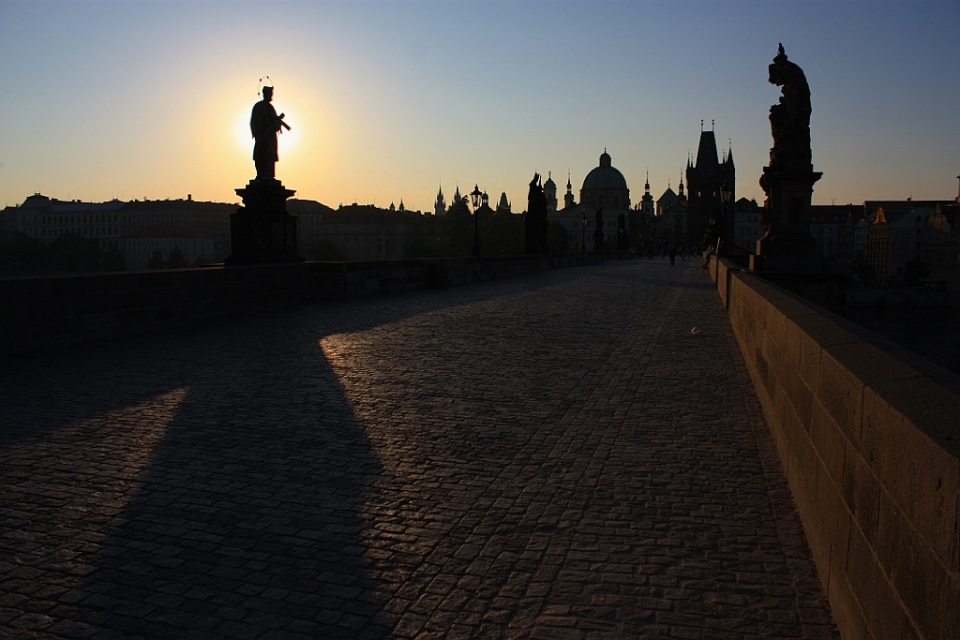
Karluv most, Charles Bridge, dawn, Prague, Czech Republic, UNESCO World Heritage Site, fotoeins.com

The shape of things to see and spot

Come here early enough, and it’s just a few early risers, dedicated runners, and well, me. There’s plenty of space to move around and change the angle of how I’m seeing things. Sure enough, there’s a bright circular halo surrounding the famous St. John of Nepomuk statue. With the rising sun in the background, the back-lit view has other bridge fixtures, some buildings, and the tall sharp dual spires of the Church of Our Lady Before Týn in silhouette. Image: 1/640s, f/8, ISO100, 18mm focal length (29mm full) with Canon EF-S 18-55mm f/3.5-5.6 IS II lens.


Shape” is a noun whose meaning is synonymous with:

form, appearance, configuration, formation, structure; figure, build, physique, body; contours, lines, outline, silhouette, profile.

It is one of the many “pieces” of good photography, and when the separate pieces come together, there’s something beautiful to behold, even perhaps, thought-provoking and inspiring.

I’m not going to pretend my photographs are absolute “championship” quality, but I know and understand my photographs are often worth a good long look. Here is a small selection of shapes I’ve seen from around the world with my trusty Canon EOS450D (XSi) camera (which has since given way to the 6D).

(Click here for more)

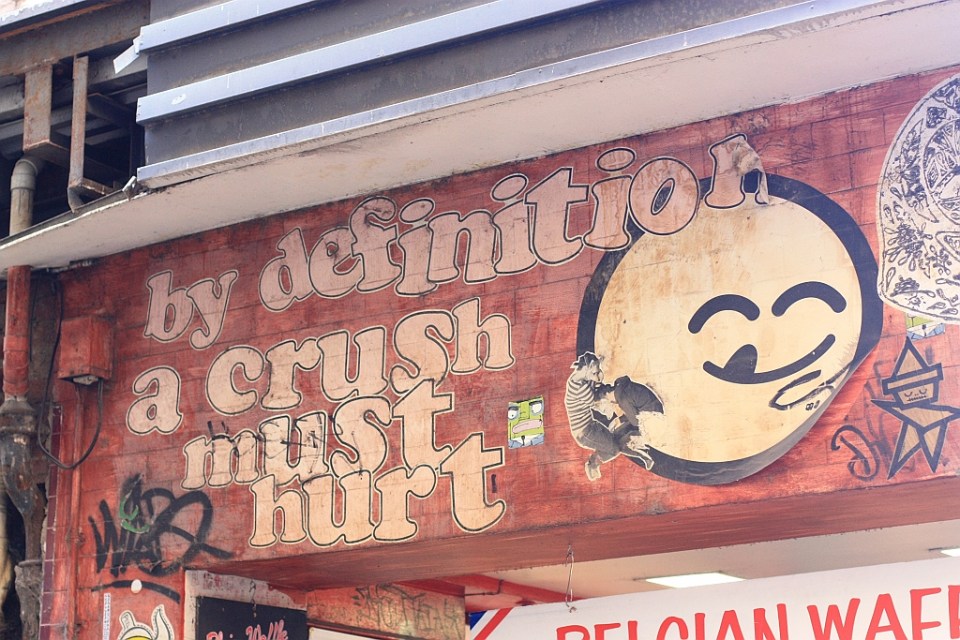
Melbourne, Australia, myRTW, fotoeins.com

Navigating Melbourne’s lanes for street art

In an earlier post, I’ve shown some work on display as street art in Adelaide in South Australia.

Over a period of four days in Melbourne, I wandered through lanes and streets to look for some representative street art in the Victorian state capital, some works which spoke of the people who live there. Would it be the same kind of art and/or messages I’d seen earlier in Adelaide? As always, the set of artists and their respective work hold unique value in each of the cities.


( Click here for images and more )