Fotoeins Fotografie

location bifurcation, place vs. home

Posts from the ‘Arts’ category

Vienna Hietzing Cemetery: F.Grillparzer, G.Klimt, K.Moser, O.Wagner

Previously, I provided short biographies for artist Gustav Klimt, artist and designer Koloman Moser, and architect Otto Wagner, and why they are important figures to the arts and culture scene in early 20th-century Vienna. These three figures are buried in Hietzing Cemetery in the 13th district of Hietzing at the city’s western periphery.

Located to the southwest of the former imperial summer residence Schönbrunner Schlosspark, Hietzing Cemetery is modest in size with an area of over 10 hectares (25 acres) and containing over 11-thousand graves. With the present site inaugurated in 1787, the cemetery has seen several expansion phases and survived damage from the Second World War.

I highlight the final resting places for Alban Berg, the Fröhlich sisters, Franz Grillparzer, Hans Hollein, Gustav Klimt, Koloman Moser, Strauss women, and Otto Wagner.

Friedhof Hietzing, Hietzing Cemetery, Friedhoefe Wien, Hietzing, Wien, Vienna, Austria, Oesterreich, fotoeins.com

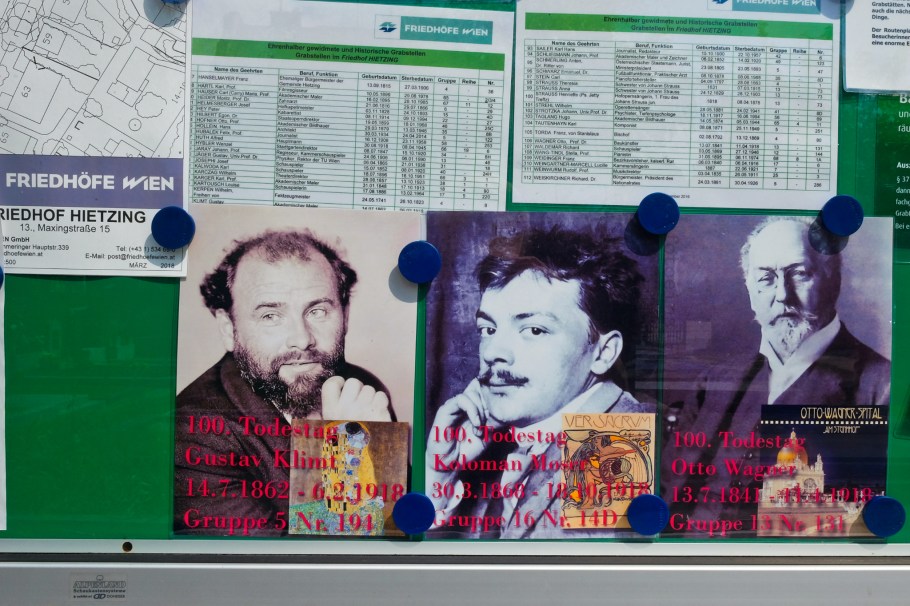
2018 was the 100th anniversary of the deaths of Gustav Klimt (1862–1918), Koloman Moser (1868–1918), and Otto Wagner (1841–1918). Photo, 16 May 2018.

13. Bezirk, Hietzing, Friedhof Hietzing, Hietzing Cemetery, Friedhoefe Wien, Hietzing, Wien, Vienna, Austria, Oesterreich, fotoeins.com

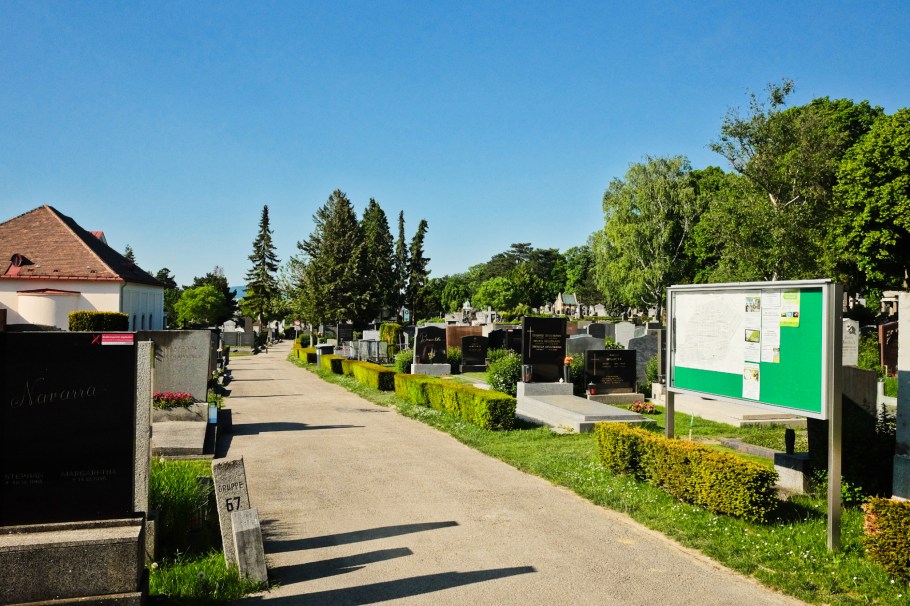
Inside the front entrance – 15 May 2022.

Friedhof Hietzing, Hietzing Cemetery, Friedhoefe Wien, Hietzing, Wien, Vienna, Austria, Oesterreich, fotoeins.com

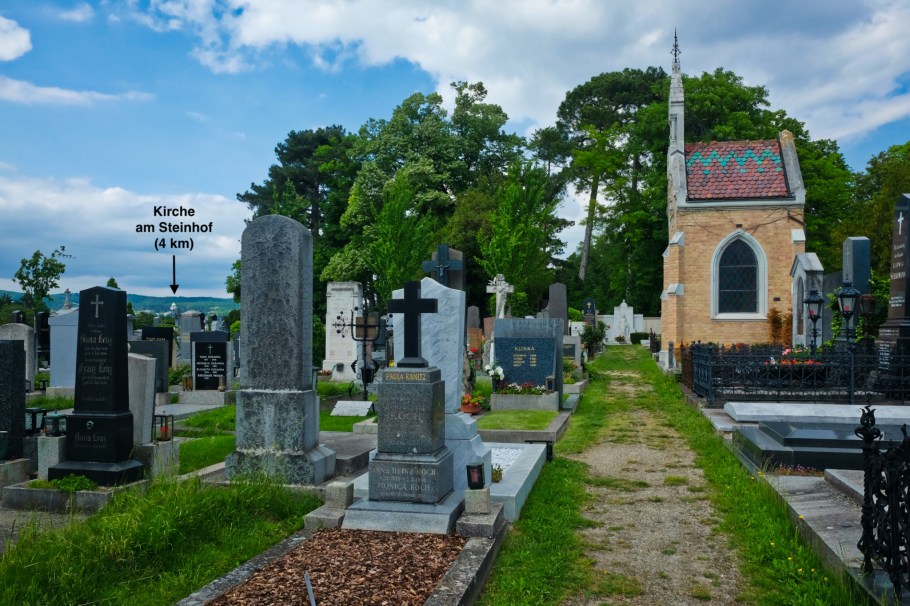
Visitors to the cemetery can look northwest to see the glowing golden dome of Otto Wagner’s Steinhof Church at a distance of 4 km (2.5 mi). Photo, 16 May 2018.


( Click here for images and more )

Seattle: living black history in the C.D.

Oh Seattle: how is your black history defined?

With the city’s proximity to Vancouver, my time in or any understanding of Seattle was incomplete without an examination of the city’s non-white communities. I had questions about the black community and in particular why the city remains racially segregated. People of color, including black people, were once forbidden from buying houses in specific neighbourhoods because of their skin colour. The Central District (CD) thrived as a black community in the 2nd-half of the 20th-century, but now, citizens struggle with gentrification, displacement, and economic racism. There’s much more I need to ask and learn, but for now, I describe below a selection of landmarks highlighting contributions by and the historical impact of the black community to city and nation.


( Click here for images and more )

My Konstanz: Jan Hus’ last stand

Above/featured: Old Town from the Bodensee (Lake Constance): visible from left-to-right are respectively the broad-roofed Konzilgebäude (Council Building), Münster (tall Cathedral spire behind sailboat), and the Dominikanerinsel (Dominicans Island). Photo on 23 Sep 2017.

6 July is a national holiday in the Czech Republic; the formal name is “the day Jan Hus was burned at the stake” (Den upálenĂ­ mistra Jana Husa).

I wrote previously about medieval Bohemian theologian and reformer Jan Hus (John Huss) whose teachings in the relatively novelty of the Czech language and criticisms about abuse and injustice within the Catholic Church predated Martin Luther’s own revolution for change by almost 100 years. Hus’ place within Czech history is fixed onto the nation with a giant memorial sculpture at the centre of Old Town Square in the capital city of Prague. His place is also assured in the European Reformation as seen in full display at the world’s largest Reformation Monument in the German city of Worms. Hus’ conviction and execution and the resulting armed conflicts would give rise not only to the concept of European unity (see also the prominent Czech historical figure George of PodÄ›brady), but would also give way to the European continental wars of religion.

As key historical aspects for creating unique Bohemian and subsequent Czech identity, Hus’ life, final days, and death are also a part of the historical record in the southern German city of Konstanz (Constance in English, Kostnice in Czech).


How Hus got here

The backdrop was the one of the largest conferences in the Middle Age. The Council of Constance met from 1414 to 1418, during which one key directive of the synod was to decide once and for all a single pope from three candidates. With the Council’s election of Pope Martin V in 1417, the Papal Schism which began in 1378 effectively came to an end; this would also be the one and only time a pope was elected on German soil. As the only meeting of its kind held north of the Alps, this massive medieval assembly gathered tens of thousands of people, including religious, political, civic, and social leaders; scholars and other civic officials; as well as traders and merchants from around the continent.

Constance had become a free Imperial city in the late 12th-century, allowing the city to prosper by trade of many goods around the European continent and onto the Mediterranean to destinations in Africa and the Middle East. The city was chosen to host the 15th-century conference, because the city as bishopric had sufficient space and resources to host, house, and feed a very large number of conference guests. Constance has the nickname “Stadt des Konzils” or the “Council City”, and has been included as part of the Hussite Cultural Route (Hussitische Kulturroute), which traces Hus’ final journey from Prague to Konstanz.

As follower of English philosopher John Wycliffe, Hus spoke out on flagrant abuse and corruption, especially on the sale of indulgences with the act of forgiveness for sin being used as a tool to increase church income. At a time when the church claimed complete spiritual, moral, and civic authority, Hus was an obvious troublemaker, and the central church authority punished him with censure and excommunication. Hus was called to travel from Prague to Konstanz and answer charges of heresy at the Council of Constance. He ignored the pleas of friends and colleagues to stay put (“it’s a trap!”), and armed with an apparent imperial promise of safe passage and conduct, he set off on his journey to Konstanz. Upon arrival in November 1414, the promise was naught and the betrayal complete; Hus was promptly arrested, imprisoned, and tortured in various places throughout the area for several months. In refusing to recant over his criticisms against the church, he was never given a fair trial. The Council convicted him of heresy inside the city’s cathedral on 6 July 1415. Hus was immediately handed over to the civil authority, who condemned him to death by burning at the stake on the same day. Jan Hus is revered as a key historical figure for Czechs and the Bohemian Reformation, just as Martin Luther would be for his role to kick off the German Reformation almost 100 years later.


( Click here for images and more )

“Iconic Black Women”, by Seattle artist Hiawatha D

(Best you view these images NOT on a tiny mobile screen, but from your desktop or laptop.)

As part of an ongoing journey to learn more about Seattle’s black community and their ongoing story, I visited the city’s Northwest African American Museum (NAAMNW) in March 2020. The museum’s permanent collection casts a spotlight on black migration within the United States, and the contributions by blacks to the nation and to the American Pacific Northwest. Also timely was the simultaneous visit of the NHL’s Black Hockey History mobile museum as part of their 14-city tour throughout North America.

I was especially moved by the museum’s special exhibition “Iconic Black Women: Ain’t I A Woman“, by Hiawatha D, an artist based in Seattle. His work and paintings highlight his story as a black man and black artist in America. His series of paintings “Iconic Black Women” shines a positive light on black women throughout past and contemporary American history: the important places they’ve occupied, and the important contributions they’ve made to human rights, music, literature, and sport. On sight of the paintings, the context, clothing, and body language may be immediately familiar. But many of the people painted don’t have faces, which allows viewers, especially young women, to see themselves in these figures, sparking and strengthening a connection between viewer and iconic black women.

I would love to see another name added to this list of iconic black women: African-Canadian Viola Desmond.

In 1940s Nova Scotia, Viola was a successful black businesswoman in the city of Halifax. In 1946, Viola Desmond was jailed, convicted, and fined for refusing to leave a whites-only area of a movie theatre. She fought unsuccessfully to have the conviction overturned. In 2010, the Lieutenant Governor of Nova Scotia, Mayann Francis (1st black person to serve in that post), posthumously pardoned Viola Desmond, removing her conviction from the historical record. In honour of her struggle, the Canadian Mint put Viola Desmond onto the face of Canada’s 10-dollar bill in 2018; she is the first black person and first Canadian woman to appear on Canadian currency in active circulation.


( Click here to see images )

Seattle’s Chris Cornell

Above/featured: One of many customer contributions to the walls of Beth’s Cafe in Seattle’s Phinney Ridge – 7 Mar 2020 (X70).

Who: Chris Cornell, 1964 – 2017.
What: Musician, songwriter; Temple of the Dog, Soundgarden, Audioslave.
Where: Seattle, WA, USA: he grew up in the neighborhood of Bitter Lake.
Why: A search for traces in the city of his birth.
My fave: “Hunger Strike“: live at Alpine Valley, 4 Sept 2011.

On 21 April 1991, an album of music both memorial and celebratory in nature was released, and changed not only the nature of rock at the time, but also the lives of many, both inside and outside the music industry. In the days and weeks after Andrew Wood’s death in March 1990, a group of people gathered to mourn and remember; they wrote new compositions and sang their songs. Temple of the Dog was born: the release of their self-titled album on that early-spring day in 1991 would be the only full-length album to the band’s name.

Decades later, the album’s 3rd track “Hunger Strike” is as compelling now as the first time the music video dropped in 1992 to grab my eyeballs and the harmony-melody-guitar-crunch latched onto my ears and brain. For lead singer Chris Cornell, intervening years included critical acclaim and success with Soundgarden and Audioslave, among solo efforts and other collaborations. Hours after performing on tour with Soundgarden, Cornell was found dead in his Detroit hotel room on 18 May 2017, shocking the communities within Seattle and music at large; he was only 52 years young. Wherever they may be, that jam session with Cornell, Kurt Cobain, Layne Staley, and Andrew Wood has got to be one for the ages.

21 April 2021 marked the 30th anniversary of the release of Temple of the Dog’s self-titled album.


( Click here for images and more )