Fotoeins Fotografie

location bifurcation, place vs. home

Posts from the ‘Architecture’ category

Dessau: The Bauhaus Building, UNESCO WHS

21st-century Modernity, from 1919 on

The chair or couch on which you sit.
The table on which you’re resting your mobile or pad.
The desk on which your laptop or desktop resides.
The light fixture on your desk or above your head.
The windows in your room, your house, or in the café where you’re reading this.

The “universal” idea of living in a house or apartment with the furnishings we all take for granted from bathroom to bedroom and kitchen to living room is a relatively young idea by historical standards. It’s easy to imagine a time where only the rich upper-class could afford and were allowed to have and live in heated furnished residences, and the poor lower-class lived in unheated homes under damp dirty squalid conditions. Past designs with its heavy stone, porcelain, and ornate decorative components gave way to steel, glass, lightness of space, to favouring function over form. Simpler designs were meant to provide universal access: to the home, and to the essentials which furnished the home.

( Click here for images and more )

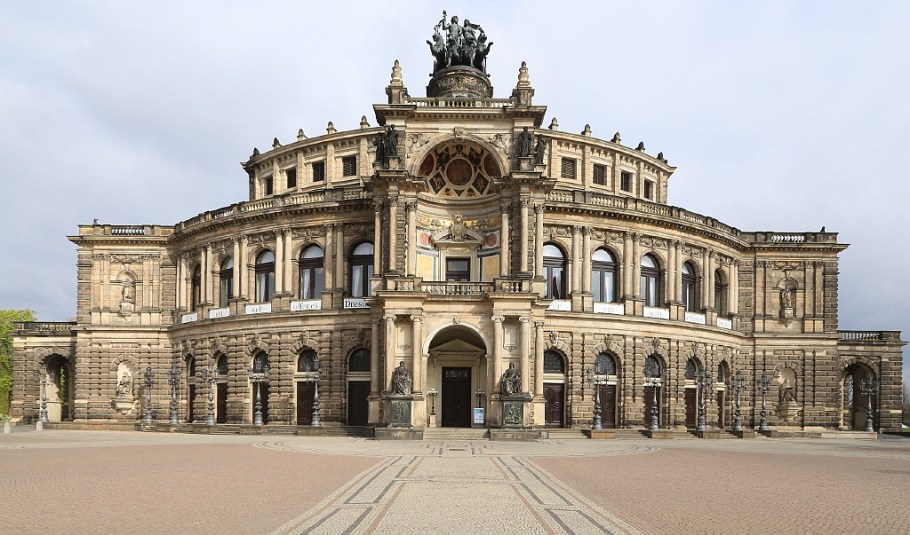
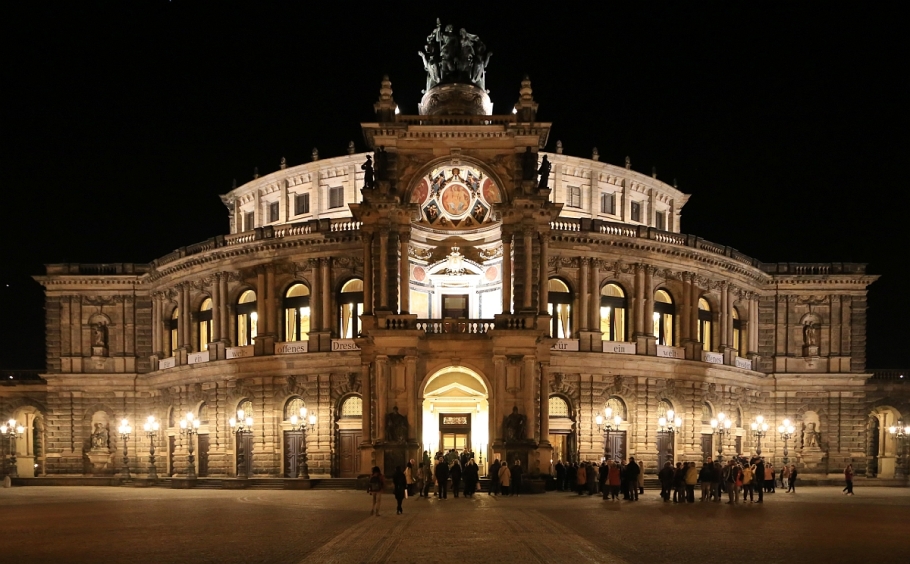
Dresden Semperoper: outside by day, inside at night

When I lived in Germany, I remembered the ads for Radeberger Pilsner, and I wondered about some of the venues shown. I realized the buildings were in the famous city of Dresden on the Elbe river in southeast Germany, and the city of Radeberg was only 15 kilometres from Dresden. Images of the Dresden’s landmarks have been an important part of Radeberger brewery’s advertising campaign to show the beer’s exceptional quality and to associate that very same quality by (physical) proximity with the symbolism of Dresden’s historic landmarks.

Dresdner Wahrzeichen (Dresden Landmark)

As one of the city’s most well-known landmarks, the Semperoper (Semper Opera House) appears in countless images representing Dresden. The Semperoper is the showpiece structure at Theaterplatz (Theater Square) looking over the river Elbe in the city’s Altstadt (Old Town). The first version of the building opened in 1841 with the design provided by Gottfried Semper. After destruction by fire in 1869, the second version of the building, also to Semper’s design, was completed in 1878. Only the Semperoper’s outer facade remained in 1945 during the final stages of the Second World War. Built once again to Semper’s original designs, the third and present version of the Semperoper opened to great acclaim on 13 February 1985. The interiors were reconstructed according to original plans and designs, whereas stage machinery and technical and engineering requirements are all updated to the best standards in audio quality.

With the leading title “Sächsische Staatstheater-Staatsoper und Staatsschauspiel Dresden”, the opera house is home to the Saxon State Opera, the Saxon State Theatre, the Semperoper Ballet, and one of the world’s oldest orchestras, the Staatskapelle Dresden, founded by Prince Elector Moritz von Sachsen in 1548.

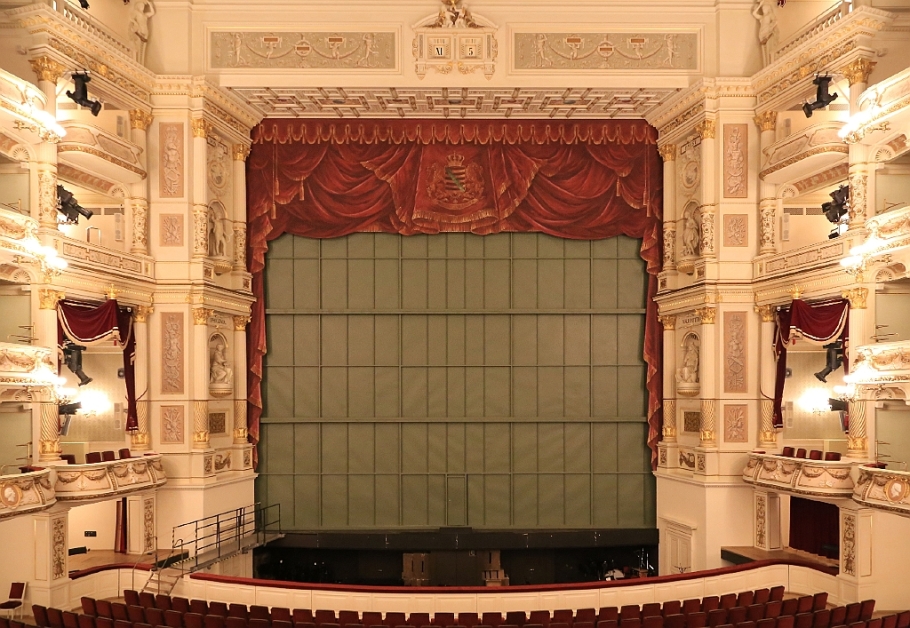
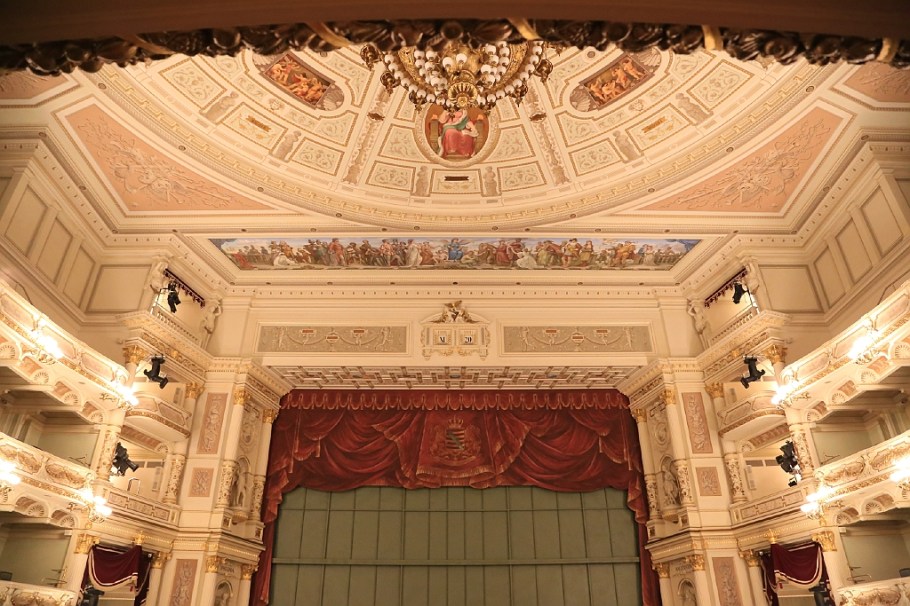
The Semper Oper is a natural part of any walking tour of Dresden, as Theaterplatz is minutes from the Zwinger, Residenzschloss, and the Frauenkirche. I’m awed by the night tour, a chance to see up close the building’s Baroque style exterior and the classic ornate interior. Everybody speaks in calm hushed voices, the unspoken agreement to be mindful and respectful of this venue. Despite the presence of other people in other tour groups, it feels like I have the Opera House to myself at 11pm.


Semper Oper, Theaterplatz, Dresden, Sachsen, Germany, fotoeins.com

Classic shot of the front by day

Semper Oper, Theaterplatz, Dresden, Sachsen, Germany, fotoeins.com

Classic shot of the front at night; also featured on the “night watch”

Semper Oper, Theaterplatz, Dresden, Sachsen, Germany, fotoeins.com

Ceiling mural

Semper Oper, Theaterplatz, Dresden, Sachsen, Germany, fotoeins.com

Some columns real marble (cool to touch); some faux-marble plaster (warm to touch). Full replacements were too expensive for the GDR/DDR at the time

Semper Oper, Theaterplatz, Dresden, Sachsen, Germany, fotoeins.com

S. Kurpiers, one of the stage managers and our guide for the evening

Semper Oper, Theaterplatz, Dresden, Sachsen, Germany, fotoeins.com

Main stage & orchestra, from central box section in the 1st balcony (Loge, 1. Rang). Clock at top-centre reads “XI 5”, or 1105pm

Semper Oper, Theaterplatz, Dresden, Sachsen, Germany, fotoeins.com

“Box” seats normally reserved for representatives and guests of the German federal state of Saxony

Semper Oper, Theaterplatz, Dresden, Sachsen, Germany, fotoeins.com

Separate guided tour to our left; there are 4 balconies

Semper Oper, Theaterplatz, Dresden, Sachsen, Germany, fotoeins.com

Another tour to the right

Semper Oper, Theaterplatz, Dresden, Sachsen, Germany, fotoeins.com

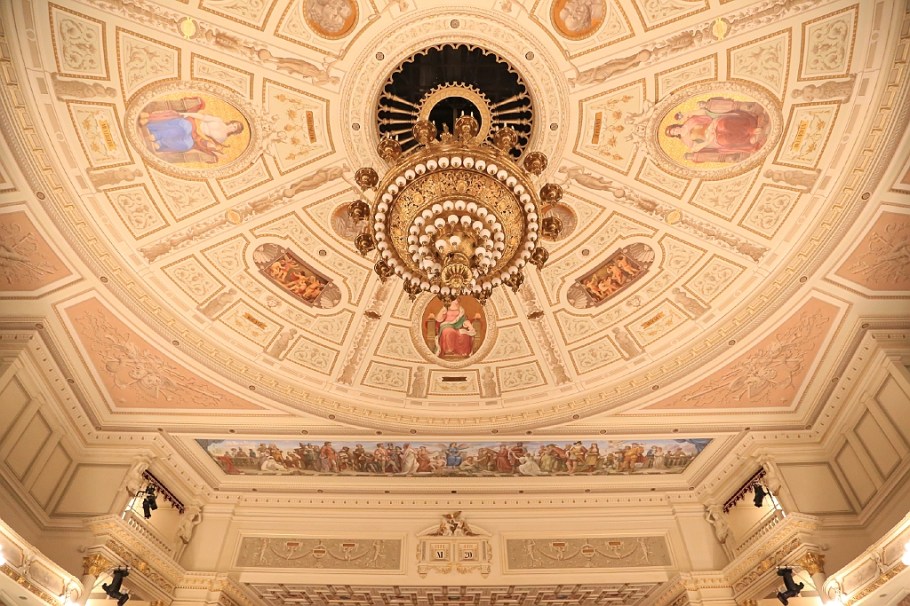
Looking up; lip of the 2nd balcony appears at top

Semper Oper, Theaterplatz, Dresden, Sachsen, Germany, fotoeins.com

Massive central chandelier light-fixture overhead; clock reads “XI 20” (1120pm)


More

DresdenSaxony TourismDW, architecture

Thanks to Semperoper for opening their facility to the public at night, and thanks to S. Kurpiers who kindly guided our tour of the venue. Thanks also to Germany Tourism, Saxony Tourism, and Dresden Tourism for their support and hospitality. I made all of the photos above on 22 April 2015 with the Canon EOS6D. This post appears on Fotoeins Fotopress at fotoeins.com as http://wp.me/p1BIdT-7sx.

The following is an advertisement for Radeberger brewery from 2014. The advert for their Pilsener ends with an image of Dresden’s Semper Oper at night and the slogan “schon immer besonders” (always special).

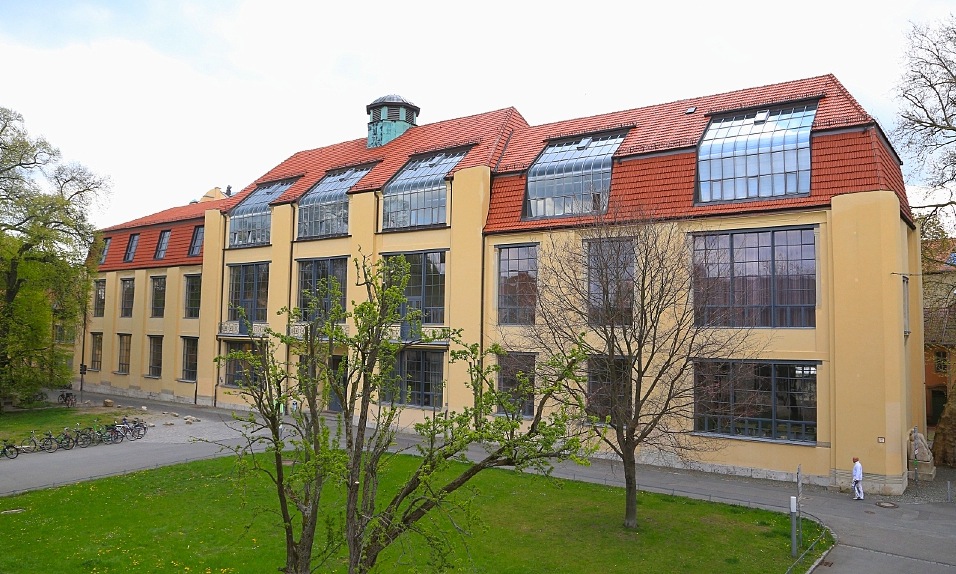
Uni-Hauptgebäude, Bauhaus Universität, Weimar, Thüringen, Germany, UNESCO World Heritage, Weltkulturerbe, fotoeins.com

Weimar Bauhaus Old & New, UNESCO WHS

There’s a clear transition in time where architecture and design took a step from behind closed doors for the sole purview of the rich and royal and out into the open for public and general consumption. It’s no surprise the years from the end of the 19th-century into the 20th-century marked big changes, with Art Nouveau at the time as part of the Secession movement. Throughout Europe, rebellion and revolution were in the air, economically, politically, and culturally.

The Bauhaus movement also helped initiate a conversation, creating and fostering a relationship between industry’s machinery and artistic or cultural creativity. Bauhaus opened in Weimar in 1919, before moving to Dessau and Berlin. The rise of the National Socialists deemed Bauhaus “degenerate” and did all they could to eliminate a movement and her people deemed counter to National Socialist policy. With Bauhaus’ forced closure in 1933 by the Nazis, a number of practitioners escaped Germany to other parts of the world, including the United States and Argentina.

For their deep and wide-ranging influence on 20th-century art, architecture, and design, an incomplete list of names includes Martin Gropius, Lyonel Feininger, Gerhard Marcks, Paul Klee, Wassily Kandinsky, Oskar Schlemmer, Herbert Bayer, Irene Bayer (née Hecht), Karla Grosch, Hannes Meyer, Ludwig Mies van der Rohe, etc. In particular, László Moholy-Nagy would move to Chicago in the United States and established in 1937 the New Bauhaus which became the Institute of Design in 1944.

Tucked away on a university campus a few minutes south of the Weimar city centre, two important building lie across from each other: the Saxony Academy of Art1 building and the Grand Ducal Saxony School of Arts and Crafts (College of Applied Arts)2. The former is now the main building for the present-day Bauhaus University, and the latter now houses Bauhaus University’s Faculty of Design. In 1996, these two buildings formed a part of the UNESCO World Heritage Site (WHS) listing and designation for Bauhaus sites in Weimar and Dessau.


( Click here for images and more )

Weimar: Duchess Anna Amalia Library, UNESCO WHS

As one of over ten buildings, residences, and properties making up what is called “Classic Weimar”, the Duchess Anna Amalia Library (Herzogin Anna Amalia Bibliothek) has been a UNESCO World Heritage Site since 1998.

To consolidate her love of books into a larger holding space, Duchess Anna Amalia commissioned in 1761 the State Architect to rebuild and convert the Renaissance-style French (Green) Castle into a library, which opened in 1766. Becoming one of the most important libraries in the country, the collections included some of the finest written and produced in German literature, art and culture, history, and architecture. Johann Wolfgang von Goethe himself was Library Director between 1797 and 1832.

The library has had its fair share of names: initially called the Ducal Library (Herzogliche Bibliothek); in 1815 renamed as the Grand Ducal Library (Großherzoglichen Bibliothek); in 1918 renamed as the Thuringia State Library (Thüringische Landesbibliothek); in 1969 renamed as the Central Library of German Classics (Zentralbibliothek der deutschen Klassik); and in 1991, renamed as Duchess Anna Amalia Library (Herzogin Anna Amalia Bibliothek) in honour of the library’s founder.

An electrical short from aging damaged wiring sparked a fire on 2 September 2004; the fire held on for over two days before the final hotspot was put out. Over 100 thousand books were damaged or destroyed by fire, water, and smoke. The fire was the largest to strike a German library in post-war history. Subsequent donations and volunteers poured into Weimar from throughout Germany and Europe to help with rescue and preservation efforts. After conclusion of extensive restoration work to the building, the interior Rococo Hall, and to thousands of rescued books, the library was reopened on 24 October 2007, the birthday of the library’s namesake (Anna Amalia born 24 October 1739).

( Click here for more )