Fotoeins Fotografie

location bifurcation, place vs. home

Posts from the ‘Architecture’ category

Before Bauhaus: Alfeld Fagus Factory, UNESCO WHS

Before Bauhaus found its first footing in Weimar, there was in the town of Alfeld in central Germany the Fagus-Werk factory building.

The Fagus factory building is looked upon as the first building in the world for the modern architectural age, and is the predecessor to the elegant 1926 Bauhaus headquarters building in Dessau. Fagus company founder Karl Benscheidt commissioned architect and future Bauhaus founder, Walter Gropius, to create and build a shoe-making factory as an artistic project. Gropius and his collaborator Adolf Meyer stuck with working floor-plans by architect Eduard Werner, and set their sights on new exterior and interior designs. Completed in 1911, the factory’s office building set a new standard for 20th-century industrial architecture with steel and glass construction and tall unsupported windows at the corners of the building.

“Fagus” is Latin for “beech tree”, and shoemaking began with shoe lasts or moulds constructed from beech wood, which were sold and distributed around the world to other companies for the productions of shoes. In the 1920s, Benscheidt developed the turning precision-lathe speeding up production, prompting growth and expansion and elevating the company to world’s top producer of shoe lasts. Today, the building is still a working factory: Fagus creates plastic lasts milled by automated machinery to precise specifications for specific designs by shoe companies. Also on-site is GreCon which produces systems for fire-detection and fire-extinguishing in industrial settings. The Fagus factory building was recognized as “unique living monument” and inscribed by UNESCO as World Heritage Site (Welterbe) in 2011.

With a population of over 20-thousand people, Alfeld is located in the German federal state of Lower Saxony. The town’s reach by train is 30-minutes from Hannover or 40-minutes from Göttingen, after which is a short 5- to 10-minute walk from Alfeld(Leine)1 train station to the entrance of the Fagus/GreCon complex. Visitors can walk around the working factory site, stop at the World Heritage Site Visitor Centre, sit in the neighbouring café for coffee or tea, and visit the museum dedicated to the building’s origins, the building’s century-long history of shoe-making, and a general history of footwear.

Walter Gropius and others would move to Weimar to establish a centre of art, design, thought, and attitude for Bauhaus in 1919, eight years after inauguration of the Fagus-Werk.

Die Baukunst soll ein Spiegel des Lebens und der Zeit sein.
(Architecture should be a mirror to life and its time.)

– Walter Gropius.

( Click here for images and more )

Vienna: Disrupting Historicism with Modernism (1918-2018)

Above/featured: Modernism at Steinhof Church: building by Otto Wagner, angels by Othmar Schimkowitz, stained glass by Koloman Moser (HL).

Vienna is as much a present-day cultural capital city as she was for decades and centuries. Many will get a peek and taste of long-established aspects of the city by walking the streets of the Old Town for the atmosphere, chatting in cozy cafés with coffee and cake for the ambience, and swaying to the rhythms of the waltz under the spell ofOlbr the (blue) Danube.

The early years of the 20th-century were troubled by greater calls for more autonomy from multiple ethnic groups within the patchwork of the Austro-Hungarian empire, by destruction and loss of life from The Great War (World War I), and by subsequent dissolution of the Empire. The capital city became an open theatre for socioeconomic and political changes across all class divisions within an environment where rebellion and revolution were the big talking points against the dogma of long-held traditions. Deep longing for the stability of the old and familiar mingled with equally enthusiastic desire for the radical of the new and mysterious.

Many in the arts, design, and cultural scene were questioning the excessive persistence of past styles, and were seeking something new to better represent changes happening all around them in Vienna. In 1897, a group of artists and architects resigned from the established Künstlerhaus to form the Vereinigung Bildender KĂĽnstler Ă–sterreichs (Union of Austrian Artists), known also as the Vienna Secession. Architecture moved towards a sharper focus to geometry and abstraction, and art flowed to the decorative with organic floral-like designs in the Jugendstil, Art Nouveau’s chapter in German-speaking lands. To promote their new ideas, the Secession group produced an official magazine called Ver Sacrum (“sacred spring” in Latin, 1898) and constructed the Secession building (1897) as an exhibition hall to display their work. The Wiener Werkstätte (Vienna Workshops) was created in 1903 as an association of artists whose thinking and applied arts creations were a precursor to the Bauhaus movement. Members of the Werkstätte worked with Vienna’s architects to broaden and unite the various concepts for a complete artwork, or Gesamtkunstwerk, as applied to a living space: the house, its rooms and furnishings, the interplay of light and space, and the tools and utensils for every day aspects of living.


( Click here for images and more )

Innsbruck’s Hungerburgbahn, by Zaha Hadid

As much as the Austrian federal state of Tirol is about mountains, spending time in the capital city of Innsbruck is also about reaching those very heights. To that end, Iraqi-British architect Zaha Hadid left her mark in Innsbruck with her redesigned Bergisel Ski Jump which opened in 2002, and her “Shell and Shadow” design of the Hungerbergbahn stations which opened in 2007.


( Click here for images and more )

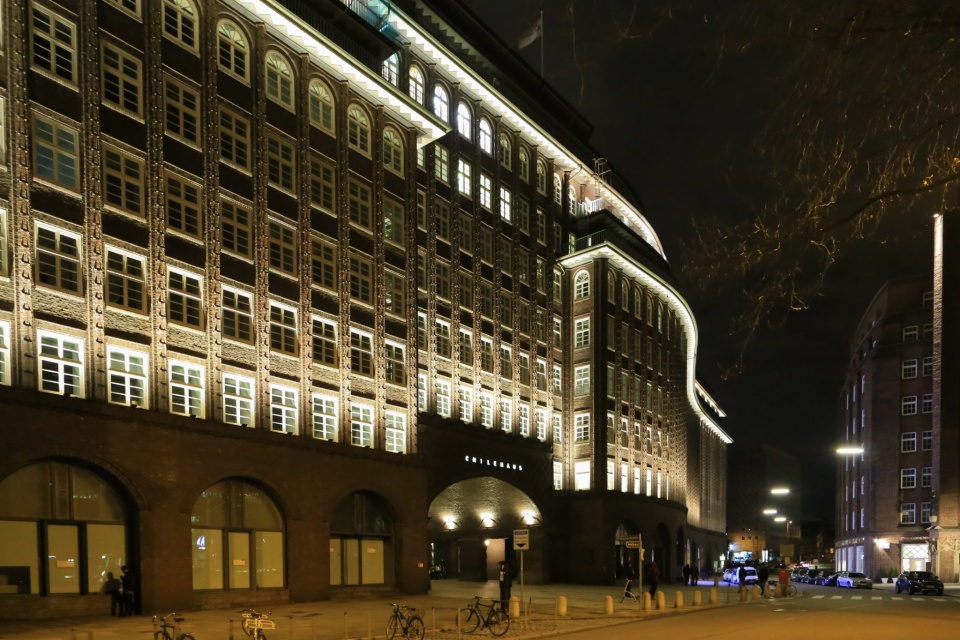
Chilehaus, Kontorhausviertel, UNESCO, Weltkulturerbe, World Heritage, Hamburg, Germany, fotoeins.com

Hamburg UNESCO WHS: Kontorhausviertel (Commercial District)

On 5 July 2015, UNESCO awarded World Heritage status to two sites in Hamburg: the Speicherstadt (Warehouse District) and the Kontorhausviertel (Office Building District). In the latter are two important brick buildings: Chilehaus and the Sprinkenhof, representative of the construction in the late 19th- and early 20th-century.

The Chilehaus was built by Fritz Höger for client Henry Sloman from 1922 to 1924 in the Kontorhausviertel as a prime example of German expressionist architecture using hard-fired brick. Höger undertook the project for Hamburg merchant and banker Sloman who made his fortune in importing nitrates from Chile. Built entirely to serve and complement the functions of the warehouses in neighbouring Speicherstadt, the Kontorhausviertel was the first dedicated office- and commercial-district on the European continent.


( Click here for images )

My Berlin: that tower again

I like shiny pointy objects, and if it’s by deliberate effort or accidental circumstance, the Fernsehturm (TV Tower) slides into many of my photos from Berlin. And if people throughout Berlin can see the tower, how do those who live in or commute through different parts of the capital city view the landmark? After multiple visits between 2005 and 2021, I’ve accumulated over 45 lines-of-sight to the TV Tower around Berlin.


( Click here for images and more )