Fotoeins Fotografie

location bifurcation, place vs. home

Posts from the ‘Architecture’ category

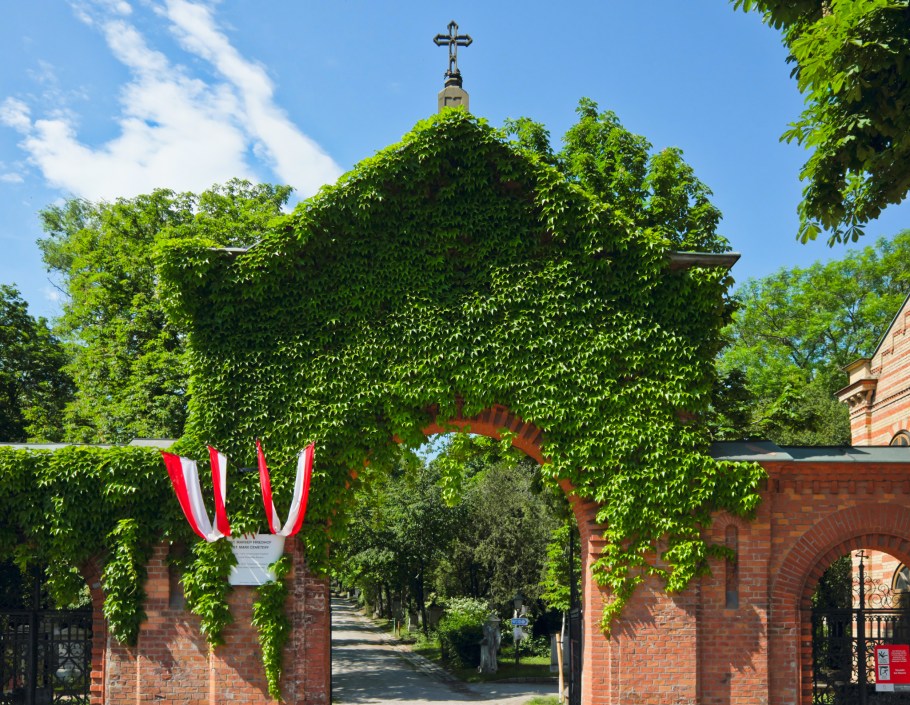
Vienna’s St. Marx Cemetery, Biedermeier style

Above/featured: Morning visit to the city’s Biedermeier cemetery – 20 May 2022.

In Vienna’s 3rd district, the St. Marx cemetery is the only surviving Biedermeier cemetery in the city. A visit now is a jump into the frozen past. The cemetery opened with its first burial in 1784. Closure of the city’s multiple neighbourhood cemeteries began in 1873 with the final burial at St. Marx taking place in 1874. Subsequent funerary functions were transferred to the newly constructed Zentralfriedhof located farther out from the city centre. The very leafy avenues and “leafy gate” are what’s left of the city’s only remaining 18th-century cemetery that is now open to the public as a city-administered park.

Why Biedermeier

Biedermeier in Vienna corresponds to a cultural period during the first half of the 19th-century marked by increased industrialization in rapidly urbanized areas and strict censorship with the elimination of dissenting political voices. Instead of looking outward to change, the artist and design community moved to safer spaces in nature or to their homes. While innovation might have given way to a modest yet graceful and functional style, Biedermeier architecture in its neoclassical spin provided inspiration for subsequent Art Nouveau (Jugendstil) and Secession movements. An important Viennese architect of the period was Josef Kornhäusel who designed many buildings in the city. Important music from this period was composed by, for example, Beethoven, Chopin, Liszt, Schubert, Schumann. One of the largest collections of Viennese Biedermeier art is in the Belvedere’s collection. St. Marx cemetery is a reflection of both city and age from the 19th-century.

St. Marxer Friedhof, St. Marx cemetery, Biedermeier cemetery, 3. Bezirk, Landstrasse, Wien, Vienna, Austria, Ă–sterreich, fotoeins.com

Cemetery entrance. Photo, 5 Jun 2023.

St. Marxer Friedhof, St. Marx cemetery, Biedermeier cemetery, 3. Bezirk, Landstrasse, Wien, Vienna, Austria, Ă–sterreich, fotoeins.com

Main gate. Photo, 20 May 2022.

St. Marxer Friedhof, St. Marx cemetery, Biedermeier cemetery, 3. Bezirk, Landstrasse, Wien, Vienna, Austria, Ă–sterreich, fotoeins.com

Address: Leberstrasse 6–8. Photo, 20 May 2022.

St. Marxer Friedhof, St. Marx cemetery, Biedermeier cemetery, 3. Bezirk, Landstrasse, Wien, Vienna, Austria, Ă–sterreich, fotoeins.com

Information stone with visiting hours by month. Photo, 20 May 2022.


( Click here for images and more )

Vienna Judenplatz: centuries & memories of the Jewish community

Above/featured: Judenplatz at night. The Holocaust memorial is in the foreground at centre. In the background are “To the little trinity” at centre and Misrachi House (Museum Judenplatz) at right. Photo, 10 Jun 2022.

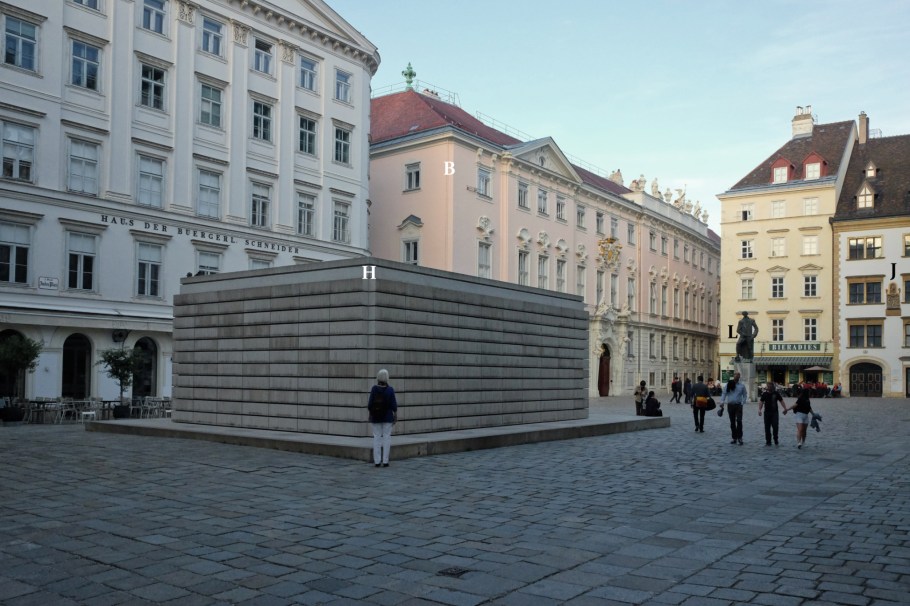
At Judenplatz are clear visual reminders of the city’s first Jewish community in medieval times.

The first Jewish community in Vienna settled around present-day Judenplatz in the Middle Ages with mention in written documents dated mid- to late-13th century AD/CE. Daily Jewish life thrived around the Or-Sarua Synagogue, the Jewish School, and the Mikveh ritual bath. The community along with the surrounding Jewish neighbourhood came to an end with the Pogrom of 1421. Catholic Habsburg Duke Albrecht II rolled out a decree (Wiener Geserah, Vienna Gesera) which legitimatized the expulsion, incarceration, torture, and murder of some 800 Jewish residents; accompanied by destruction and forced takeover of buildings and property.

Below I highlight remnants and traces to the medieval Jewish community at this square in central Vienna.

Judenplatz, Vienna, Wien, Oesterreich, Austria, fotoeins.com

Facing northwest: B, Bohemian Chancellery; H, Holocaust Memorial; L, Lessing monument; M, Misrachi House; T, To the little Trinity. Photo, 20 May 2018.

Judenplatz, Vienna, Wien, Oesterreich, Austria, fotoeins.com

Facing southeast: B, Bohemian Chancellery; J, Jordan House; H, Holocaust memorial; L, Lessing monument. Photo, 20 May 2018.


( Click here for images and more )

Vienna’s Art Nouveau highlights

Above/featured: A captive audience surrounds the Gustav Klimt painting “The Kiss” in Vienna’s Upper Belvedere. Photo, 19 May 2018 (X70).

If you’re paying attention, traces of the turn-of-the-century Viennese Art Nouveau (Wiener Jugendstil) art and design movement are visible throughout the Austrian capital city.

A painting.
A sculpture.
A building.
A clock.
A church.
A building mural.
A staircase, with railings and light fixtures.
The front facade of an apartment block.
The entrance pavilion to the municipal railway.
A decorative structure marking the exit/end of a river’s diverted route underneath the city.

I provide ten visual examples below, all of which are accessible with public transport.


( Click here for images and more )

Vienna: Holocaust Wall of Names Memorial

Above/featured: Shoah Namensmauern Gedenkstätte memorial site.

I drag my fingers gently down each stone block, across the fine indentations and the print of countless names.

I give quiet voice to each name I see.

In Vienna’s 9th district is a small green space, Ostarrichi Park, in front of the Österreichische Nationalbank (Austrian National Bank). The park is home to the Shoah Namensmauern Gedenkstätte (Holocaust Wall of Names Memorial), dedicated to over 64-thousand Austrian Jews murdered during the Nazi regime. Public inauguration of the memorial occurred on 9 November 2021 on the 83rd anniversary of the Pogromnacht.

The establishment and realization of the memorial has been a lifelong project for Vienna-born Holocaust survivor Kurt Yakov Tutter, who with his family fled to Belgium in 1930. Kurt and his younger sister, Rita, survived with the help of a Belgian family; their parents were deported and murdered in Auschwitz.

He made a new home in Toronto, Canada, where in 2000 he began working to create a memorial to murdered Austrian Jews. Funding from the national Austria state emphasized the enormous significance of the historical memorial; responsibility for continuing maintenance of the memorial is now shared by the Austria National Fund and the City of Vienna.

The names of over 64-thousand children, women, and men are engraved onto 160 giant granite slabs, arranged in the park space as an oval ring. Within the open and uncovered space, visitors to the memorial can walk briskly past each vertical block, but the air is thick with names.

•   Jewish Welcome Service
•   Austria National Fund for Victims of National Socialism
•   Austrian Holocaust Victims database, DĂ–W (Documentation Centre of Austrian Resistance)
•   Audio: Mr. Tutter speaks about Austria’s very late road to dealing with the past (Vergangenheitsbewältigung) and why he created the Wall of Names project.


( Click here for images and more )

Vienna: Imperial Court Pavilion Hietzing, by Otto Wagner

Above/featured: Hofpavillon Hietzing in afternoon light, facing east with the departing eastbound U-Bahn U4 train. Photo, 15 May 2022.

Along Vienna’s U4 metro line, a dark-domed white cube-like structure seems to float over the tracks between Schönbrunn and Hietzing stations. Most may not realize the building’s relevance to the history of the city’s first railway, the city’s rapid urban evolution into the 20th-century, and the railway architect’s eventual “break away” transition from historicism to modernism.

Vienna was going to look very different after 1890. The city undertook its second and greatest expansion, absorbing 6 outer districts and ballooning the total population to almost 1.4 million (almost doubled in 10 years). The city’s administration recognized the challenge of efficiently transporting people between its new outer suburbs and the inner city. In 1894, Vienna appointed architect Otto Wagner with the complete design and construction of the new Wiener Stadtbahn metropolitan railway. The railway saw the creation of four new lines: the Danube canal line (Donaukanallinie), the “Belt” line (Gürtellinie), the suburb line (Vorortlinie), and the Vienna river valley line (Wientallinie). Today, the city’s U-Bahn U4 and U6 lines and the S-Bahn S45 line operate electrified over much of the original routing.

The Vienna valley line brought track and construction in front of Schönbrunn, the imperial summer palace for the ruling Habsburgs. The rail line’s new Schönbrunn station was located at the northeast corner of the palace grounds. But at the grounds’ northwest corner, Wagner created two stations: one for the public, and one for the Habsburgs. Built for the inauguration of the city railway on 1 June 1898, the imperial pavilion was set aside for the emperor, family, and staff. Emperor Franz Josef I only used the pavilion twice, as he was reluctant (hostile) to accept rapid changes brought by modernity.

Wagner created a domed-building whose interior was furnished with floral and vegetal elements in the Jugendstil (Art Nouveau) style, a painting with a bird’s eye view of the city over Schönbrunn, a private suite for the emperor; and whose exterior included the uniform green and white colours seen throughout the entire rail network, glass and wrought-iron elements, and a separate portal providing a covered entrance for the imperials. Out of the many station buildings Wagner designed for the entire system, the imperial pavilion at Hietzing is most associated with the “historical” architectural style. The building is now a part of the city’s Wien Museum after successful post-war efforts to save and restore the structure.

The informal name is the “Hofpavillon Hietzing” (Imperial Court Pavilion Hietzing), but the building’s formal name is “Pavillon des kaiserlichen und königlichen Allerhöchsten Hofes” (Pavilion of the Imperial and Royal Highest Court). In the images below are divided sections: “exterior”, “interior”, and “sketches”.


( Click here for images and more )