Fotoeins Fotografie

location bifurcation, place vs. home

Posts from the ‘Australia’ category

Canberra: Poppies at the Australian War Memorial

The word “poppy” in Germany is associated with the delicious poppy seed filling (“Mohn”) commonly used in cakes and pastries. Elsewhere, poppies are unfortunately associated with the production and consumption of hard drugs.

It’s easy to forget another representation associated with the flower: a commemoration symbol for the war dead.

Wild poppies grow in Belgium, and in particular, in the Ypres salient, one of many places where bodies, blood, and mud were the norm in close-contact trench warfare in World War One. Canadian physician and Lieutenant Colonel John McCrae was serving in the 1st Field Artillery Brigade, and after burying his friend, Lieutenant Alexis Helmer who died of injuries sustained during the Second Battle of Ypres, McCrae wrote the poem “In Flanders Fields” as he took the scene before him. Moved by McCrae’s poem, American Moira Michael began in 1918 the practice of wearing poppies on Remembrance Day.

It’s why you may see people sporting poppies on their lapels in the days leading up to November 11; the tradition is encouraged and upheld mostly in Commonwealth countries. In Australia and New Zealand, the big day of commemoration is ANZAC Day on April 25.

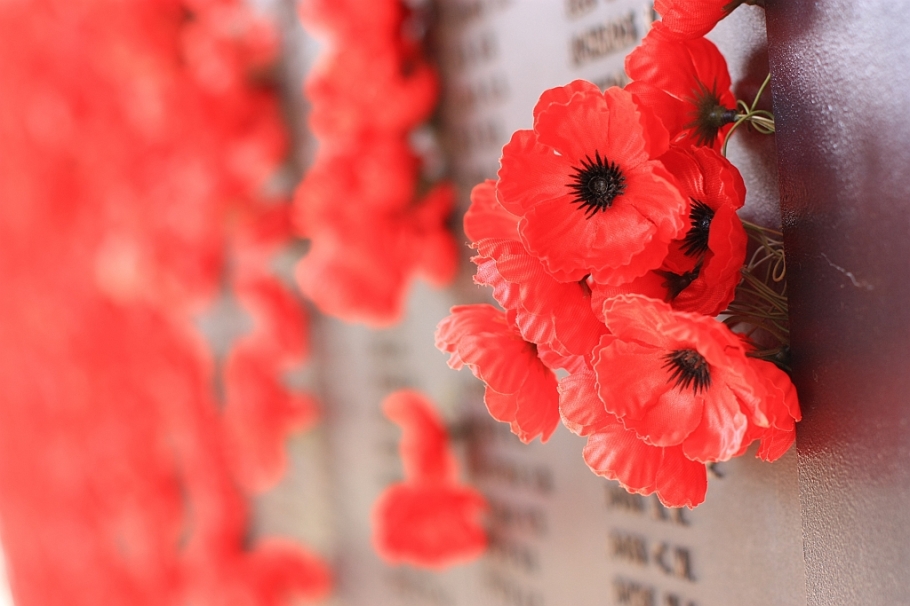
At the Australian War Memorial in Canberra, over one hundred thousand names are inscribed on the walls at the Roll of Honour; these are the names of people killed in action since 1885. A paper poppy is placed next to each name for relatives or direct descendants.
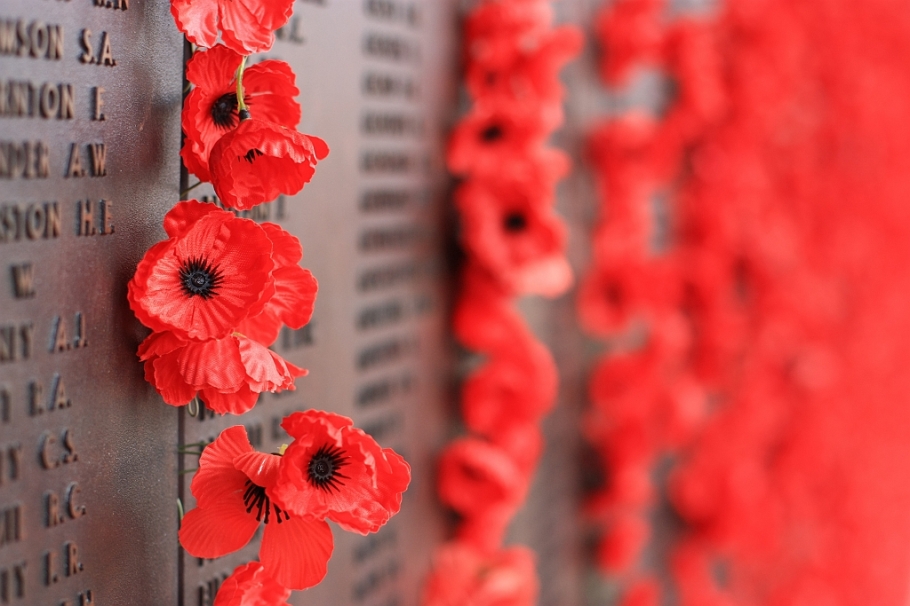
Roll of honour, west, Australian War Memorial, Canberra, ACT, Australia
Roll of honour, east, Australian War Memorial, Canberra, ACT, Australia

Roll of honour: west (top), east (bottom) : Australian War Memorial, Canberra, ACT

I made the two photos above at the War Memorial’s Roll of Honour on 6 September 2012; this post appears on Fotoeins Fotopress at fotoeins.com.
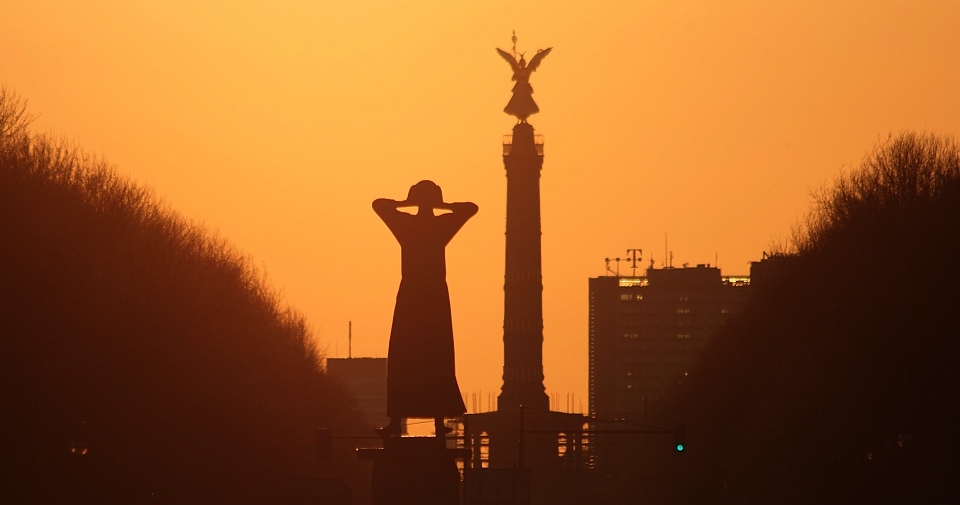
The Crier, Tiergarten, Berlin, Germany, fotoeins.com

The Crier: from Berlin to Perth

In this post, I wrote about how I discovered the statue called “Der Rufer” (The Crier) in Berlin’s Tiergarten:

The statue in the foreground is called “Der Rufer” (The Caller or The Crier). Created by Gerhard Marcks in 1966, a cast of the bronze statue was purchased and erected here in place in the former West Berlin in May 1989. The statue was placed deliberately so that the “caller” faced East Berlin. At the sculpture’s base is a quote by Italian poet Francesco Petrarch (1304-1374): “Ich gehe durch die Welt, und rufe ‘Friede Friede Friede'” | “I wander through the world, and cry ‘Peace, Peace, Peace.'”

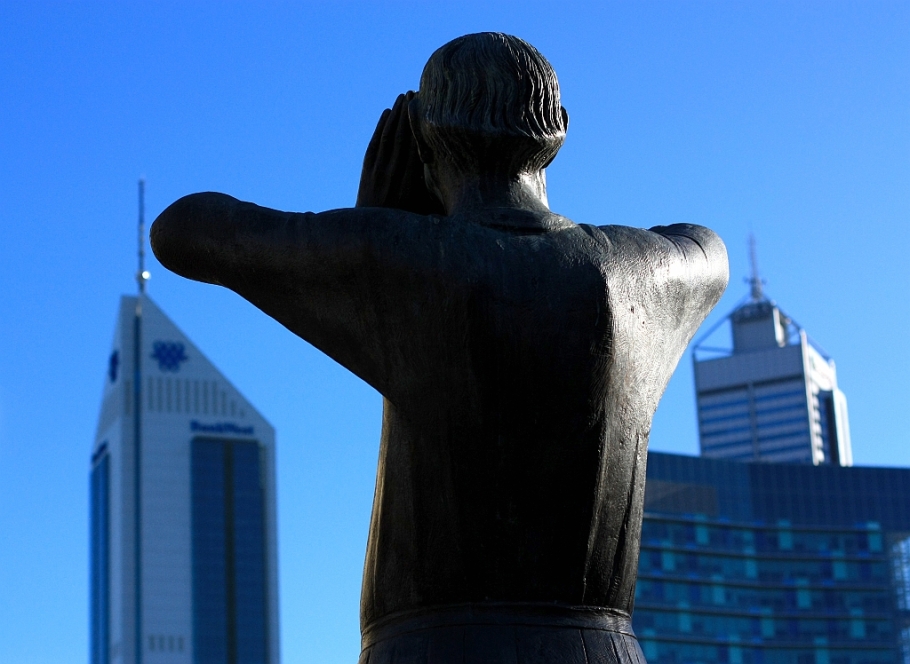
On 12 September 2012, some 18 months after making the above photo, I discovered the same statue by accident at the Cultural Centre in Northbridge, Perth, Australia.

The Crier, Art Gallery of Western Australia, Perth, WA, Australia, fotoeins.com

The Crier (Perth)

Sculptor Gerhard Marcks (1889-1981) did not intend to convey a specific message or meaning to his piece of work. However, the version of the sculpture in Berlin was dedicated to a call for peace, whereas the casting in Perth was dedicated to the victims of torture.

I made the photos shown above with a Canon EOS450D: the first (Berlin shot) with EF-S 18-55mm f/3.5-5.6 IS kit-lens, and the second (Perth shot) with the 50mm f/1.4 prime-lens. This post appears on Fotoeins Fotopress at fotoeins.com as http://wp.me/p1BIdT-2og.

Hyde Park, Sydney, Australia

Sydney: Sunday bubbles in Hyde Park

It’s a beautiful Sunday, halfway into a long Labour Day holiday-weekend in the Australian states of New South Wales and the Australian Capital Territory. The early-spring day brings sun, blue skies, and a very reasonable temperature of +21C/70F.

Located in the City centre, Hyde Park is not only the oldest park in Sydney, but also the oldest park in Australia. The area was originally used as a staging ground for soldiers, and in 1810, was officially recognized as a “common” (open land for public use). Then-governor Macquarie named the common after Hyde Park in London, England.

On this afternoon, there are many in Hyde Park : some are here for the art exhibition; some are enjoying a picnic or a suntan on the grass; some are out with their baby strollers; and others have their cameras to photograph the day. A gentleman next to the Archibald Fountain is blowing soap bubbles large and small, to the joy of young and old alike. The tip jar is getting some joy, as the curious stop, watch, and part with some coins.

And so it goes, the streams of soapy spheres on a sunny Sunday in Sydney’s Hyde Park.

( Click here for more )

Kangaroo Island (SA): seals, koalas, & roos

Devastating bushfires in the 2020 Australian summer (December 2019-March 2020) wiped out a significant fraction of flora and fauna on Kangaroo Island. For many plant and animal species, recovery will require years to decades.

Kangaroo Island in South Australia was named for the large number of kangaroos, which were a source of fresh meat for the crew of the British ship HMS Investigator in 1802. The ship was captained by Matthew Flinders, who was tasked to chart the southern Australian coastline. Desperate without fresh supplies for months, Flinders named the island in gratitude for the abundance of roo meat.

Then again, the indigenous name for the island is “Karta” or “Island of the Dead.” That’s a little sinister, as something must have happened; either the aborigine population left the island or they died out.

But life bounces back, and there’s plenty of it on this island.

There are plenty of sheep where on grassy meadows, seals at Kingscote Jetty, young and adult seals relaxing and sleeping in the sun at Admirals Arch, free-climbing koala bears and free-roaming kangaroos at the Hanson Bay Wildlife Sanctuary, Ligurian honey bees at Clifford’s Honey Farm, and a lone echidna by the side of a dirt road in the middle of the island.

In making these photos, I used my long-zoom lens; no animals were harmed, poked, prodded, or ridiculed in the process.

( Click here for images and more )