In Vienna’s Museum of Science and Technology, I get to nerd out over things like cameras, calculators, radios, televisions, and telephones: all of which are now contained in some compact form within a mobile “smart” phone. Much of the history for the development of gadgets large and small is both long and fascinating.
But there’s also regulation of the Danube river, fresh- & waste-water management, computers & data management, bookmaking & block-type, print-making & lithography, tools & equipment “at home”, national radio & television broadcasting, telegraph & telephony, power generation, engines & automobiles, aircraft & airports, industrial-scale smelting, elevators & funiculars, transport signals, hygiene practices, et cetera, et cetera.
No surprise, really, that it’s a wae difficult to see everything available in the museum’s general collection inside a single visit.
TMW: Technisches Museum Wien.
Ebene 4 (4th level).
Ebene 3 (3rd level).
Typewriter: one of the earliest prototypes, by Peter Mitterhofer in Partschins (Italy) in 1864.
Top view: one of the earliest typewriter prototypes, by Peter Mitterhofer in Partschins (Italy) in 1864.
Arithmetic (mathematics) book from Johann Hemeling, printed in 1678 by Johann Görlin in Frankfurt, Germany. At right is an example of compound interest of 5-percent applied annually over 20 years on a principal of 10 million; that is, 10^7 * 1.05^20 =26532977.
Hewlett-Packard HP-35 electronic pocket scientific-calculator: USA, 1972.
Texas Instruments SR-40 electronic pocket scientific-calculator: USA, 1975.
Rolleiflex reflex camera with cut film adapter: Franke & Heidecke, Braunschweig (Germany), around 1929.
Front view, Leica I 35mm-camera: Ernst Leitz GmbH in Wetzlar (Germany), 1930. The word “Leica” is constructed from “Leitz” and “camera”.
Top view, Leica I 35mm-camera: Ernst Leitz GmbH in Wetzlar (Germany), 1930.
Front view, Leica IIIa 35mm-camera: Ernst Leitz GmbH in Wetzlar (Germany), 1938.
Top view, Leica IIIa 35mm-camera: Ernst Leitz GmbH in Wetzlar (Germany), 1938.
Left: Western Union, internal memo, 1876. Right: purple Telekom/Magenta telephone booth with a large digital screen and webcam.
Würfeluhr (Viennese cube-clock), 1930 to 1960s. This style of city clock can be found throughout the city of Vienna.
On Ebene 1 (level 1), the public can make their own thermograms: images in the thermal infrared at wavelengths around 10 microns. Red to orange are the warmest temperatures.
The hope is real: to live long and prosper (in the thermal infrared) with my trusty X70 (in the optical/visual). Thankfully, my glasses and camera remain “cool”.
I received neither support nor compensation for this piece. Except for the final two frames, I made all remaining images with an iPhone15 on 8 July 2025. This post composed within Jetpack for iOS appears on Fotoeins Fotografie at fotoeins DOT com.
No, I’m not “declaring”, nor am I “bowled all-out” 🏏
… and India scored over one-thousand runs against England at Edgbaston …
Two-thirds of my time in Europe has rapidly come and gone. By this point, I promise myself to take more time for self-reflection and express more appreciation into the universe. But what’ll happen is I’ll likely “rush” myself in the final 1/3rd with a more punishing pace.
Today’s weather was a little strange but welcoming. Steady rain-showers and cool-below-20C in the morning broke by mid-afternoon to sun and the temps back up to +23C, a far cry from the heat last week.
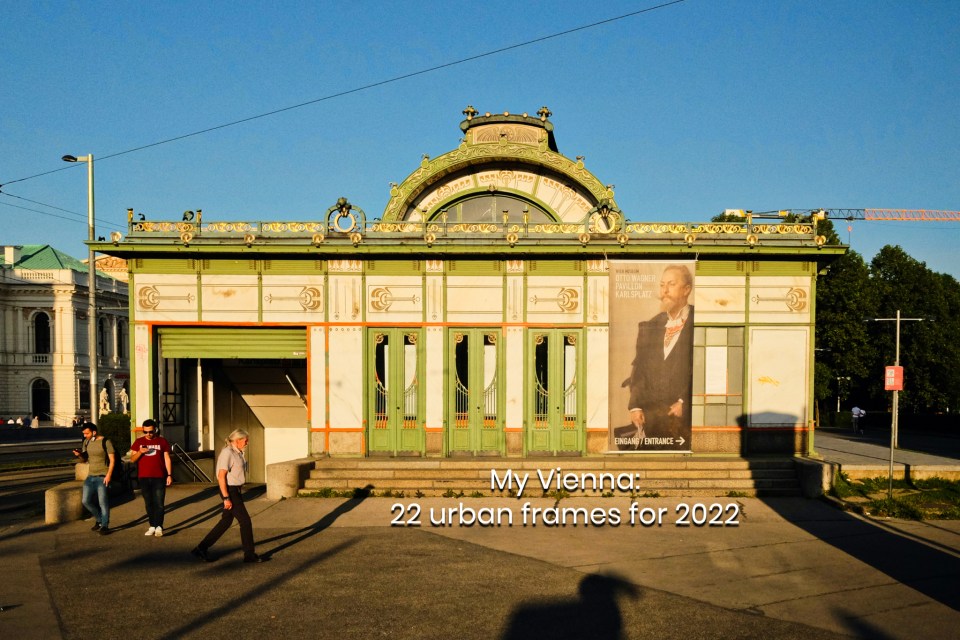
Wien Museum Karlsplatz is closed Mondays, but on this Monday afternoon, the light is very good.
U4 station Stadtpark (“city park”).
South entrance to the city’s Stadtpark.
U2 station Schottentor: on the right is a train departing south to Karlsplatz.
U2 station Schottentor: what faces commuters going up and down the escalators is “Einen Augenblick Zeit” (just a moment), a 1994 installation by Austrian artist Hofstetter Kurt. Transmitting an eyeful also helpfully includes the current time.
U2 station Schottentor, also known as Universität for the nearby University of Vienna. Wall adverts: “Listen to each Oida” / “I love you but don’t touch my pizza.”
Passing through Wien-Mitte/Landstrasse in early-evening, I stopped off at Thalia, a chain of bookstores based in Germany. They also carry books in multiple languages, and their English-language section is very decent. These three titles grabbed my eyeball, thereby loosening the wallet. “Mapmatics” combines my love of maps and mathematics. “Nuclear War: A Scenario” is a what-if chain of events. “Prequel” is about how early 20th-century Nazism had crossed west over the Atlantic in their undisguised attempt to soften American public opinion and delay or stop any possible American military intervention.
I made all images above with an iPhone15 on 7 July 2025. This post composed within Jetpack for iOS appears on Fotoeins Fotografie at fotoeins DOT com.
The city bus drops off passengers in front of a building with the words “Otto Wagner Spital”, a legacy of early 20th-century construction for a hospital complex. Many of the former hospital buildings are now art-, music-, and cultural-spaces.
Keeping faith with the accuracy of signs, it’s a short but steep walk on graded gravel paths until a large dome pokes out into the open behind the canopy of trees. On a sunny day, the dome looks like a bright yellow lemon to the city below.
Completed in 1907 to serve patients in the surrounding hospital complex, the Church of St. Leopold at Steinhof by Otto Wagner is one of Vienna’s most important buildings, one of the finest examples of turn-of-the-century Vienna Modernism, and considered to be Europe’s 1st modernist church. Today, the Wien Museum maintains and opens the still-functional church for the public.
Otto Wagner’s architectural and design legacy from the early 20th-century is predominantly secular, remaining visible throughout the city today.
Seated near the top of Lemoniberg hill (345m), the church’s yellow dome can be seen for miles around.
Public entrance.
Interior space; the entire floor is slightly tilted from the entrance towards the chancel in front.
Eyeballs converge onto the high altar. The length of the pews are deliberately short.
The high altar, behind which is a 1913 mural by Leopold Forstner on the wall.
Free-standing high altar made with white marble; design by Otto Wagner.
Angels surround the canopy for the altar; at the top is a circular opening with a view maintained upwards.
0.5x image scaling. The large stained-glass windows on each side are by Koloman Moser. Sharp readers will have noticed a few people seated in the pews.
The first Sunday of the month means that all Wien Museum properties are free admission for the day. I made all images above with an iPhone15 on 6 July 2025. This post composed within Jetpack for iOS appears on Fotoeins Fotografie at fotoeins DOT com.
I’m in the mood for a slow sit-down meal of the highest order. Yeah, it’s gonna cost me, and it’ll be pasta and pesto or bread and cheese the next few nights, but it’s time here and now, that I say hello once again to Plachutta and their modern version of the imperial Tafelspitz.
There are many beef cuts to choose from the menu, but I’ll go what brought me here the first time: the Tafelspitz cut. I provided a longer and more flavourful description here, but here are today’s highlights.
The Plachutta restaurant in Hietzing, Vienna’s 13th district. Take the U4 to Hietzing station and walk, or hop on tram 10 or 60 at Hietzing station for the 1 stop to Dommayergasse.
“An-eighth” (0.125L) glass of Gemischter Satz (centre), a local specialty that’s grown in vineyards within and around the city of Vienna. I also have a big bottle of carbonated mineral water. Yes, drunk separately; I’m no heathen.
Simple bread and rolls, with whipped garlic butter or regular butter.
The big pot, with side pots (top) with creamed spinach and fried potatoes; at lower right are chive cream sauce and apple horseradish sauce.
Hot savory beef broth ladled over a small bowl filled with ribbons of sliced pancake.
Beef marrow spread over toasted rye bread.
The slab of the slow-simmered rump-roast cut: simultaneously lean and fatty, moist, tender, not dry; cut root-vegetables; creamed spinach; fried potatoes; and big dollops of sauces.
Against better judgement (which is the moment I walked in the door), I get caramel ice cream to cool off a big warm hearty meal on a warm summer day. (There’s outdoor patio seating, but they’ve got the A/C working hard inside.)
I received neither support nor compensation for this piece. I made all images above with an iPhone15 on 5 July 2025. This post composed within Jetpack for iOS appears on Fotoeins Fotografie at fotoeins DOT com.
Yesterday, I had lunch at one of my favourites at Yak+Yeti. Today, I revisited another favourite that’s Eisfuchs for their homemade ice cream. Nowhere as toasty as yesterday’s +35°C, today’s +25°C is plenty warm for a sweet cold treat.
Similarly to Yak+Yeti, I also discovered Eisfuchs for the first time in 2022, when I made the short walk up Neubaugasse from the 6th into the 7th district. I’ll always try something new, but every year since, I’m gonna have my two scoops: “Cheesecake Marille” (apricot cheesecake) & “Tarte Zitrone” (lemon tart).
There’s no inside seating, but there are benches on the street outside, as Neubaugasse is essentially restricted to buses, taxis, and service vehicles. I’m in the city for a month: multiple visits to the fox are an essential requirement.
Eisfuchs, on Neubaugasse just south of Westbahnstrasse.
What’s available today 🍨
Glorious.
Sweet, creamy, tart, plus the crunchy bits.
🧊 🦊 = ❤️ + 🍨
I received neither support nor compensation for this piece. I made all images above with an iPhone15 on 4 July 2025. This post composed within Jetpack for iOS appears on Fotoeins Fotografie at fotoeins DOT com.