Fotoeins Fotografie

location bifurcation, place vs. home

Posts by HL fotoeins

Berlin Grunewald: no train will ever leave track 17 again

Present in the vicinity of a train station are very distinct and familiar sounds: the racket of heavy locomotives chugging down the rail and the screech of high-friction braking. A breeze sweeps through two columns of trees, creating a low keening sound which escapes into the open space beyond. To stop and listen, the sounds could easily be human: faint shouts and cries. Are they tricks of the mind, or are the dead speaking? The spectre of cruelty, despair, and suffering clings to the abandoned track; seven decades in the past don’t seem very far.

On a cool grey late-autumn afternoon, I’m on an S-Bahn train heading towards Potsdam. Beyond the limits of the “Stadtbahn” and one stop beyond the “Ring” at Westkreuz, the train pulls into the former goods and freight station at Grunewald. Dropping into the underground passage, signage points to the memorial at track 17. I leave the station by the southeast exit, and turn left to ascend the ramp along the side street.

In the Berlin borough of Charlottenburg-Wilmersdorf, Grunewald station lies on the S7 S-Bahn line serving central Berlin city, the city of Potsdam to the southwest, and Ahrensfelde to the northeast in the Berlin borough of Marzahn-Hellersdorf. Grunewald station began operation in 1879 under its original name Hundekehle named after a nature reserve nearby. The station changed its name to “Grunewald” in 1884 when the old Grunewald station began its new life as “Halensee” station. Grunewald station and its tracks were incorporated into Berlin’s S-Bahn train network in 1928.

Many companies including the Deutsche Reichsbahn (German Imperial Rail) were actively complicit in the machinery of mass murder during Nazi rule. After reunification of East and West Germany in 1990, the two separate railways also merged to form Deutsche Bahn in 1994, and calls arose for the new company to acknowledge its dark past. To mark the Reichbahn’s collaboration in deporting people to camps and their deaths, present-day Deutsche Bahn AG established a memorial at track 17. Inaugurated in 1998 the memorial was designed and built by architects Hirsch, Lorch, and Wandel who were very mindful of the 1991 Karol Broniatowski memorial near the station’s entrance.

Along track 17, metal plates have been inserted, one for every transport train which took Berlin’s Jews to their deaths. Each plate includes the transport date, the number of people deported, and the transport’s destination. The first train of record departed Grunewald on 1941 October 18 when 1251 Jews were deported to Łódź. Another plate marks the last train of record (so far) leaving Grunewald on 1945 March 27 when 18 Jews were deported to Theresienstadt; blank plates leave room for additional commemorations with new uncovered information. More than 50-thousand Jews from Berlin were deported from this station alone. The first set of trains went to concentration-camps in eastern Europe, but by the end of 1942, trains were directed to Auschwitz and Theriesenstadt.

The vegetation that’s been left to grow around the track over the years is a visible symbol and an unspoken promise to all: that no train will leave track 17 ever again.

( Click here for images and more )

Rothenburg ob der Tauber: medieval city by day

I’ve been hearing about this place for years. “Ya gotta come; the beautiful magical city is a dream come true.” At some point, hype bleeds into “white noise”, and attention turns elsewhere.

The day arrives when the timing is a great fit, when the city becomes the first stop on a four-week long tour of the country. I’m hitting a seasonal “sweet spot” in between the summer surge and the Christmas crush. There are far fewer tour buses and day-trippers, but even in mid-November, plenty of visitors are spellbound by the visual beauty. Freed by the weight of the crowds, the feeling collectively from Rothenburg ob der Tauber and her residents feels a lot like a big exhalation of relief.

Directly translated as “red castle over the Tauber (river)”, Rothenburg ob der Tauber is located in the Middle Franconia (Mittelfranken) region of Bavaria. The city lies at the junction of the Romantische Strasse (Romantic Road) and the Burgenstrasse (Castle Road).

From the first community established in nearby Detwang in 960 AD/CE, the Hohenstaufen “Castrum Imperiale” (Imperial Castle) in 1142, a new settlement adjacent to the castle recognized as “Civitas” in 1241, the young city’s Free Imperial City status claimed in 1274, the Reformation’s arrival in 1544, the Thirty Years’ War siege and forced occupation in the early 17th-century, an independent imperial city forced to join the Bavarian Kingdom in 1802, Allied bombing destroyed a large chunk of the old town in World War Two, to subsequent post-war reconstruction and repair, the rich and tumultuous history together with the half-timbered red-roofed houses, cobblestone streets, and the stone wall perimeter make Rothenburg ob der Tauber one of the most beautiful medieval cities in Europe.


( Click here for images and more )

Easter (Xmas) eggs, Miniatur Wunderland, Speicherstadt, Hamburg, Germany, fotoeins.com

Hamburg: Miniature Wonderland’s Christmas eggs

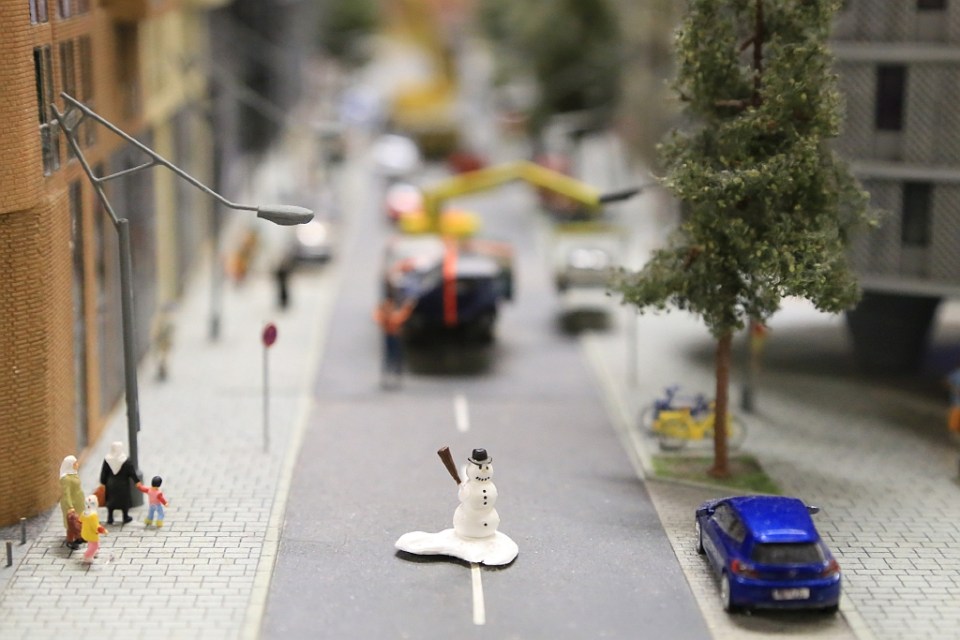
Above/featured: “Stranded.”

Since 2001, Miniatur Wunderland has been delighting children of all ages in the northern German city of Hamburg with the world’s largest miniature railway set, attracting a total of 12 million visitors so far. After many visits to the city over the last decade, I’ve somehow managed to stay away, but it’s finally high time curiosity wins the day.

The Urban Dictionary describes “easter eggs” as: “hidden items placed in a movie, television show, or otherwise visual media for close watchers”; see also here. Plenty of details in the form of “easter eggs” await visitors at various sections in the museum. With a few shorts weeks before Christmas, the designers have cleverly inserted many Santa Claus and other Christmas- or winter-related figures throughout the entire venue.


( Click here for more )

Wurstkuchl, Regensburg, Bayern, Germany, fotoeins.com

Regensburg: Wurstkuchl, historic sausage kitchen

It must be midday, and time for lunch. There’s a queue more than twenty deep for the takeaway- or takeout-counter, as people walk away with a long thin grilled sausage sitting snug in an undersized oval bun. Next to the Döner, I’m also fond of the “Bratwurst”, or grilled pork sausage.

Along the Danube promenade in Regenburg’s Old Town is the historical sausage kitchen, formally “Die Historische Wurstkuchl zu Regensburg”, better known as “Wurstkuchl”. The Wurstkuchl is known as the oldest running grilled-sausage stand in the world, with the presence of a stand serving food to labourers from town and visitors from the river since the 12th-century (A,B).


( Click here for images and more )