Fotoeins Fotografie

location bifurcation, place vs. home

Posts by HL fotoeins

Vienna: Armenian Mekhitarist Community (since 1810)

From outside, the buildings don’t look particularly special. But they tell a tale of extraordinary migration: beginning in Armenia and ending here in Vienna’s 7th district, by way of present-day Turkey, Greece, and Italy.

At the corner of Neustiftgasse and Mechitaristengasse is a set of buildings for the Armenian Mekhitarist Congregation.

If I’m in the city for a month, my curiosity demands to learn more. Through e-mail and by phone, I inquire with the monastery’s contact person about a visit, and I’m instructed to join a group of Americans for a guided tour.


Armenian Mekhitarists

The Mekhitarists are an order of Benedictine monks of the Armenian Catholic Church founded by Mekhitar Petrosean from Sebaste (now Sivas). Since 1810, the Mekhitarists established (a second) headquarters in Vienna, whose modern presence includes monastery, church, museum, and a library containing the world’s third largest collection of Armenian manuscripts.

Understanding the sustaining power of the printed word to a fragile culture, Mekhitar and the order’s monks created a complete dictionary of the Armenian language. The first volume of the “Dictionary of Classical Armenian Language” (ԲԱՌԳԻՐՔ ՀԱՅԿԱԶԵԱՆ ԼԵԶՈՒԻ) was published after his death in 1749, and the second volume appeared in 1769. In 1837, the New Dictionary of Classical Armenian Language was published, whose contents have now been digitized.

With my love of books since childhood, I’m regularly on the look for (sources of) old manuscripts, which is obvious in the images below.

By tour’s end, I have a few quiet minutes for a couple of questions.

Q1. How many Armenians are there in Austria?
A1. With a total population of almost 9 million, Austria is home to about 8000 Armenians, of which about 5000 live in Vienna.

Q2. Who was Deodat/Diodato?
A2. Diodato was an Armenian merchant whose birth name was Owanes Astouatzatur. He is credited with opening Vienna’s first licensed coffee house in 1685. Today, that location happens to be occupied by another café with a memorial plaque inside.


Mekhitarist Timeline

•   1701: Mekhitar of Sebaste (1676–1749) establishes congregation in Constantinople (now Istanbul).
•   1706: Move to Greece’s Methon; new monastery established.
•   1717: Move to San Lazzaro, one of Venice’s islands.
•   1773: 2nd group breaks away from Venice, establishing monastery in Trieste in the Habsburg empire.
•   1775: Habsburg Empress Maria Theresa’s “Privilege” guarantees Armenian colony with permanent status.
•   1805: Napoleon seizes Trieste as French territory; Trieste’s Mekhitarists flee to Vienna.
•   1810: Habsburg Emperor Franz I grants Triestine Mekhitarists permission to settle in Vienna.
•   1811: Mekhitarists establish presence in Vienna’s St. Ulrich.
•   1811–1873, 1889–1898: Book printing press by the Mekhitarists in Vienna.
•   1837: after 1835 fire, new construction designed by Josef Kornhäusel begins in Neubau.
•   1874: Site expansion includes new church, also by Kornhäusel.
•   2000: The Venice and Vienna chapters reunite into single Mekhitarist order.


( Click here for images and more )

Vienna: 1 capital city, 4 Danubes

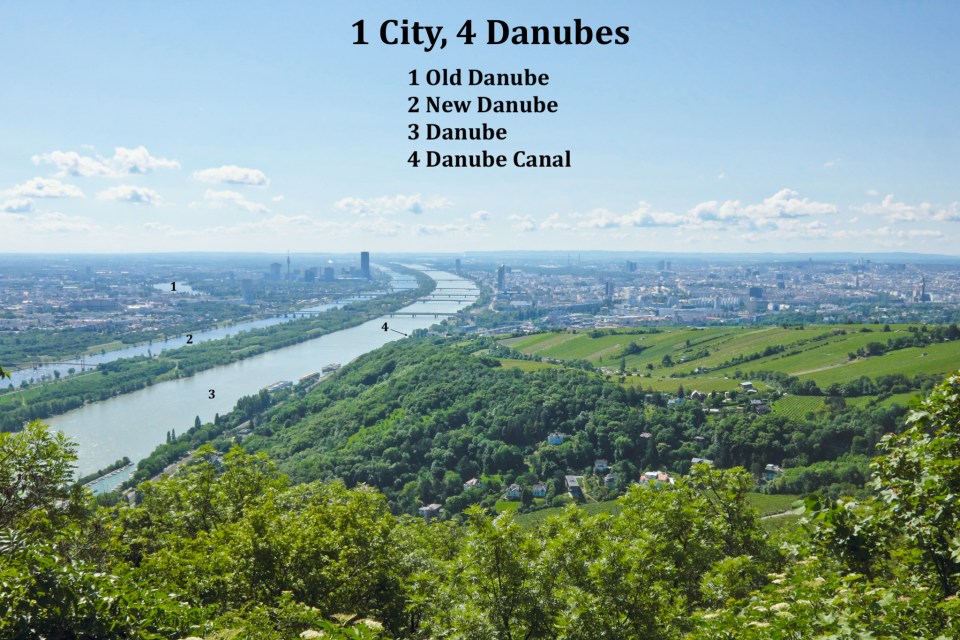
Above/featured: Southeast view from Leopoldsberg in the city’s 19th district. Visible are the waters of the Old Danube, New Danube, Danube, and the Danube Canal. Photo, 1 Jun 2022.

Vienna loves the Danube so much that the city now has four water features with the label “Donau”.

All of it is thanks to the regulation of the Danube river after the city of Vienna and the surrounding region had to put up with frequent flooding. Vienna embarked on works of flood-control engineering in two major periods of construction: 1870 to 1875, and 1972 to 1988.

Once a former arm of the river, the Old Danube is now a crescent-shaped lake that’s been cutoff by “linearization” and straightening of the Danube. A former natural arm of the river, the Danube Canal was regulated for the first time around 1600. Most visitors will encounter the Danube Canal which is best integrated with the city with the appearance of multiple road and rail crossings and the canal’s reach with 7 of the 23 city’s districts. The Danube river proper was completely regulated and straightened during the second engineering period, which also saw construction of the New Danube as a secondary flood channel in parallel with the primary river.


( Click here for images and more )

My Vienna: 40+ food spots from A to Z

Above: Mayer am Pfarrplatz, 26 May 2022 (X70).

Whatever your choice or preference, there’s no shortage of places for a sip and nosh in the city of Vienna. Over stays spanning a total of 100-plus days across 3 consecutive summers, the Austrian capital city provides plenty of opportunities to try something new.

I stayed in Vienna’s 2nd district in 2023, and in the 6th district in 2022, 2024, & 2025. I describe below food visits throughout the city, for all the tasty bits including Turkish Döner, falafel, finger sandwiches, Georgian breakfast, horsemeat rolls, ice cream, Nepali curry, pastries, raspberry torte, roast pork, Shakshuka for breakfast, Viennese veal schnitzel, and shwarma Syrian-style.

“Wer in Wien hungrig bleibt, ist überall verloren.”
(You’re a lost cause if you remain hungry in Vienna.)


( Click here for a lot more )

Vienna Tafelspitz: Habsburg dish at Plachutta Hietzing

What appears to be a plate of slow simmered beef is anything but “simple”.

Tafelspitz is a dish with a lot going on,” said Austrian chef Kurt Gutenbrunner to the New York Times in 2002. “It’s hot, cold, spicy, creamy, crunchy and soft.”

Eaten daily by Habsburg Emperor Franz Joseph I (1830-1916), the dish is well-known among Vienna favourites. Among members of the Jewish community of the time, the Tafelspitz was a beloved symbol of assimilation in late 19th-century/early 20th-century Vienna.

Reading about the description for Tafelspitz brings about a sharp childhood memory of a soup made by Mum. Tender chunks of chuck roast, accompanied by carrots, potatoes, celery, shards of ginger root, and often with apple to provide extra sweet; cooked slow and simmering in a huge pot on the stovetop for hours. The resulting soup was a meal on its own, or served as a final course at dinner.

Plachutta is well-known among the Viennese for making some of the best Tafelspitz in the city. A big Plachutta is located centrally in the inner city, but I head west to the city’s 13th district for their original Stammhaus location in Hietzing. It’s fitting somehow that the Hietzing location is close to the Habsburg summer palace at Schönbrunn.

The images show a wonderful spread with the Tafelspitz dish with my choice of the Tafelspitz or rump steak cut. I started with the long slow simmered soup broth, ladled out into a bowl with big chunks of egg frittata. And provided within a bowl of soup are specific details of family dinner: nourishing, caring, satisfying.

After a section of slow-cooked bone is presented, I spread the soft gelatinous marrow onto slices of toasted dark bread, with a light sprinkle of salt and pepper. Next, slices of moist tender slow-cooked beef are laid onto a plate, along with crunchy fried potatoes, creamed spinach, apple-horseradish sauce, and chive sauce.

Certainly, I paid more for this meal compared to others, but the Plachutta Tafelspitz was a great dining experience, providing a new memory of Viennese cuisine, combined with family memories of home-cooked food.


( Click here for images and more )

My Fuji X70: Fujichrome Slide, Kodak Platinum 200 (XTrans2 recipes)

Above/featured: 1st Narrows, from John Lawson Pier.

My Fujifilm X70 mirrorless fixed-lens prime camera has been a big plus for photography at domestic and international locations. The built-into-camera film-simulations (e.g., Provia, Velvia) work beautifully in standard settings, but as I’ve never had a film camera, the advent of “camera recipes” to produce additional film-like settings stimulated interest in different colour or pictorial representations.

So far, I’ve tested these Fujifilm film-simulation (“film-sim”) recipes:

•   Ektachrome 100SW (saturated warm), simulating images with the Kodak colour transparency or slide films produced 1996–2002;
•   Kodachrome 64, simulating images with the Kodak colour film produced between the mid-1970s and 2009;
•   Kodacolor, “producing classic Kodak analog aesthetic closest to early-1980s Kodacolor VR200 colour film that’s been overexposed.”


( Click here for images )