The Wien Museum at Karlsplatz extends its opening hours on Thursdays to 9pm, which gives everyone a better appreciation for its permanent collection in the examination of the city’s history that spans almost 8 centuries. The museum’s permanent collection is free of charge, but there is a charge to view the museum’s temporary exhibitions. The collection includes paintings, sculptures, posters, photographs, metalwork, various kinds of mementos and documents, and other forms of human keepsakes.
“The city of Vienna’s historical museum”
“Young Mother”, by Egon Schiele (1914). Schiele was a key figure in the early 20th-century Vienna Modernism cultural movement.
“Emilie Flöge”, by Gustav Klimt (1902). Klimt was another key figure in the early 20th-century Vienna Modernism cultural movement.
From 1904 to 1938, the three Flöge sisters operated their fashion and clothing shop in the Casa Piccola building on Mariahilfer Straße.
“Lady in Yellow”, Max Kurzweil (1899). The bright blue dot is a reflection of floor lighting.
The model for the painting was the painter’s wife Martha Kurzweil.
Poster: “A cry for help: read Bettauer’s weekly newsletter”. Writer Hugo Bettauer (1872-1925) fought against Article 144 of the Criminal Code which at the time made termination of pregnancy punishable with jail time of up to 5 years. He also fought against anti-Semitism and for the decriminalizing of same-sex couples.
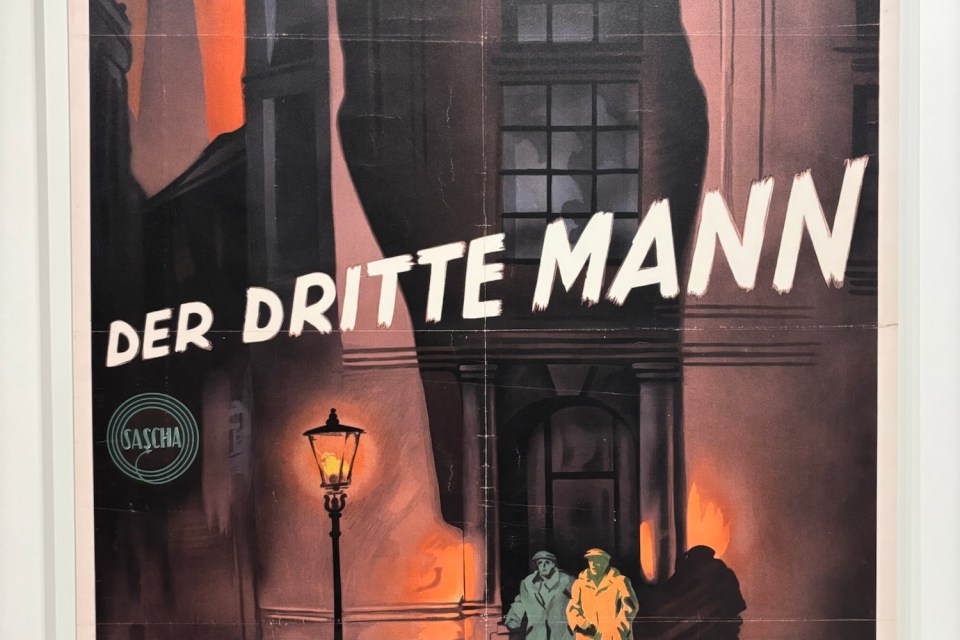
Poster for the classic movie “Der Dritte Man” (The Third Man) which was filmed in post-war Vienna. I saw this movie in a small room at Vienna’s Burg Kino cinema house in 2022.
The people: they come, they work, and no surprise, they want to stay. (Re. post-war labour requirements to boost productivity and the economy.)
In 2000, the City of Vienna officially unveiled its memorial to Jewish victims of the Holocaust with a sculpture by British artist Rachel Whiteread. Situated at Judenplatz, the memorial takes on the form of an “inverted library” whose books are placed spine facing inwards. The image shows a “row of books” in detail (1996) as a model for the memorial.
“Closing time … take me home.”
I made all images above with an iPhone15 on 17 July 2025. This post composed within Jetpack for iOS appears on Fotoeins Fotografie at fotoeins DOT com.
The first Sunday of the month means free entry for a number of museums, including many under the Wien Museum umbrella. With Secession as the temporary exhibition at Wien Museum Karlsplatz, I learned about different figures of the early 20th-century arts movement, which was not only in Vienna, but also sprung up in Berlin and Munich. Later, I meandered over to Wien Museum MUSA to discover the work by Vienna photographer Elfriede Mejchar.
“Secessionen”
“Pallas Athena”, by Gustav Klimt (Vienna Secession), 1898.
“… heads turn to meet her; steely eyed …”
“Houses on Montmartre,” by Maria Slavona, 1898.
Self-portrait, by Teresa Feodorowna Ries, 1902.
Self-portrait by Käthe Kollwitz, 1904. Full member of Berlin Secession, 1901. 1st woman artist elected to Berlin Secession board, 1912.
“Cherry Harvest”, by Dora Hitz, before 1905.
“Tilla Durieux as Circe”, Franz von Stuck, c. 1913.
Elfriede Mejchar (1924-2020)
In post-war Austria, Vienna photographer Melchar pointed at the ordinary and seemingly uncomplicated; and what Austria discovered instead was extraordinary and complex, and something the national scene had not seen as much about themselves. I think she raised important (existential) questions in the late post-war period about who Austrians thought they were, and who they wanted to be.
From 1950s series: “Light and Shade”.
Advertising column with Suchard poster, Vienna, 1950.
From 1967-1976 series: “Simmeringer Heide and Erdberger Mais”.
From 1989-1991 series: “Aether ad narcosim, Victor Alder Chemical Works, Vienna”.
From 1988-1991 series: “A Costume of Borrowed Identity”.
From 1979-1991 series: “Wienerberger Brick Kilns and Housing Estates, Vienna”.
“Amaryllis”, 1996.
From 2001-2007 series: “Nobody is perfect.”
I made all images above with an iPhone15 on 7 Jul 2024. This post composed with Jetpack for iOS appears on Fotoeins Fotografie at fotoeins DOT com.
After a few years of expansion and renovation, Vienna’s city museum at Karlsplatz reopened to the public in late-2023. With more exhibition space, their permanent exhibition about the city’s origins and evolution over the past millennium is free to the public; there’s now even more room for temporary exhibitions. The city’s history including art, architecture, and archaeology are some of my sweet spots, and I’m more than happy to spend a few afternoons exploring their permanent exhibition: an obvious advantage of an extended stay.
North side.
Wien Museum.
Entry hall.
Historisches Museum der Stadt Wien / Vienna City History Museum (1x).
Foyer: ticketing to the right, gift shop to the left (0.5x).
A modern mash-up of Max Kurzweil’s famous painting which is in the museum’s permanent collection.
Six floors: permanent exhibition on the ground floor, 1st floor, and 2nd floor; temporary exhibitions on the top or 4th floor.
One of my favourite paintings is about bold colour, intensity, and defiance. “Dame in Gelb” (Lady in Yellow), by Max Kurzweil, 1899. Wien Museum permanent exhibition.Museum entrance.
South side.
West side.
The “new” city museum from Karlskirche, at Karlsplatz.
I made the photos above with an iPhone15 on 27 and 28 Jun 2024. This post composed with Jetpack for iOS appears on Fotoeins Fotografie at fotoeins DOT com.


 Fotoeins Fotografie