Fotoeins Fotografie

location bifurcation, place vs. home

Posts tagged ‘Weltkulturerbe’

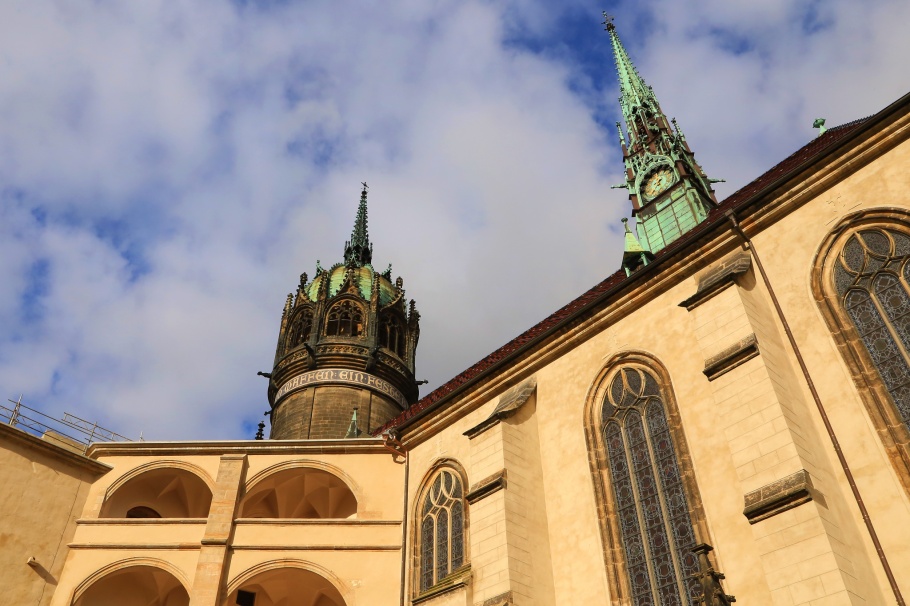
Stadt- und Pfarrkirche St. Marien, St. Mary's Town and Parish Church, Wittenberg, Saxony-Anhalt, Sachsen-Anhalt, UNESCO, World Heritage, Luther Country, Luther 2017, Germany, fotoeins.com

Wittenberg UNESCO WHS: St. Mary’s Church

Above: West side illuminated by afternoon sun, 30 Oct 2016 (HL).

The Stadtkirche Sankt Marien (St. Mary’s Town and Parish Church) is the oldest building in Wittenberg, and is one of four sites in town as part of the town’sasx inscription as UNESCO World Heritage Site since 1996. Not only is this the location where Luther preached, the church also contains important relics by the Cranachs highlighting the young Reformation movement. The Cranach and Luther families were close, as well as contemporary colleagues.

The east chancel (near the main altar) was part of the original St. Mary’s chapel built around 1280. By the early 15th-century, the chapel was incorporated into a triple-naved structure with two towers in the late-Gothic style at the west end of the new church; the Gothic tops were removed and replaced by octagonal shapes by the mid-16th century. The original pulpit from which Luther delivered his sermons has survived the centuries, and is now located in Wittenberg’s Luther House (Lutherhaus).

( Click here for images and more )

Eisleben: Luther’s birth and death sites, UNESCO WHS

Above/featured: Luther monument by Rudolf Simmering at Eisleben’s market square. The monument was inaugurated in 1883 to mark the quatercentenary of Luther’s birth year (1483). At left and upper-right are the Hotel Graf von Mansfeld and St. Andrew’s Church, respectively.

With a population over 25-thousand people, Eisleben is a quiet town in central Germany in the federal state of Saxony-Anhalt. But the South Harz region holds a special place in German and European history: Martin Luther came into the world in Eisleben in 1483, spent his childhood years in Mansfeld, and, on a trip home from Wittenberg to negotiate a local dispute in Mansfield, died in Eisleben in 1546. As shown in the map below, a number of important locations in Eisleben are associated with Luther and the Reformation, including the Luther monument in the town’s market square, St. Peter’s Church, St. Andrew’s Church, and St. Anne’s Church. Specifically, two sites in town constitute a part of the inscription for UNESCO World Heritage Site since 1996: (1) the house where Luther was born, and (2) the museum on Luther’s death.


( Click here for more )

My Germany: 47 (of 55) UNESCO World Heritage Sites

Above: Cologne at dusk: that Dom (cathedral) again, at left; Colonius telecommunications tower at centre, and the Hohenzollern rail and pedestrian bridge at right. Photo, 26 May 2016 (6D1).

Every year UNESCO-Welterbetag (UNESCO World Heritage Day) in Germany is celebrated on the first Sunday in June. Highlighted below are my visits to 47 of 55 UNESCO World Heritage Sites (WHS) in Germany for a modest completion rate of 85%.

UNESCO DE, UNESCO, Germany

( Click here for images and more )

Stadtkirche, Schlosskirche, Lutherstadt Wittenberg, Wittenberg, Saxony-Anhalt, Sachsen-Anhalt, Germany, UNESCO World Heritage Site, fotoeins.com

Wittenberg: 13 historical highlights in the Lutherstadt

Above: Facing west from Kirchplatz, the Stadtkirche (City Church) and Schlosskirche (Castle Church) at upper-left and lower-right, respectively, are Wittenberg’s major landmarks.

If you’re thinking about or you’re already present in Wittenberg, two words have already provided the marquee reasons why you’re here at this blogsite and there in the town: Martin Luther.

The biggest reason why people will step foot in Wittenberg is to see and learn about how the Protestant and Reformation movement began and took hold, who the major players were, and what their roles were in the movement. For most, they’ll want to visit the four sites which form the basis for the town’s status as UNESCO World Heritage Site (WHS; see below). In addition to these four, there are other highlights for the curious and interested visitor, and all of them are easy to reach in the compact Old Town.


( Click here for images and more )

Dessau: The Bauhaus Building, UNESCO WHS

21st-century Modernity, from 1919 on

The chair or couch on which you sit.
The table on which you’re resting your mobile or pad.
The desk on which your laptop or desktop resides.
The light fixture on your desk or above your head.
The windows in your room, your house, or in the cafΓ© where you’re reading this.

The “universal” idea of living in a house or apartment with the furnishings we all take for granted from bathroom to bedroom and kitchen to living room is a relatively young idea by historical standards. It’s easy to imagine a time where only the rich upper-class could afford and were allowed to have and live in heated furnished residences, and the poor lower-class lived in unheated homes under damp dirty squalid conditions. Past designs with its heavy stone, porcelain, and ornate decorative components gave way to steel, glass, lightness of space, to favouring function over form. Simpler designs were meant to provide universal access: to the home, and to the essentials which furnished the home.

( Click here for images and more )