Fotoeins Fotografie

location bifurcation, place vs. home

Posts tagged ‘Upper Franconia’

Fotoeins Friday: Bayreuth Opera House, 🇩🇪 UNESCO WHS

Bayreuth, Germany: inside the main hall of the Margravial Opera House (Markgräfliches Opernhaus) during guided tour. The building was inscribed as UNESCO World Heritage Site in 2012.

I made the image above on 9 Jun 2024 with a Fujifilm X70 fixed-lens prime and the following settings: 1/30-sec, f/2.8, ISO6400, and 18.5mm focal length (28mm full-frame equivalent). This post appears on Fotoeins Fotografie at fotoeins DOT com as https://wp.me/p1BIdT-wBK.

24T34 Bamberg Old Town, world heritage

E33

In Bavaria’s Upper Franconia, the city of Bamberg is described as “a central European town with a medieval plan and with a number of surviving secular and ecclesiastical buildings from the medieval and baroque periods.” For its architectural, cultural, and historical character, UNESCO inscribed the city’s Old Town as World Heritage Site in 1993.

This is my 2nd time in Bamberg, after my 1st visit 14 years ago on this very same month.


From Geyerswörthbrücke: Old Town Hall, perched on top of the Regnitz.
World Heritage Centre: modest visitor centre with displays about the city’s heritage landmarks and the road to inscription.
Bamberger Dom (Bamberg Cathedral).
Bamberger Reiter (Bamberg Rider).
Dionysius, and beheaded.
Neuer Residenz (New Residence).
Rose garden inside New Residence; the 2 steeples from St. Michael’s appear at left.
“Gruß aus Bayern” (Greetings from Bavaria).
Michelsberg, Kloster Michelsberg.
View from Michelsberg towards the New Residence and the Cathedral.
Outdoors terrace café at Michelsberg, with a cold Rauchbier (smoked beer) on tap.
Back to the “beginning”: the old town hall, with late-afternoon illumination on the west side.
This west side of Old Town Hall is lit up in the afternoon.
Stadtwappen (city’s coat of arms), between clockface and balcony.
Maximiliansplatz.

I made all images above with an iPhone15 on 10 Jun 2024. This post composed with Jetpack for iOS appears on Fotoeins Fotografie at fotoeins DOT com.

24T33 Bayreuth’s Margravial Opera House

(E32)

The Margravial Opera House in Bavaria’s Bayreuth is a fine surviving example of Baroque theatre architecture. Completed in 1748, the building was initiated by Margravine Wilhelmine and her husband Margrave Friedrich III of Brandenburg-Bayreuth for their daughter’s wedding. For its unique architectural, cultural, and historical character, UNESCO inscribed the building as World Heritage Site in 2012.


Not bad at all from the outside (0.8x)
… but inside, the auditorium is much better.
Left side tiers of loges, facing the stage.
Right side tiers of loges, facing the stage.
Front, and up (0.5x).
Back of the venue; court loge.
“Pro Frederico et Sophia – Josephus Gallus Bibiena fecit – Anno Domini MDCCXLVIII.” (Built for Friedrich & Wilhelmine-Sophie, by Giuseppe Galli Bibiena, in 1748 A.D.)
Back of the auditorium, and up to the ceiling with god Apollo surrounded by arts and muses (0.5x).
From the right side loge-seats.
On the stage proper (guided tour), facing out to the back.
Markgräfin (Margravine) Wilhelmine of Bayreuth: portrait by Antoine Pesne, in 1738-1740. Multilingual and trained in both arts and literature, Wilhelmine was daughter of Prussian king Friedrich Wilhelm I, and sister to Friedrich the Great.
Wilhelmine memorial bust, on Schlossberglein, opposite the opera house.
Afternoon illumination, from Schlossberglein and above the Wittelsbacher fountain. The opera house is at centre.
The Margravial Opera House, in Bayreuth.

This visit to Bayreuth completes my 8th new German UNESCO WHS over the last 33 days. My total tally is now up to 42 (of 52).


I made all images above with an iPhone15 on 9 Jun 2024. I received neither sponsor nor support from any organization. This post composed with Jetpack for iOS appears on Fotoeins Fotografie at fotoeins DOT com.

Freistaat Bayern, The Free State of Bavaria

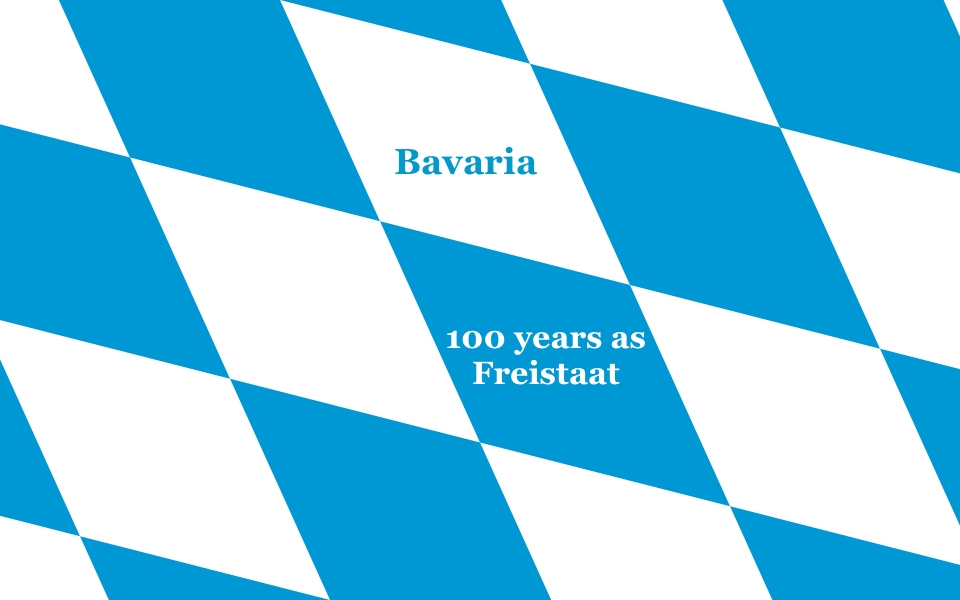
Bavaria: 100 years of statehood (2018)

Featured image: The blue and white diamonds (fusils) are a familiar Bavarian symbol, adopted in the late 13th-century by the Wittelsbach family who ruled Bavaria from 1180 to 1918.

As a product of the coastal and mountainous Canadian Southwest, I always feel the pull exerted by the Bavarian Alps regardless of where I am in Germany; it’s been this way over the past 18 years. But there’s more to Bavaria than fairytale castles, Oktoberfest, and BMW, although they’re spot on for the Wurst (sausage). And frankly, there’s a ton more to Germany than Bavaria, but that’s one of many reasons for this entire blogsite after all.

Located in southeast Germany, Bavaria includes more than a half-dozen World Heritage Sites, the pre-Easter Fasching/Fastnacht festival, the sight of Audis on the Autobahn, over one thousand years of wine-making in Franconia, and violin-making since the late 17th-century, among many things to explore, eat, and experience.

( Click here for more )