Fotoeins Fotografie

location bifurcation, place vs. home

Posts tagged ‘river’

Alter Synagogenplatz, Altstadt, Heidelberg, Baden-Württemberg, Germany, fotoeins.com

My Heidelberg: Synagogue Square and Pogromnacht

It happens every time without fail.

My spirit breaks a little more every time I see a memorial, another example of the depths to which our species have plumbed.

Does feeling this way make me weak? Or am I resembling a human being after all?

I often hear a common chorus:

history is hard, history is boring, why should I care?

I can’t decide what’s worse: the rise of the far-right or blatant willful ignorance.


A Mob of Broken Glass

From the evening of 9 November to the following morning of 10 November 1938, Kristallnacht (“the night of broken glass”) was a “pogrom”, a coordinated series of violent attacks by Nazis against the Jewish people and their property in Germany, Austria, and Czechoslavakia’s Sudetenland. Pogromnacht (or Reichspogromnacht) is a truer description; the “prettier sounding” Kristallnacht hides the brutality of “the night of (broken) crystal” referring to broken shattered glass from windows to synagogues, homes, and stores owned by Jews. Aside from a few who intervened, most stood aside and watched people and property burn.

The word “pogrom” is a late 19th- to early 20th-century Russian word (“погром”), derived from the verb “gromit” (громи́ть) meaning “to destroy with violence.” While “pogrom” is used generally to describe mob violence by one ethnic or religious group on another, the term is used in this post to describe attacks on the Jewish community.

The numbers across the country were appalling: at least 90 dead, hundreds injured, 30000 arrested and detained in concentration camps, up to 2000 synagogues burned, over 7000 Jewish businesses damaged or destroyed. With one more insult, the Jewish community was forced to pay for damage to their own property. The outbreak of coordinated actions against Jewish people marked the beginning of state-sanctioned violence. With the Pogromnacht, the state no longer hid their hate and escalated their savagery as a turning point directly leading to the Holocaust.

( Click here for more )

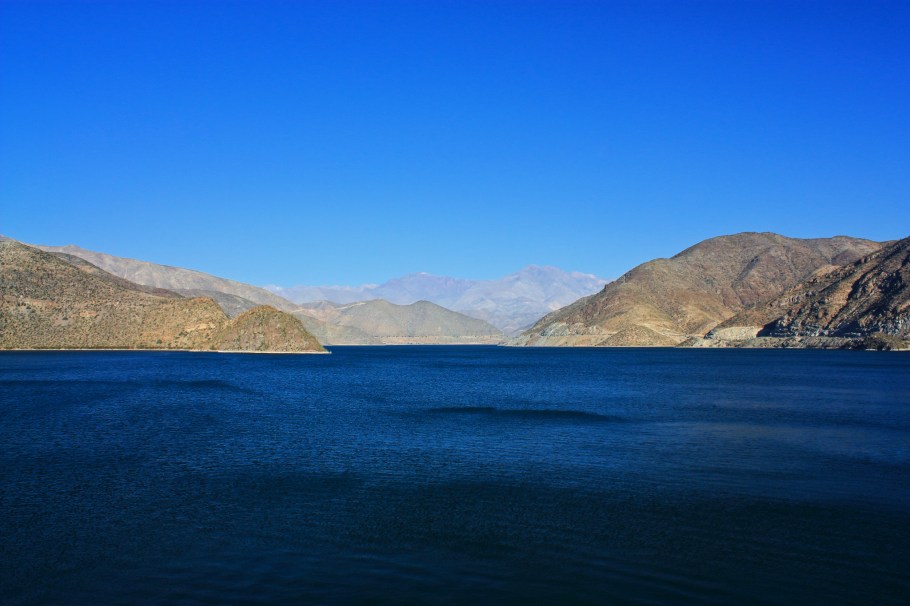
Embalse Puclaro, Puclaro, Rio Elqui, Elqui river, Region de Coquimbo, La Serena, Chile, fotoeins.com

My Chile: Elqui River, Puclaro Dam

Above/featured: Upstream and east to Andes – 9 August 2008.

27 September has been earmarked by the United Nations World Tourism Organization (UNWTO) as “World Tourism Day”. The following is a tweet by the United Nations for World Tourism Day in 2013.

The Elqui River in north-central Chile begins in the mountains of the lower Andes, and flows west to the Pacific along the southern edge of the Atacama desert through the towns of Vicuña and La Serena. The average annual total rainfall in La Serena is 10 to 13 cm (4 to 5 inches), less than one-tenth of the total for Vancouver, Canada.

The Elqui was dammed by 1999 to control water usage by farms in the lower valley and by pisco vinyards in the upper valley; however, construction of the dam displaced people in small low-lying towns on both sides of the river. Behind the dam in the Embalse or reservoir Puclaro (photo above), the water level has declined with lower annual snowfall in the mountains above and higher usage by farms and the increasing population below. The price for water continues to rise due to competition from mines, farms, and the growing population. Numerous research visits and five years living in La Serena emphasized the contrast of the importance of water to people’s lives in the region with the dominant presence of the neighbouring Atacama.


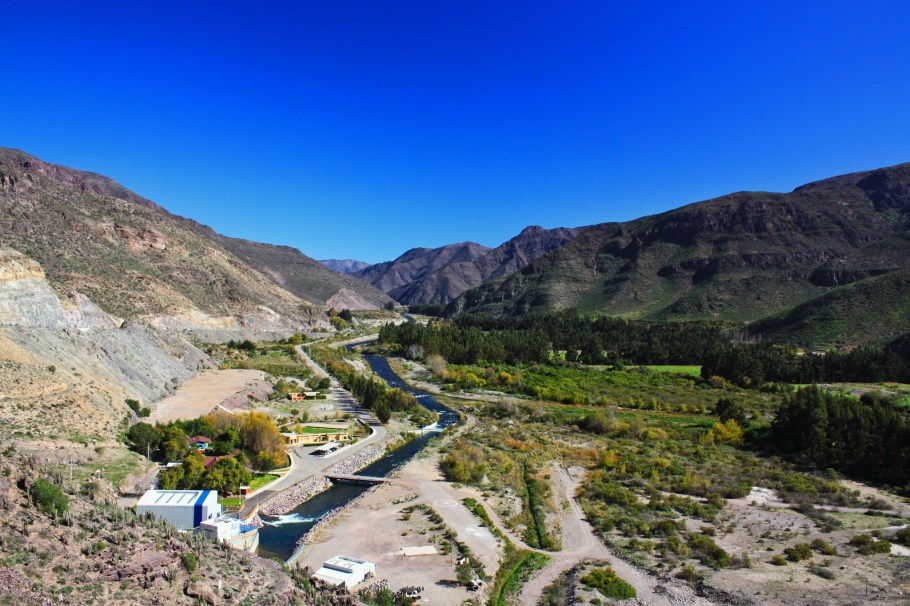
Embalse Puclaro, Puclaro, Rio Elqui, Elqui river, Region de Coquimbo, La Serena, Chile, fotoeins.com

Rio Elqui, downstream and west from the Embalse Puclaro – 9 Aug 2008.

Embalse Puclaro, Puclaro, Rio Elqui, Elqui river, Region de Coquimbo, La Serena, Chile, fotoeins.com

Retaining wall – 13 Sep 2009.

Embalse Puclaro, Puclaro, Rio Elqui, Elqui river, Region de Coquimbo, La Serena, Chile, fotoeins.com

Flags for the upcoming Fiestas Patrias national holiday – 13 Sep 2009.

Embalse Puclaro, Puclaro, Rio Elqui, Elqui river, Region de Coquimbo, La Serena, Chile, fotoeins.com

View east into the Andes – 13 Sep 2009.


I made all photos above with a Canon EOS450D/Rebel XSi on 9 Aug 2008 and 13 Sept 2009. This post appears on Fotoeins Fotografie at fotoeins DOT com as http://wp.me/p1BIdT-3PS.

New Zealand: Air Safaris’ Grand Traverse flight over the Southern Alps

The majestic mountain spine along New Zealand’s South Island is known as “The Southern Alps”; the Maori Ngai Tahu name for these mountains is “kā tiritiri o te moana”. For many locations around the South Island, you cannot avoid or ignore the sight of looming towers of rock and snow.

Between visits to the Franz Josef Glacier and Fox Glacier, I’d been thinking about whether or not I should have a look at the mountains from above. It would be beautiful, but it also seemed very expensive. What to do, what to do … it sounds stupid writing it out now, but a unique opportunity had presented itself, and I knew I’d have deep regrets if I didn’t take it.

I bit the proverbial bullet and hopped onto a plane with Air Safaris for a 50-minute “The Grand Traverse” tour including aerial views of various glaciers, Horokoau (Mount Tasman), and Aoraki (Mount Cook).


( Click here for images and more )

New Zealand: slow bound to Franz Josef Glacier

To a person, from the InterCity coach driver to the proprietors of motels along the South Island’s west coast, everyone spoke about how the Franz Josef and Fox Glaciers are two of the most accessible glaciers in the world. All things being equal, reaching the glaciers is definitely easier with a vehicle.

But I’m on New Zealand’s South Island, in the middle of a rainforest, and within the Westland National Park which is part of a UNESCO Heritage Site. I’m in no rush; so I think I’ll spare the trees from the expelled products of a combustible engine.

( Click here for images and more )