Fotoeins Fotografie

location bifurcation, place vs. home

Posts tagged ‘river’

24T10 Slow wet tracks to Trier

E09

Travel day 10, Europe day 9.

An atmospheric low-pressure system is stuck between a low over northern France and a high over the Baltic states. The “stuck” low moves slowly over a region, but drops a lot of water in quick time.

Heavy rainfall in southwest Germany today disrupted surface traffic, including cutting off in places a key interregional and interstate rail route between Saarbrücken (Saarland) and Trier (Rheinland-Pfalz). With the route hugging the bank of the Saar river, dislodged trees and minor slides cut the route in several places, even though the swollen Saar didn’t wash out the tracks. What is normally 90 minutes with a single train took over 5 hours with a delayed train from Saarbrücken that stopped abruptly in Dillingen, a flow of pax to replacement bus service to Mettlach, and finally, single-track train service to Trier.

As of writing, maximum river heights/depths have yet to be reached as rain continues to fall, and areas of reported flood damage will broaden over this Pentecost holiday weekend.

People here are rightly sensitive about intense rain, because of memories and the speed by which flood waters swept catastrophically through the nearby Ahr river valley in the summer of 2021.


1455h, on DWD’s WarnWetter weather-warning app: deeper the red, the heavier the rain. It’s purple on today’s assigned route between Saarbrücken and Trier.
1555h: this dislodged tree (upper left) just south of Saarburg affected the northbound track, reducing all traffic in this area to single-track. I’m on a northbound train on the southbound track.
1838h: at this part of the river bank in Trier is a Hochwasser (lit., “high water”) or flood alert for the Moselle. The symbol/sign: no vehicles beyond this point.
1838h: the Moselle is a “wae high” against the bank.
2207h, from website of Germany’s national flood reporting centre. Green: good; yellow-orange: caution; red: danger; purple: it’s bad.

I made three images above with an iPhone15 on 17 May 2024; the first and final images are screen captures. All listed times are in the CEDT time zone. This post composed with Jetpack for iOS appears on Fotoeins Fotografie at fotoeins DOT com.

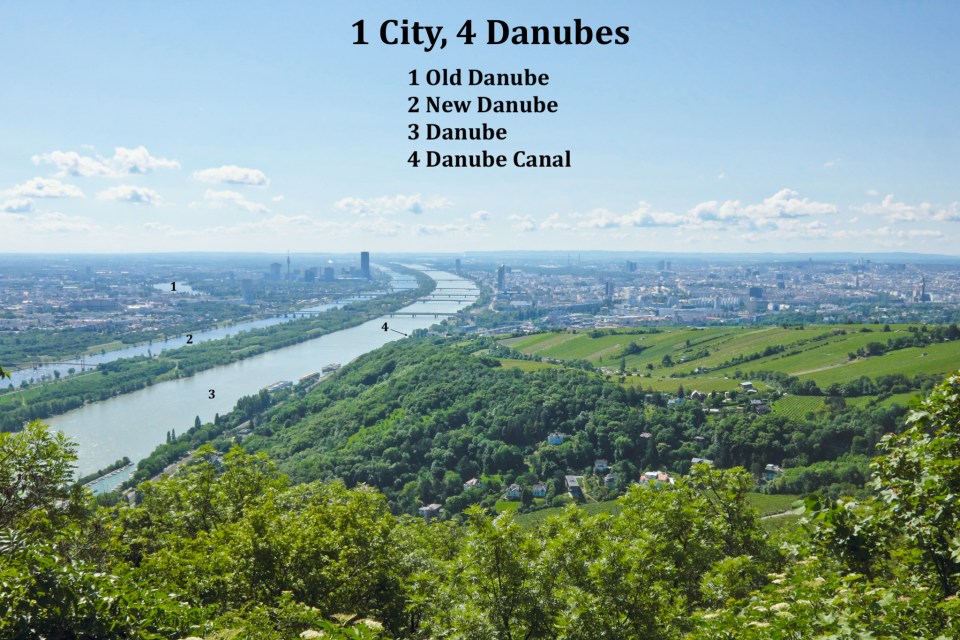
Vienna: 1 capital city, 4 Danubes

Above/featured: Southeast view from Leopoldsberg in the city’s 19th district. Visible are the waters of the Old Danube, New Danube, Danube, and the Danube Canal. Photo, 1 Jun 2022.

Vienna loves the Danube so much that the city now has four water features with the label “Donau”.

All of it is thanks to the regulation of the Danube river after the city of Vienna and the surrounding region had to put up with frequent flooding. Vienna embarked on works of flood-control engineering in two major periods of construction: 1870 to 1875, and 1972 to 1988.

Once a former arm of the river, the Old Danube is now a crescent-shaped lake that’s been cutoff by “linearization” and straightening of the Danube. A former natural arm of the river, the Danube Canal was regulated for the first time around 1600. Most visitors will encounter the Danube Canal which is best integrated with the city with the appearance of multiple road and rail crossings and the canal’s reach with 7 of the 23 city’s districts. The Danube river proper was completely regulated and straightened during the second engineering period, which also saw construction of the New Danube as a secondary flood channel in parallel with the primary river.


( Click here for images and more )

Vienna: free city views from modest heights

At the eastern limit of the Alps, the city of Vienna is built at the “low end” where the hills meet the Danube river, at a minimum altitude of about 150 metres (500 feet) above sea-level. Visitors to the Austrian capital city who don’t have much time but want a broad overview of the city will make their way to one or all of the Donauturm (Danube Tower), Riesenrad (Ferris Wheel), and Stephansdom (St. Stephen’s Cathedral). Each of these landmarks requires the price of admission to get up high in the sky.

For other views at more modest heights, you’ll see there are options, especially because I’ve set foot in all 23 of the city’s districts. Below I highlight seven locations; all are free (zero charge) to access. All but one are well outside the inner city for the opportunity to explore other city districts and to gain a better sense of the physical size of the city. All images below are cropped square.


( Click here for more )

Salzburg city views from Mönchsberg

In Salzburg, I’m motivated by a search for Mozart and for signs of modernity. I’ve already examined part of the city through its art: what more can Salzburg offer?

Excellent views of the city and surroundings.

The Mönchberg hill on which the Hohensalzburg fortress sits provides many viewpoints over the city. You can walk along the entire length of Mönchberg for varying perspectives, or you can approach a number of the viewpoints separately.

I ascended and traversed the hill on foot from southeast to northeast, beginning from Kapitelplatz to the viewpoints just north of the Museum der Moderne. I returned to the Old Town below with the MönchsbergAufzug elevator which is a part of Salzburg’s public transport.


( Click here for images and more )

My Tirol: Scharnitz and Porta Claudia

Where: Scharnitz, at the northern edge of Austria’s Tirol, next to the Austro-German frontier.
What: Porta Claudia, mid 17th-century fortifications directed by and named after Claudia de’ Medici.
BTW: Scharnitz Pass is technically not a mountain pass.

I’m interested in geography, historical relics, and the topography of European borders.

Scharnitz Pass is one of the lowest crossing points over the Alps at an elevation of only 955 metres (3130 feet) with the Wetterstein mountains on one side to the west and the Karwendel mountains to the other side in the east. The pass might better be described as a “gorge”, given how the Isar river traverses the valley floor between the two sets of mountains. Naturally, a road at this location would’ve been ideal as a vital north-south route for trade and communication, which is why the Romans built the stone road, Via Raetia, through the river valley. A 200-metre section of this old Roman road remains in the woods outside the nearby town of Klais. The location of the pass/gorge is also why the Romans built a guard station “Mansio Scarbia” here to control traffic between the northern outer provinces and the rest of the inner empire to the south.

One of the earliest records from the 8th-century AD/CE documents the establishment of Scaraza Monastery, known also as Scarantia#. The name evolved to “Scaraz”, “Scarbia”, “Scarnize”, and eventually “Scharnitz”. Today, between 1300 and 1400 people live in the Austrian town of Scharnitz in the Tirolean region of Seefeld. The town lies on the road between Innsbruck and Munich and next to the international border between Austria and Germany; the strategic importance of this modest town has never gone away.

“Porta Claudia” is the name of former fortifications on high ground at a narrow curve over the Isar river valley. In the midst of the pan-European Thirty Years War, Claudia de’ Medici, the Regent of Austrian Tirol, ordered in 1632 the construction of a strategic defensive rampart at the Tirol-Bavaria border to protect Tirol’s northern border from invasion by Swedish forces. The Bavarians overran the rampart in 1706, but fortifications were expanded in 1766. Johann Wolfgang von Goethe wrote about passing through Scharnitz in 1786 on his journey into Italy. In 1805, Napolean’s army laid siege and destroyed the fortifications, freeing the path for joint French-Bavarian armed forces to enter Austria. Remnants of the retaining wall up to six metres in height and an archway through the wall are visible today.

I’m up and about at dawn, and within 50 minutes on an S-Bahn Tirol S5* train from Innsbruck, I’m about to satisfy my curiosity about this stretch of the Tirolean landscape in Scharnitz. With the existing Schengen treaty among participating European nations, anyone can walk, bike, or drive freely across the unguarded international border between Austria and Germany%.

# “Scar” (noun), 2nd etymological meaning.
% I entered the European Union at Frankfurt am Main international airport where I went through passport check and control.
* S5 in May 2018; renumbered as S6 as of Oct 2020.


( Click here for images and more )