An hourly regional train between Trier and Perl is only 50 minutes in duration. My “true” destination is hinted in the train signage, because on the other side of the Moselle river from Perl is Luxembourg and a town called Schengen.
This modest town of about 5000 residents where the rage was once to wars over this strip of fertile land, politicians from across the continent arrived to sign a famous agreement in 1985. A tangible result is the ability to travel among all nations participating in the “Schengen area” without separate passport controls. I’m very grateful I can walk across a bridge from Germany to Luxembourg.
Schengen displays its historical importance proudly, not only for Luxembourg’s and Europe’s residents, but for all who arrive to learn more about this 20th- and 21st-century experiment and experience.
Germany-Luxembourg border: Perl DE behind me, Schengen LU ahead to the west.
Entering the town of Schengen.
“Welcome to Europe without borders” (plus, there’s wine produced here).
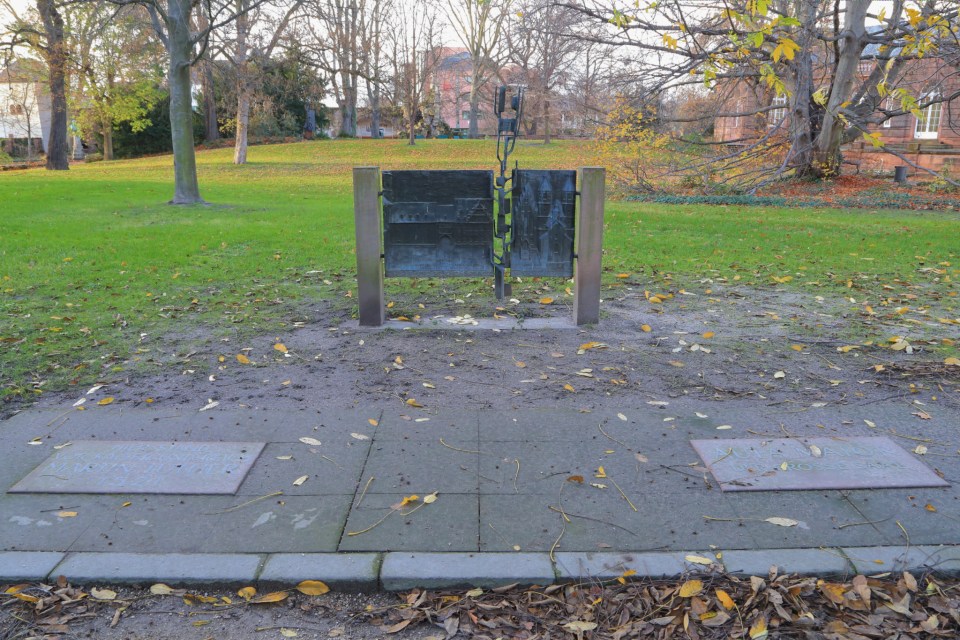
Place de l’Europe: Accord de Schengen (Schengen Agreement memorial): “Europe without borders.”
Beyond the boundary stone in this east-southeast view about 2/3rds across the waters of the Moselle river is the triple-nation point for Germany (left), France (right), and Luxembourg (stone).
Place des Étoiles (Plaza of Stars) with flags of participating nations; Musée Européen (Europe Museum).
Germany.
Estonia, for my former neighbours in Strathcona.
United Kingdom, out in 2020 with Brexit.
The Schengen Treaty of 1985.
Der Schengen-Raum (Schengen Area).
#schengenisalive
I made all images above with an iPhone15 on 19 May 2024. This post composed with Jetpack for iOS appears on Fotoeins Fotografie at fotoeins DOT com.
Born in Trier in 1818, Karl Marx spent his childhood and teenage years in town. He departed for studies in Bonn, Berlin, and Jena, becoming well-versed in economics, history, journalism, and philosophy. I highlight a few traces of Marx (KM) in Trier.
At centre: building where KM lived from the ages of 1 and 17.
At centre is the house where KM was born. The house is now home to the Karl-Marx-Haus, museum about the history of KM.
Inside Karl-Marx-Haus is this 1950 bronze bust of KM, by great-grandson Karl-Jean Longuet.
“Don’t walk.” Near KM-Haus are pedestrian-crossing signals with KM symbols. Images at dusk.
“Walk.” And no, that is not a biped with a dog’s head. And yes, little Karl is carrying a book.
I made all images above with an iPhone15 on 19 May 2024. This post composed with Jetpack for iOS appears on Fotoeins Fotografie at fotoeins DOT com.
(The Moselle is running high in Trier, but it’s not much compared to the flood damage in many low-lying parts of Rheinland-Pfalz and Saarland. Plus side, there are lots of visitors here this Pentecost holiday long-weekend.)
Built around 310 CE, the Aula Palatina (Palatinate Hall) functioned as the throne-space for Roman Emperor Constantine the Great: the building was a single-room palace basilica. The measurements are impressive not only to list, but also by sight: length 67 metres (220 feet), width 27 m (88 ft), height 33 m (108 ft). The building is the largest single-room Roman structure still in existence, and is the largest intact Roman structure outside of Rome. In 1986, the Aula Palatina was included with the set of historically important buildings in Trier inscribed as World Heritage Site. Today, the structure is in full use as Protestant church.
Interior, facing east towards the altar (0.5x).
Interior, near the altar facing west to the church organ (0.5x). This single-room building as 4th-century imperial throne palace.
An atmospheric low-pressure system is stuck between a low over northern France and a high over the Baltic states. The “stuck” low moves slowly over a region, but drops a lot of water in quick time.
Heavy rainfall in southwest Germany today disrupted surface traffic, including cutting off in places a key interregional and interstate rail route between Saarbrücken (Saarland) and Trier (Rheinland-Pfalz). With the route hugging the bank of the Saar river, dislodged trees and minor slides cut the route in several places, even though the swollen Saar didn’t wash out the tracks. What is normally 90 minutes with a single train took over 5 hours with a delayed train from Saarbrücken that stopped abruptly in Dillingen, a flow of pax to replacement bus service to Mettlach, and finally, single-track train service to Trier.
As of writing, maximum river heights/depths have yet to be reached as rain continues to fall, and areas of reported flood damage will broaden over this Pentecost holiday weekend.
People here are rightly sensitive about intense rain, because of memories and the speed by which flood waters swept catastrophically through the nearby Ahr river valley in the summer of 2021.
1455h, on DWD’s WarnWetter weather-warning app: deeper the red, the heavier the rain. It’s purple on today’s assigned route between Saarbrücken and Trier.
1555h: this dislodged tree (upper left) just south of Saarburg affected the northbound track, reducing all traffic in this area to single-track. I’m on a northbound train on the southbound track.
1838h: at this part of the river bank in Trier is a Hochwasser (lit., “high water”) or flood alert for the Moselle. The symbol/sign: no vehicles beyond this point.
1838h: the Moselle is a “wae high” against the bank.
2207h, from website of Germany’s national flood reporting centre. Green: good; yellow-orange: caution; red: danger; purple: it’s bad.
I made three images above with an iPhone15 on 17 May 2024; the first and final images are screen captures. All listed times are in the CEDT time zone. This post composed with Jetpack for iOS appears on Fotoeins Fotografie at fotoeins DOT com.
I’m looking for a “thousand-year history” in the city of Worms located in southwest Germany. This has nothing to do helminthology or nematology, as the town’s name is derived from “Warmaisa”, the former Jewish name of the city. This is about an important part of Jewish-German history and peaceful coexistence of the Judeo-Christian communities within Europe. The town’s fame and reputation is also partly derived from Martin Luther; I’ve already visited the site where Luther was on trial to answer charges of heresy, as well as the world’s largest Reformation monument.
This part of the Rhein river area is considered the “cradle of European Jewry”, known also as “little Jerusalem on the Rhine.” In medieval times, flourishing Jewish communities in the cathedral cities of Speyer, Worms, and Mainz facilitated the creation of a common Jewish league with the name ShUM (SchUM), spelled out by the first letters of the Hebrew names for the three cities. As emphasis on the influence of Jewish heritage in Europe and the ongoing process of preservation and education, the Holy Sand cemetery is one of four constituents in the newly inscribed UNESCO World Heritage Site (2021).
On a breezy late-autumn afternoon, light fades quick, casting solemn shadows on this ground. In the town’s old Jewish cemetery, I’m the only person present, and I’ve placed a small stone on top of a number of gravestones. I’m surrounded by apparitions over an millennium’s age and by the remaining physical traces in various shapes, stones, and size.