Fotoeins Fotografie

location bifurcation, place vs. home

Posts tagged ‘rail’

25T86 Nuremberg’s DB Museum 🚂 : my picks

E85, N03.

There was a time I didn’t think I’d be a fan of trains. I’m glad I was wrong, helped in large part to living and visiting Germany over much of the last 25 years.

Nuremberg’s Transport Museum includes the Deutsche Bahn (DB) Museum and the Museum of Communication. I spent the better part of Friday afternoon, learning and gathering bits and pieces on German rail.


Nuremberg’s Verkehrsmuseum, including Bahn (rail) and Post (mail).
With North at the bottom of the map, Johann Georg Kuppler drew this map of the Ludwigseisenbahn (Ludwig Railway) between Nuremberg (left) and Fürth (right) in 1835.
Replica of the “Adler” steam locomotive engine, next to an ICE-3 model.
Established between Nuremberg and the nearby city of Fürth, the Ludwigseisenbahn began operation as Germany’s 1st railroad on 7 December 1835. A replica of the engine car, the Adler from the very first journey is in the museum proper (above).
Built in 1835, this lemon-yellow “car number 8” is the only remaining surviving passenger car from the Ludwigseisenbahn, and is Germany’s oldest railway vehicle.
In 1896, the Skladanowsky brothers produced short-films of Berlin city-life for the first time. This image is a snippet of one of their films showing the comings and goings, including city rail above street-level, at Berlin’s Alexanderplatz.
Train ticket in 2nd class, from Berlin to Wiesbaden, on 15 May 1901.
Train ticket in 3rd class, from Munich-Obermenzing to Regensburg, on 22 June 1946.
Left to right, respectively: West Germany’s Deutsche Bundesbahn logo in 1955; East Germany boundary stele at the inner German boundary, c. 1967; East Germany’s Deutsche Reichsbahn logo, c. 1960.
1974 map showing routes for the Trans-Europe-Express. By present-day standards, Berlin, Prague, and Warsaw are conspicuous by their absence.
1984 1:10 model of VT11.5 (601) locomotive for the Trans Europe Express. Cue up the Kraftwerk song …
1976 advertisement for Deutsche Bundesbahn’s Intercity trains running every 2-hours inside West Germany; note Berlin’s exclusion.
The modern DB logo.

I received neither support nor compensation for the present piece. I made all images above with an iPhone15 on 1 August 2025. This post composed within Jetpack for iOS appears on Fotoeins Fotografie at fotoeins DOT com.

Berlin Hauptbahnhof, B Hbf, Berlin, Germany, Deutschland, fotoeins.com

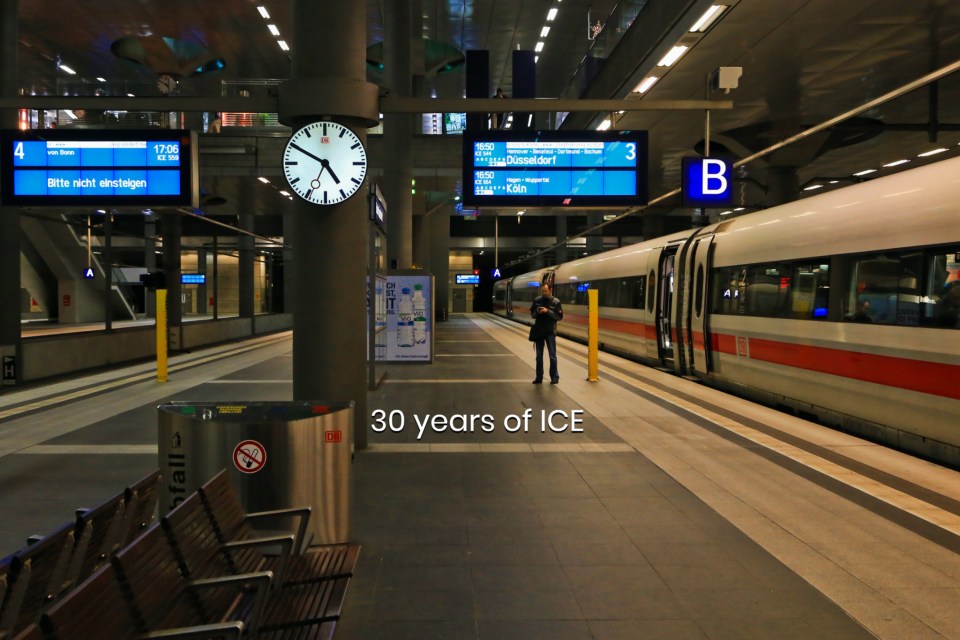
Germany: 30 years of ICE on the rails (2021)

Above/featured: Berlin Hauptbahnhof – 9 Dec 2015 (6D1). Departing from track 3 is ICE 554 to Köln (front-half) and ICE 544 to Düsseldorf (back-half); trains split in the town of Hamm.

June 2021 marks the 30th anniversary of high-speed Intercity Express (ICE) service on German rail.

In the 1991 vs. 2021 comparison graphic provided by Deutsche Bahn, I’ve marked in green the ICE routes upon which I’ve made dozens of trips since late-2001 (when I moved to Heidelberg). Even after leaving in 2003, frequent annual trips back to Germany meant spending a lot of time planted on express trains across the country. Arriving in Europe mostly meant flying into Frankfurt am Main airport, from which I’d travel:

  • Frankfurt to Berlin, via Kassel
  • Frankfurt to Heidelberg, via Mannheim
  • Frankfurt to Köln
  • Frankfurt to Munich, via Stuttgart
  • Berlin to Frankfurt, via Kassel
  • Berlin to Köln, via Hannover
  • Köln to Berlin, via Hannover
  • Köln to Frankfurt
  • Munich to Frankfurt, via Stuttgart

Over the last few years, the express stretch between Erfurt and Halle/Leipzig has vastly improved the Berlin-Frankfurt and Berlin-Munich routes, cutting the one-way travel time for each route by about one hour. Except for the Erfurt-Halle/Leipzig stretch, I’ve travelled on every “Stundentakt” ICE route (thick red/green in the graphic below).

Intercity Express, Deutsche Bahn, German Rail, Germany, Deutschland

ICE coverage, including recent work on the Erfurt-Halle/Leipzig stretch; graphic courtesy of Deutsche Bahn. My “dozens on ICE” are marked in green; red filled circles indicate cities I frequented the most (B, F, HD, K, M).

Intercity Express, train fleet, Deutsche Bahn, German Rail, Germany, Deutschland

The ICE fleet of trains include vehicles with maximum speeds of over 300 km/h; graphic courtesy of Deutsche Bahn.

Frankfurt am Main Hauptbahnhof, F Hbf, Frankfurt am Main, Hesse, Hessen, Germany, Deutschland, fotoeins.com

Morning ICE 5 service from Frankfurt am Main to Basel; how to read this train station signage – 20 May 2016 (6D1).

Hackerbrücke, München, Munich, Bavaria, Bayern, Germany, Deutschland.

Morning light at Munich’s Hackerbrücke station. Foreground: westbound metallic-white ICE train just departing the city’s central station, traveling right to left. Background: red DB regional train approaching central station, from left to right. Photo on 23 Feb 2017 (6D1).

I made three images above with a Canon EOS6D mark1 (6D1). This post appears on Fotoeins Fotografie at fotoeins DOT com as https://wp.me/p1BIdT-l60.

Deutsche Bahn, IC 2218, Oberes Mittelrheintal, Upper Middle Rhine Valley, Germany, fotoeins.com

The nebulous transition

I’m racing past kilometer 554.

The simple black and white sign on the east flank of the river counts down to the end, to the river’s mouth where the mineral-rich mud and silt enter the North Sea. Another sign tells me what this famous rock-face landmark is.

There’s barely enough time at Loreley to detect the hint of a siren’s call, as the train marches to the next bucolic town. Though small in size, the town and its buildings seem to stand fast in a “group hug” of the river bank in a futile attempt to hold back the rush of the Rhine.

This feels like routine, a journey in western Germany which I’ve repeated many times over the last 15 years. With heavy heart, I’ve departed my adopted hometown of Heidelberg for the umpteenth time. I’m traveling north to meet with friends I haven’t seen in a couple of years.

( Click here for more )

Abfahrtstafel (Departures board), Frankfurt am Main Hauptbahnhof, fotoeins.com

How to read signage at German train stations

You’re excited – you’ve finally arrived in Germany. You’ve decided to travel the country by train, but you’re not familiar with the German language, and you may find the signs puzzling and difficult to read.

The following is a short guide to signage at German train stations to help get you on your way. Examples below are taken from Frankfurt am Main Hauptbahnhof (central or main train station), although descriptions should apply similarly at other stations.

Below are descriptions for:

  • Departures board (Abfahrtstafel)
  • Destination signage (Zugzielanzeiger)
  • Car sequence signage (Wagenreihungsplan)
  • Arrivals-, departures schedules (Ankunfts-, Abfahrtspläne)

( Click here for more )

Hong Kong: almost China at the Lo Wu gateway

I’m at the turnstiles, off to the side from the steady stream of people going through to the other side.

I’m standing on the one side in Hong Kong (香港).

The other side is the city of Shenzhen in the People’s Republic of China’s province of Guangdong (Kwangtung | 廣東 | 广东).

MTR trains come in from Hong Kong and stop here at the end of the line. People pour out of the trains, and head for Shenzhen. There are occasional lulls in between frequent arrivals and departures of the trains, reminding me I’m in the middle of the countryside and at the frontier section separating between what most people know as Hong Kong and China.

Over on the “other” side, Shenzhen is a strong economic force, helped along by its special designation as a Special Economic Zone (SEZ), but there’s still a special allure for many to working inside Hong Kong’s Special Administrative Region. MTR rail passengers depart Hong Kong and enter Shenzhen at either the Lo Wu or Lok Ma Chau (Spur Line) crossings. The average cross-border passenger traffic numbers are 220,000 and 80,000 people per day, at Lo Wu and Lok Ma Chau, respectively (Source 1, Source 2).

From an economic, urban planning, and logistics point of view, it’s no surprise there’s a push to amalgamate Shenzhen with Hong Kong to create a super-metropolis here at the mouth of the Pearl River. Hong Kong has over 7 million people, whereas the population of neighbouring Shenzhen exceeds 13 million. Many would like to see easier and faster movement of goods and people between the two cities, but many in Hong Kong fear an exacerbation of existing problems with overcrowding and overburdened resources.

But what of the people going back and forth? How many from China and/or Shenzhen enter Hong Kong for work or school, and reverse course at the end of every day? How many from Hong Kong go to work in Shenzhen?

I wonder what the daily routine is for someone going back and forth between Shenzhen and Hong Kong. I watch patiently, and I wonder what it’s like on the other side. I have no doubt there’s someone on the other side in Shenzhen who’s wondering the same thing.

( Click here for images and more )