Fotoeins Fotografie

location bifurcation, place vs. home

Posts tagged ‘My Berlin’

My Berlin: that tower again

I like shiny pointy objects, and if it’s by deliberate effort or accidental circumstance, the Fernsehturm (TV Tower) slides into many of my photos from Berlin. And if people throughout Berlin can see the tower, how do those who live in or commute through different parts of the capital city view the landmark? After multiple visits between 2005 and 2021, I’ve accumulated over 45 lines-of-sight to the TV Tower around Berlin.


( Click here for images and more )

Mengenlehreuhr, set theory clock, Berliner Uhr, Berlin Clock, Sixt, Europa-Center, Budapester Strasse, Charlottenburg, Berlin, Hauptstadt, Germany, fotoeins.com

My Berlin: An Unusual (Set Theory) Clock

I had read about this unusual clock years ago; the unusual mathematics connection was an additional “plus”.

I leave the crowds at Gedächtniskirche and Breitscheidplatz and head on over to the SixT car rental outlet on Budapester Strasse. What’s standing in front is most certainly a curiosity, even as passers-by look at me curiously.

The Berlin Clock is known in German as “Berliner Uhr”. The alternate name is “set theory clock” or “Mengenlehreuhr”, a German compound word consisting of “Menge” for quantities (sets), “Lehre” for theory, and “Uhr” for clock. The Guinness Book of Records claimed “the Berlin Clock was the first clock in the world operating according to the principles of set theory1“.

Created by inventor Dieter Binninger, the clock first stood at the corner of Kurfürstendamm and Uhlandstrasse in West Berlin from 1975 to 1995. Local business arrangements were made with Binninger’s widow for a long-term loan including maintenance costs, and the clock was moved in 1996 to its present location at the Europa-Center.

Here is how one reads the Berlin Clock:

  • Top circle: light flashes every 2 seconds; ‘on’ 1-second, ‘off’ 1-second
  • 1st row: hour of day in 5-hour increments, up to 20
  • 2nd row: hour of day in 1-hour increments, up to 4
  • 3rd row: minutes in 5-minute increments, up to 55
  • 4th row: minutes in 1-minute increments, up to 4

Time shown in the above featured image is 1310 hours or 110pm, which breaks down as (2 x 5) + (3 x 1) hours and (2 x 5) + (0 x 1) minutes.
( Click here for more )

My Berlin: Bornholmer Strasse, first through the Wall

By today’s appearance, it’s easy to overlook the bridge at Bornholmer Strasse (also known as Bösebrücke) as an historic landmark. On the night of 9 November 1989, the Berlin Wall opened here first, at the Bornholmer Strasse bridge border-crossing between East Berlin and West Berlin.


( Click here for images and more )

Perlin, Hackesche Höfe, Hackescher Markt, Berlin, Germany, fotoeins.com

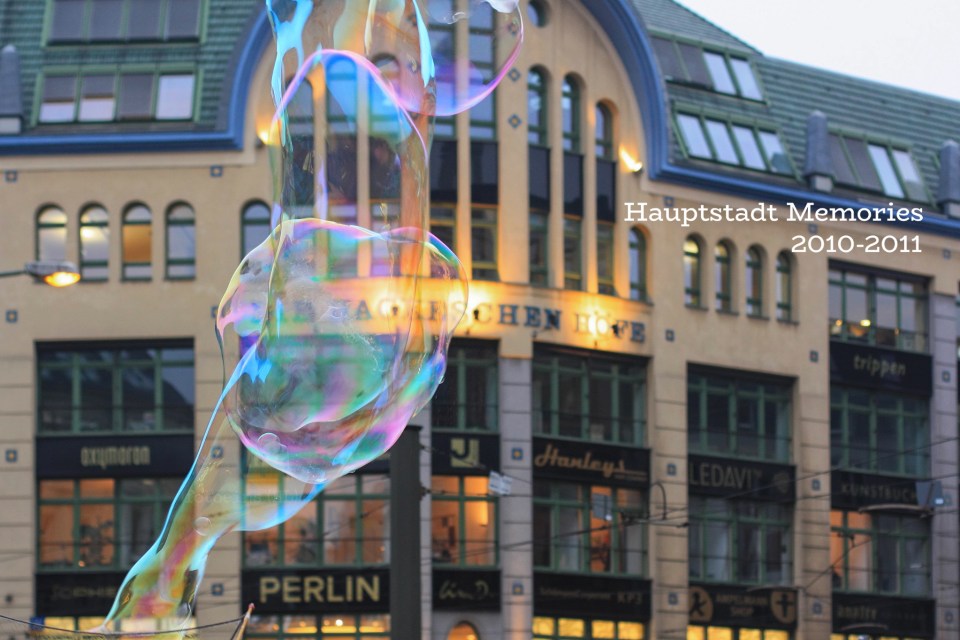
My Berlin: Hauptstadt Memories, 2010-2011

Featured: “Pe(a)rlin’ in Berlin”, Hackescher Markt – 16 March 2011 (HL).

Berlin is one of my favourite cities in the world. From the moment I stepped foot inside the German capital city for the first time in 2002, it’s been an ongoing love story. I’m convinced the “Hauptstadt” will always be worth photographing; it’s my “long game.” Naturally, there are a massive number of sights throughout Berlin, and I’ve always combined public transport with plenty of walking. In fact, traveling 10 to 20 kilometres per day throughout the city is pretty much the norm. These photographs are personal observations and measurements of location, geometry, and motion.

The pictures and memories may be from years past, but all of the them retain their contemporary nature: images which include quiet snowy Christmas, an important memorial, and pieces of architectural design.

( Click here for images and more )

Denkmal fuer die ermordeten Sinti und Roma Europas, Memorial to Murdered Sinti and Romas in Europe, Dani Karavan, Tiergarten, Berlin, Germany, fotoeins.com

My Berlin: Moving Memorial to Murdered Sinti and Roma

In the German capital city, among the rustling of tall trees is a quiet space in the northeast corner of Tiergarten Park adjacent to the Reichstag. Between the chirps and whistles of small birds, a recording of a violin plays. Individual notes are held, as long as possible, as if life depended upon the existence of each note. Slowly, the sound accumulates into a keening wail, burrowing deep (if you let it) and tearing from within (if you feel it). You’d do well not to stumble, as you gingerly move through the memorial, careful not to step on words like “Auschwitz”. Inscribed on flattened stones spreading out from the pond are the names of important places, critical to maintaining memory, with intention and purpose.

Created by Dani Karavan, the Memorial to Murdered Sinti and Roma consists of a circular pond. At the centre is a triangular slab on which fresh flowers are placed. In a ring around the pond are the words of a poem, “Auschwitz”, by writer and composer, Santino Spinelli, a member of the Italian Sinti and Roma.

Muj šukkó, kjá kalé vušt šurde; kwit. Jilo čindó bi dox, bi lav, nikt ruvbé.

Drenperdo Mui, phagede Jakha, schiel Wuschtia; Pokunipen. Phagedo Dschi, kek Ducho, kek Labensa, kek Asvia.

Eingefallenes Gesicht, erloschene Augen, kalte Lippen. Stille. Ein zerrissenes Herz, ohne Atem, ohne Worte, keine Tränen.

Pallid face, dead eyes, cold lips. Silence. A broken heart without breath, without words, no tears.

( Click here for video and images