Fotoeins Fotografie

location bifurcation, place vs. home

Posts tagged ‘Luther Country’

Stadtkirche, Schlosskirche, Lutherstadt Wittenberg, Wittenberg, Saxony-Anhalt, Sachsen-Anhalt, Germany, UNESCO World Heritage Site, fotoeins.com

Wittenberg: 13 historical highlights in the Lutherstadt

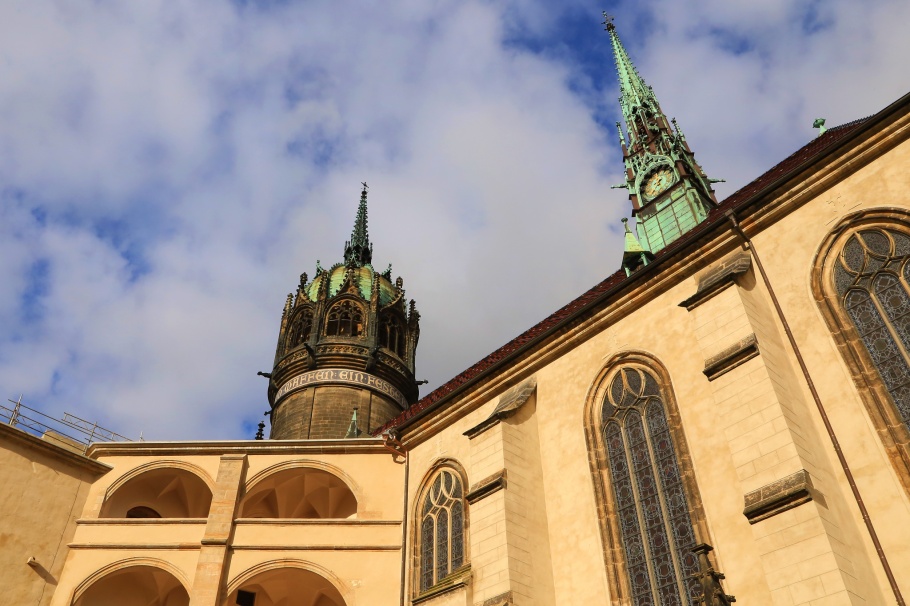
Above: Facing west from Kirchplatz, the Stadtkirche (City Church) and Schlosskirche (Castle Church) at upper-left and lower-right, respectively, are Wittenberg’s major landmarks.

If you’re thinking about or you’re already present in Wittenberg, two words have already provided the marquee reasons why you’re here at this blogsite and there in the town: Martin Luther.

The biggest reason why people will step foot in Wittenberg is to see and learn about how the Protestant and Reformation movement began and took hold, who the major players were, and what their roles were in the movement. For most, they’ll want to visit the four sites which form the basis for the town’s status as UNESCO World Heritage Site (WHS; see below). In addition to these four, there are other highlights for the curious and interested visitor, and all of them are easy to reach in the compact Old Town.


( Click here for images and more )

Augustinerkloster, Augustinian Monastery, Erfurt, Thüringen, Thuringia, Germany, fotoeins.com

Erfurt: Martin Luther’s start at the Augustine Monastery

You can almost imagine a 16th-century monk walking these halls, contemplating various aspects of spirituality, and reconciling them with the hardships of everyday living.

In the federal state of Thuringia in central Germany, the Augustinerkloster (Augustine monastery) in Erfurt is a notable place for the history of Martin Luther and the Reformation.

Martin Luther arrived in 1501 and began studies in liberal arts, law, and theology at Erfurt University. In 1505, Luther experienced a big personal event (the scare of his life, as legend goes), and decided to leave his studies by entering the Augustine Monastery to become a monk, much to his father’s displeasure and objections. Built originally around 1300, the Augustine Monastery was home for Martin Luther until 1511, and it’s here where he was ordained as a priest. The site underwent extensive post-war reconstruction after suffering heavy bombing damage in the Second World War. The monastery is now a seminary and a modest hotel: guided tours of the monastery provide a glimpse to Luther’s early years as a monk, and visitors can now reserve rooms for overnight stays in a no-frills technology-free setting and a peaceful comfortable environment.

Erfurt’s Augustinian monastery is listed as one of many additional candidate sites for inclusion into a single UNESCO World Heritage Site under the title Luther memorials in Saxony-Anhalt, Saxony, Bavaria, and Thuringia.

( Click here for images and more )

Martin Luther: tracing his steps in 16 German cities

Above/featured: “Luther war hier. (Luther was here.)” Eisleben, Germany. Photo, 27 Oct 2016.

In pre-teen years, I attended a Catholic elementary school by weekday, and a missions-oriented Protestant church by weekend. I already had multiple questions running around my pre-scientist brain, like electrons appearing and dissipating in a fuzzy halo. When various disparate elements began to settle with few satisfying answers, I left behind the churches and their respective religions. But one thing that’s remained is my love of history. History has never been boring, because I carry the past (as offspring of immigrants), and I’m determined to bring history’s lessons into the present.

Even in youth, I had to ask: why was one set of churches called “Protestant”? What was under protest? How did one man help spark a movement that would help merge and create a version of a language that continues today, that would bring accessible means to literacy for the public, and that would begin to change rule by religion to rule by law?


Martin Luther: Luder’ name at birth

From his birth in Eisleben; to formative years in Mansfeld, Magdeburg, and Erfurt; to the bulk of his working and teaching years in Wittenberg; to his death in Eisleben, Martin Luther set upon a course that helped change language, education, culture, religion, and governance. In many ways, Luther had much to thank Jan Hus for the latter’s efforts to reform the Catholic Church in Bohemia one hundred years earlier.

Every year on the 31st of October, a number of cities, regions, and federal states in Germany mark an important event in this movement. It’s widely understood Martin Luther walked up to the Castle Church in Wittenberg and pinned his 95 Theses to the church doors on 31 October 1517. Even if direct evidence Luther actually posted papers to the doors is debatable, what’s not is that 2017 marks the 500th anniversary of the Reformation in Germany.

Martin Luther, Reformation, German Reformation, Wittenberg, Marktplatz, Saxony-Anhalt, Sachsen-Anhalt, Germany, Deutschland, fotoeins.com

The illuminated Luther memorial stands tall in front of Wittenberg’s town hall at Market Square. As UNESCO World Heritage Site, the town hosts 4 sites: Luther House, Melanchthon House, St. Mary’s Town Church, and the Castle Church. 2017 is the 500th anniversary of Luther’s Reformation in Germany. Various German federal states, regions, and cities will mark the quincentenary throughout the year. Photo at Wittenberg Marktplatz on 30 Oct 2016.


( Click here for images and more )

Wittenberg UNESCO WHS: The Castle Church

In the east German town of Wittenberg, the Schlosskirche (Castle- or All Saints’-Church) is one of four sites as part of the town’s status as UNESCO World Heritage Site since 1996.

Elector Frederick III of Ernestine Saxony (1463-1525, also known as Frederick the Wise, Friederich der Weise) became the first patron of the Protestant Reformation with his support and defence of Martin Luther. On the site of the original city castle, Frederick the Wise authorized in 1489-1490 a renaissance palace with the entire north wing occupied by the Castle Church. The church was consecrated and inaugurated in 1503 as the castle and university church “Allerheiligen” (All Saints); Martin Luther taught theology as professor at the neighbouring university. The first Protestant service at the Castle Church was held in 1524-1525.

A significant portion of the church including the original wooden doors was burned and destroyed in 1760 during Europe’s Seven Years’ War (1754-1763). The 1770 replacement church was subsequently destroyed in the conflict against France’s Napoleon which ended with the town under Prussian control in 1815. With support and backing by Emperor Wilhelm II, a full renovation of the church took place between 1885 and 1892 with the west tower taking the form and shape we see today (see also below). The graves for Martin Luther, contemporary colleague and fellow reformer Philipp Melanchthon, and Frederick the Wise are inside the church. After three years of renovation and restoration work in time for the Reformation quincentenary in 2017, the Castle Church was reopened in the autumn of 2016.

Schlosskirche, Castle Church, Wittenberg, Sachsen-Anhalt, Saxony-Anhalt, UNESCO World Heritage Site, Germany, fotoeins.com

( Click here for images and more )

Lebenszeit, Zeitzaehler, Gloria Friedmann, Platz am Elbbahnhof, Magdeburg, Sachsen-Anhalt, Germany, fotoeins.com

Magdeburg: Elb(e) and flow of time

I feel every hour of every day more keenly, especially as some of my contemporaries have recently died far too early. As children, we all felt we were held back, against the sluggish crawl of time. Today, we’re holding on as hard as we can, engulfed within the surge of time. Is it better to give in to the flow, or is it better to stand and making turbulence in the tide?

Along the Elbe river promenade in the east German city of Magdeburg, a sculpture appears to keep track of time in a neighbourhood not far from the city’s Cathedral.

( Click here for more )