The last time I saw my aunt J in person was in Vancouver for Dad’s funeral ten years ago. The last time I set foot inside aunt J’s home in Calgary was in 1976, which by now is a mere hop for a 50-year anniversary.
My mum’s big sister is celebrating her 100th birthday this month, and many members of the extended family from across North America are gathering in Alberta’s most populous city for a momentous celebration.
My photographic traces of a late-summer morning and afternoon wandering the city centre is on display, “outlined” by various pieces of art and architecture.
I’m in Stuttgart for a few days, and I rediscover photographer Gerda Taro was born in the city. I’d already read some history of photography, including the Spanish Civil War and Gerda Taro as the first woman to photograph and publish images about open conflict. I’ve gone looking for some traces in the city of her birth, as a quick and spontaneous mini-project in the midst of 90 consecutive days in Europe.
Memorial, near Olgaeck
Near the bus and tram stop Olgaeck is Gerda Taro Plaza, in memory of the young woman photographer who was born “Gerta Pohorylle” in Stuttgart and who once lived with her family in the area. At the plaza is a 2014 memorial dedicated to Taro; the text on all nine panels is entirely in German.
Named for photographer Gerda Taro (1910-1937), the plaza was unveiled by the city in 2008, and redesigned in 2014 with the installation of the memorial.
“O”. Gerda Taro, a pioneer in war photography.
“R”. The 1920s: Jazz, Theater, and the Stuttgart Kickers.
“A”. Leipzig: distributing leaflets against Hitler.
“T”. Exile in Paris: meeting André Friedmann, and the creation of Gerda Taro and Robert Capa. There is no Capa without Taro.
“A”. The Spanish Civil War, 1936-1939.
“D”. Barricades, armed women, equitable distribution of land.
“R”. The camera as witness: misery and terror from bombs.
“E”. Getting up close, for the world at large.
“G”. The first woman war-photographer killed on location. Documenting Spain’s civil war with her camera, Gerda Taro was accidentally run over by a tank and died from her injuries in a hospital near Madrid on 26 July 1937. She was buried in a marked grave in Paris’ Cimetière du Père-Lachaise.
Republican militia women training on the beach outside Barcelona, Spain: photo by Gerda Taro, August 1936. Provided by Ur Cameras on Flickr via Creative Commons.
Family home
Not far from Gerda-Taro-Plaza, I found the Pohorylle family’s former home, based on this poignant essay. I didn’t see any Gedenktafel (memorial plaque) or any Stolpersteine (stumbling stones) in the pavement, at or in front of either building 170 or 170A. In 1929, when Gerta was 19 years old, the Pohorylle family moved from Stuttgart to Leipzig.
Obstructed view of the former Pohorylle family house (in light orange), as seen from passage off Cottastrasse.
Gate to path access for building address Alexanderstrasse 170A.
Former Pohorylle family house, at Alexanderstrasse 170A.
Taro, short bio
Born Gerta Pohorylle, 1910 in Stuttgart, Germany; died 1937 in El Escorial, Spain.
“… Studied in Leipzig starting in 1929. Emigrated to Paris in 1933. In 1935 began working with the photographer André Friedmann, later known as Robert Capa. In 1935-1936 worked for the Alliance Photo Agency. Shortly after the outbreak of the Spanish Civil War in the summer of 1936, she and Capa went to Spain; other photography assignments in Spain followed in early 1937. She was fatally wounded at the Brunete front in July 1937 and was the first female war correspondent killed in action.”
Source: “Women War Photographers: from Lee Miller to Anja Niedringhaus” (Munich: Prestel, 2019), p. 218.
I made all photos above with an iPhone15 on 22 Jul 2024. I received no support from an external organization. This post composed with Jetpack for iOS appears on Fotoeins Fotografie at fotoeins DOT com.
Seems like yesterday: ten years have disappeared in a flash. And yet, a hint of grief is as fresh, now as it was then.
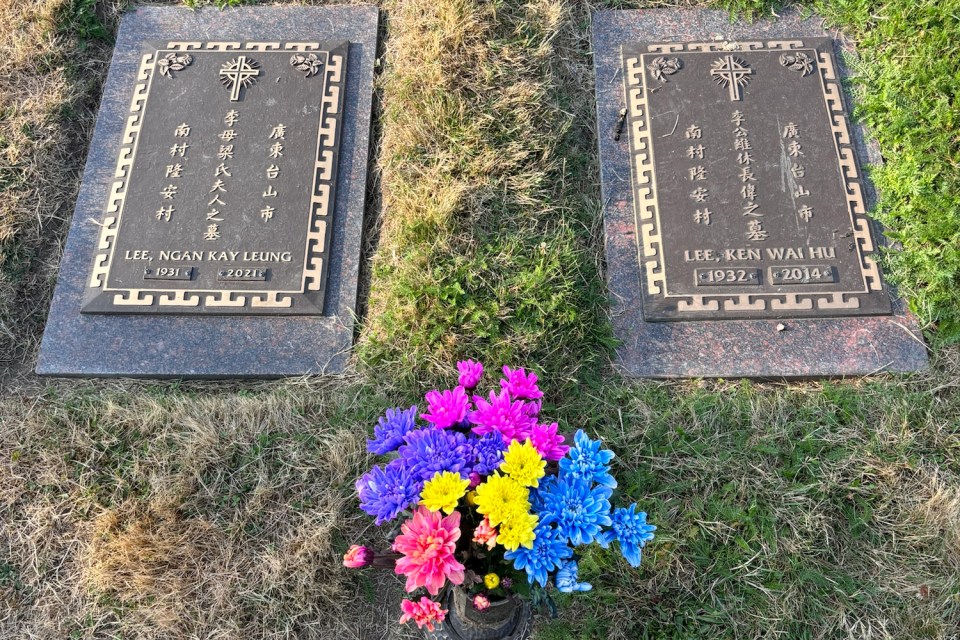
Before dawn, I swear I heard his voice calling out to me. The official pronouncement: 610am, 9 August 2014. Ken Lee, dead at 82. I was afraid I had already forgotten his voice.
Northern summer will always have an air of finality, tainted by memories of frailty and inevitability: entropy at its absolute finest.
One day, I’m on the well-travelled stretch between Mannheim and Cologne, fiddling between an online ticket for an express train and an online (Deutschland-) ticket for the next regional train.
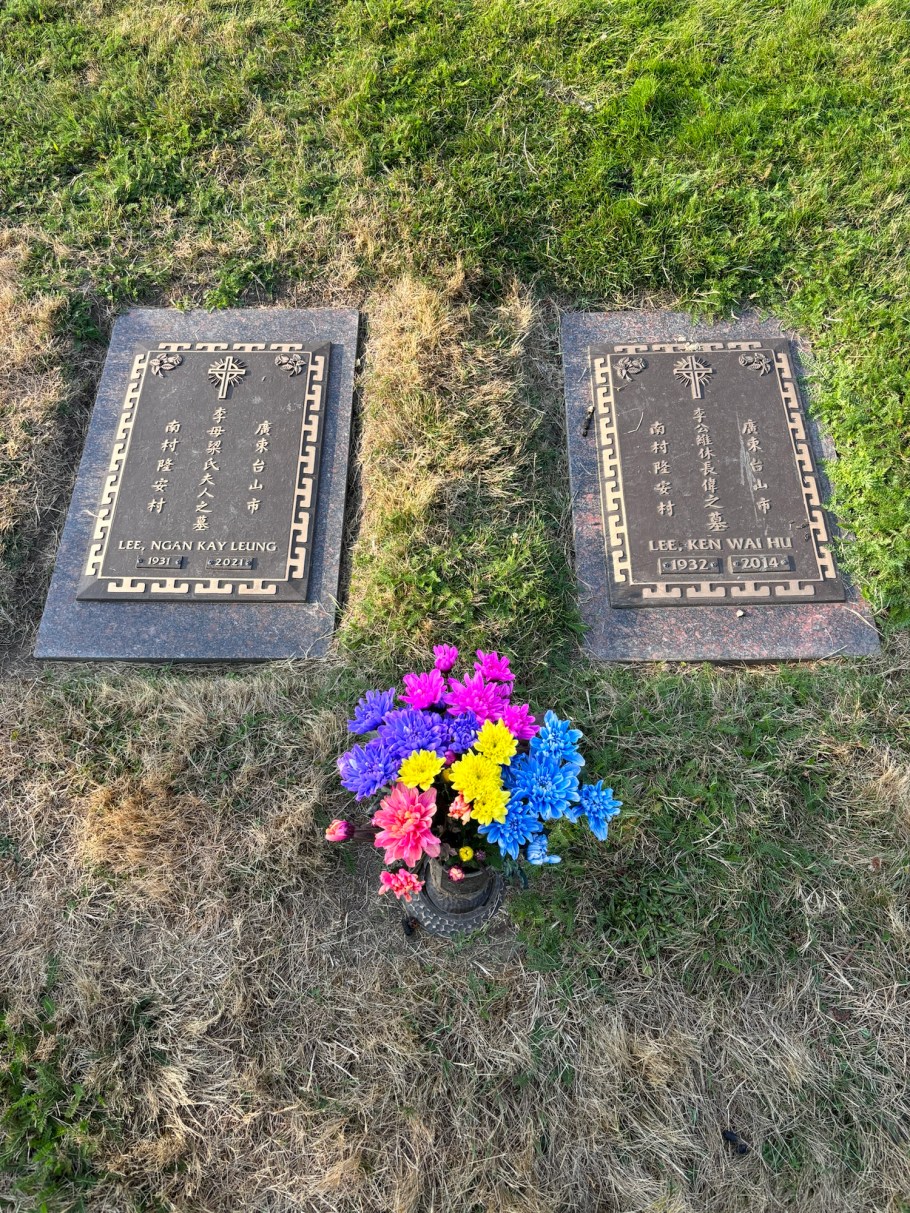
The next day, I’m in a Vancouver cemetery on a late Friday afternoon. I see only two to three other visitors out here. It is almost mid-August. Sun’s out, it’s almost 30C. Somewhere outside of this green patch of stone, metal, and flowers, life thrives and goes on. For me, I’ve come back to get “stuck”; I might as well be 8000 km away, back on the other side of the planet.
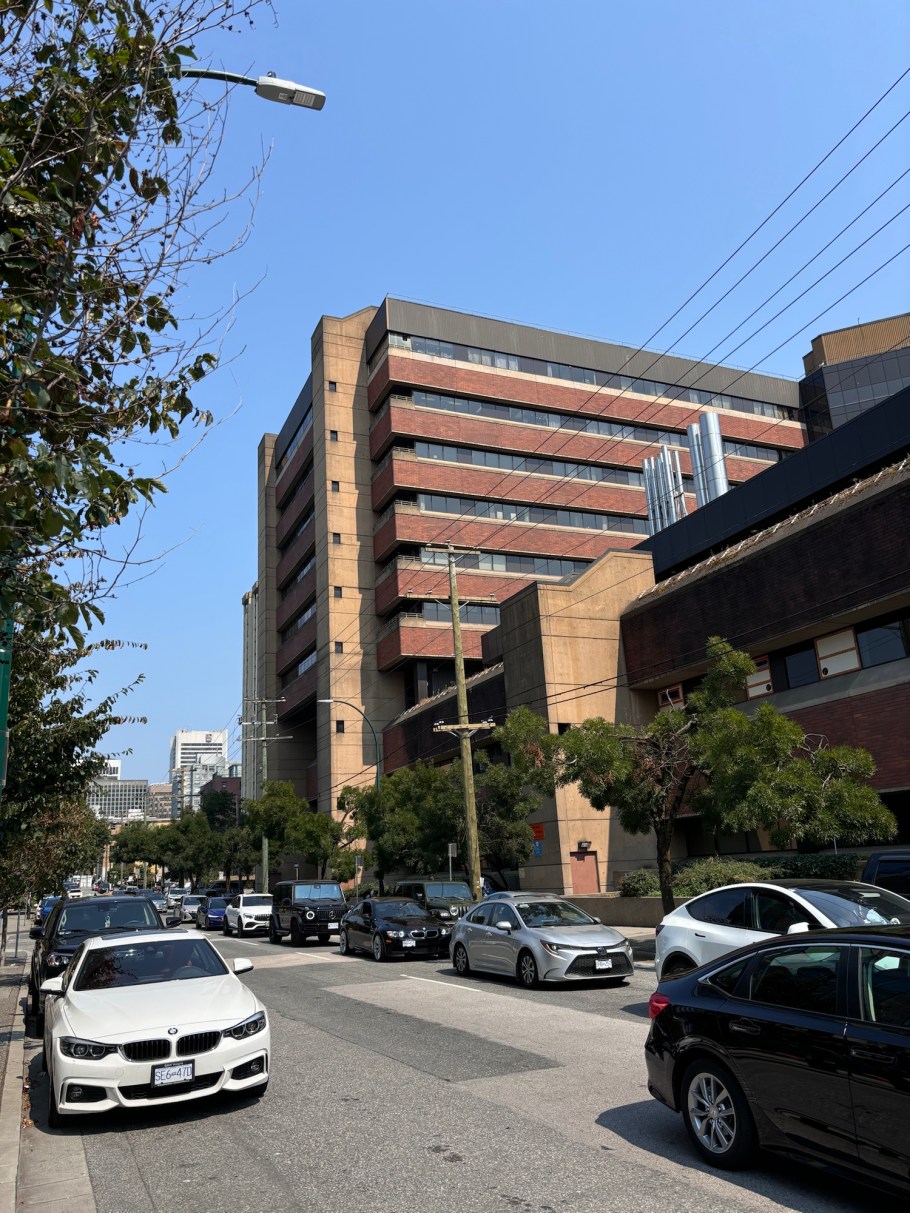
Up on the 10th floor is/was the palliative ward where Dad spent his final 2 weeks.
Ocean View Cemetery.
“Hey, Mom and Dad: it’s me …”
I made the photos above with an iPhone15 on 9 Aug 2024. This post composed with Jetpack for iOS appears on Fotoeins Fotografie at fotoeins DOT com.
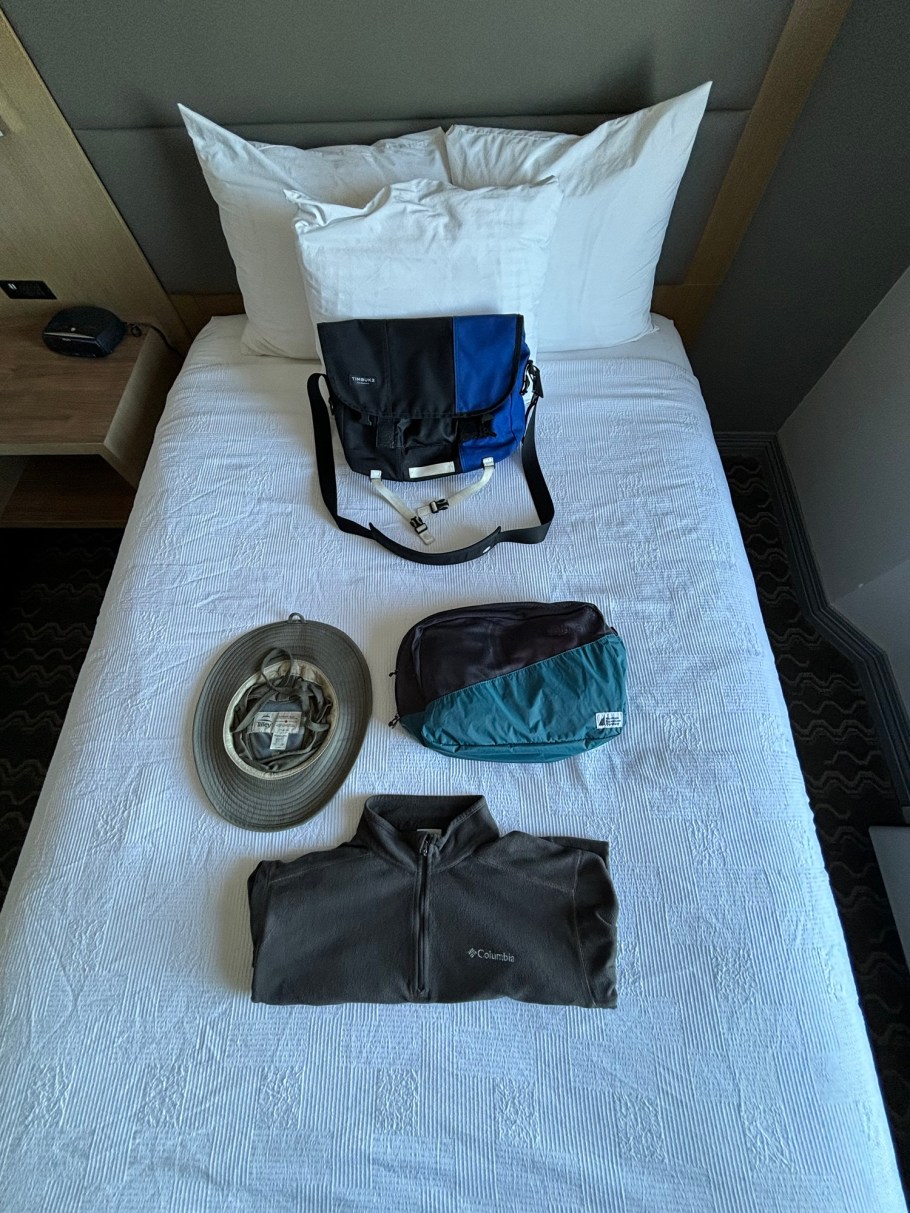
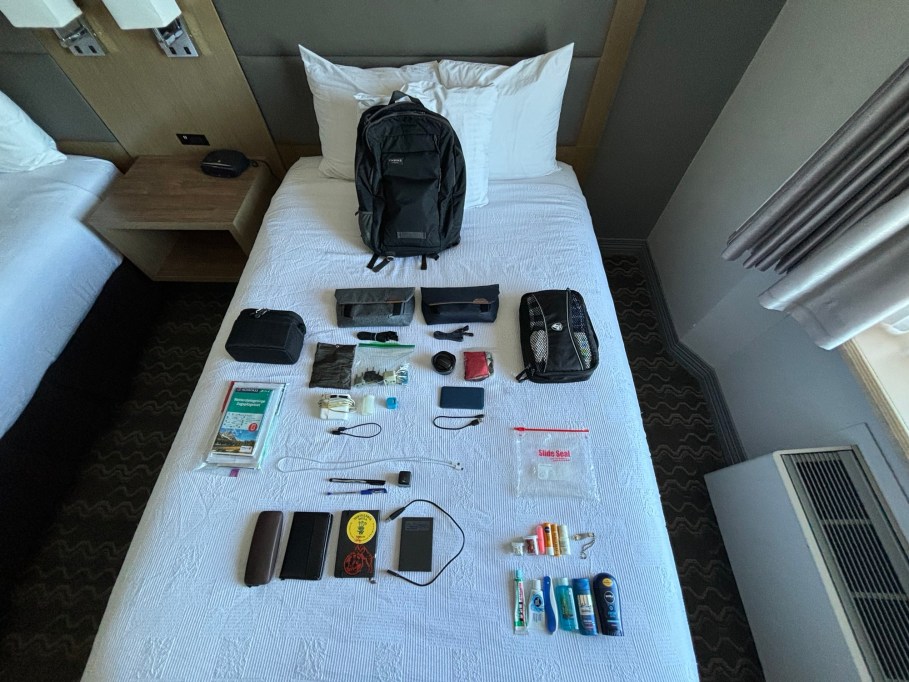
For 3 months in summer, I have a medium-sized 21-Litre (21-L) Timbuk2 Classic Messenger bag in blue and black, and a 32-L Timbuk2 Command backpack in black. (Both products are unfortunately phased out of production.) These are my “personal item” and “carry-on”, respectively, for my flights.
What’s in my 21-Litre Timbuk2 Classic Messenger bag?
21-L messenger bag
Tilley Hiker’s Hat (with evaporative cooling insert)
Mountain Equipment Company (MEC) medium-sized mesh pouch in blue, containing a change of clothes (1 t-shirt, 1 change of underwear)
Columbia grey long-sleeved half-zip fleece
What’s in the backpack 🎒
32L backpack
Centre-left:
Tenba BYOB7 Camera Insert bag in black, carry-case for my X70, extra batteries, and chips.
Kompass 4in1-Wanderkarte/map, for Wettersteingebirge and Zugspitze
Centre:
• 3-L Peak Design Field Pouch in charcoal grey, containing:
carrying strap for the pouch
small soft pouch with wired earphones and small USB-C to 3.5mm audio jack.
small freezer bag with “Europlugs” (type-C) adaptor plugs for western Europe
Charger for MacBook Pro (c. 2016; not shown)
translucent film-roll cannister, for spare change
USB-A power cube wall charger (retractable), light blue
USB-A to USB-micro cable for camera, black
• 3-L Peak Design Field Pouch in midnight blue, containing:
carrying strap for the pouch
WCL-X70 wide-lens with small rubber lens-hood
small clear zip-pouch with cleaning cloths
Mophie 5000mAh PowerBank, dark blue
USB-C to USB-A cable, black
I’ve used one of the Field Pouches as a compact lightweight day-pack; can’t carry much except for camera, batteries, memory chips, PowerBank, cables.
Below the field-pouches:
USB-C to USB-C cable, white
2 pens
USB-C power cube wall charge (retractable), black
Sunglasses in hardshell case
Passport
Moleskine hardcover small lined-notebook
Portable hard disk with black USB-A to USB-microB cable
Centre-right
• Heys medium-size packing cube in black; containing 2 t-shirts, 2 changes of underwear, 2 pairs short-socks
• Small (<1-L) freezer bag containing:
“arts & crafts styled” pill-jars, ear plugs, sunscreen stick, lip balm, eyedrops, nail clipper, Mopiko ointment, toothpaste, collapsible toothbrush, small bottles with body wash/shampoo, roll-on “deo”.
Many items on display are easy to replace at my destinations.
My nods go to their versatile Field Pouch, their Leash strap on my X70, and their Everyday case for iPhone 👍🏽
I made the images above with an iPhone15 on 7 May 2024. I have received no support from an external organization. This post composed within Jetpack for iOS appears on Fotoeins Fotografie at fotoeins DOT com as https://wp.me/p1BIdT-sts.
( 2025 note: On 18 September 2025, Bavarian state broadcaster BR24 reported the monthly price for the Deutschland-Ticket will go up by 5€to 63€, starting 1 January 2026. The price had already gone from 49€ to 58€ for the 2025 calendar year. My summer 2025 purchase went the same way as in 2024, whose details are described below. )
89 days within Europe includes by necessity substantial travel by train within Germany. I’ve already booked in advance a number of intercity express segments, but what about local transport and regional trains?
The “Deutschland Ticket” (D-Ticket) is a rail ticket for one person and costs 49€ per month on a rolling subscription. The ticket is generally valid for local transport (bus, tram, U-Bahn, S-Bahn, intracity ferry) and regional rail (RB, most RE, IRE), but not for long-distance IC and ICE routes. Intended primarily for commuters, visitors to Germany can also purchase these tickets.
It’s early-April 2024, and I’m about to buy the D-Ticket for 49€ for the entire month of May. The ticket’s “rolling subscription” means if I do nothing else before 10 May, I’ll also automatically purchase a D-Ticket for the month of June for 49€. I’ll need the D-Ticket for May, June, July, and August; but I can only buy one month at a time.
I choose Munich’s MVV-App, based on successes reported by other travellers. I’m only using the Munich app for ticket purchase, and I’m not planning to use public transport within Munich. To buy a D-Ticket, customers are neither limited by their choice of app/method, nor by the base/location where the app is based. My question is whether a Canadian-based credit card is an acceptable form of payment by the processing company in Germany for a German-based app.







 Fotoeins Fotografie