Fotoeins Fotografie

location bifurcation, place vs. home

Posts tagged ‘Hesse’

Frankfurt am Main: Frank Family Center at the JMF

Above: “It’s a miracle I’m still alive”, Otto Frank. Photo, 17 Jun 2023 (X70).

Familie Frank Zentrum, Jüdisches Museum Frankfurt

Frank Family Centre, Jewish Museum Frankfurt

Frankfurt am Main is a city I’ve visited countless times since 2001, but I hadn’t known until recently that Anne Frank and her sister, Margot, were born in Frankfurt am Main, or that their parents, Otto and Edith, had lived in Frankfurt for almost ten years before moving their family to Amsterdam in early-1934. I’ve put together a list of places and traces the Frank family spent and left in Frankfurt am Main.

Here I cast light on the Frank Family Center (FFC), both memorial and historical record of the European-Jewish Frank family which was added to the permanent collection of the Jewish Museum Frankfurt (JMF) in 2020. Having begun in 2012, the Frank Family Center brings together an extensive collection of material belonging to the Frank-Elias families. The archive includes photographs, official documents, hand-written letters, art, books, household items, and furniture. The items provide a glimpse into the lives of the Frank- and Elias-families across Europe; there’s happy times, catastrophe and loss, and the strength gained in survival. The FFC has been designed for the public to view a part of the archive on permanent display in an open museum setting, as well as for research parties to pursue various avenues of academic inquiry.

Upon entry into the space, the first panel includes the following introductory text which I’ve modified to improve clarity.

The Jewish Museum Frankfurt holds a large number of objects belonging to Anne Frank’s family who had lived in Frankfurt for several generations.

Between 1929 and 1933, the entire family departed Frankfurt am Main and established new lives in Basel, Paris, Amsterdam, and London. In 1942 Amsterdam, Otto and Edith Frank, along with their daughters, Margot and Anne, went into hiding to escape imminent deportation. In August 1944, the secret location was revealed to the authorities, and the family was detained, and deported to Auschwitz. Of the four in the family, only Otto Frank survived, who subsequently devoted the rest of his life to acquainting and educating the world with the diary of his murdered daughter, Anne.

In 1933, Anne’s paternal grandmother Alice Frank sold their home in Frankfurt am Main, and moved to Basel to join her daughter, Leni Elias, and her family. Alice was able to take some of the family belongings with her from Frankfurt to Switzerland, including personal photos and documents. Her moving boxes also contained furniture, porcelain, silverware, and paintings. The family’s heritage as documents of their previous lives in Frankfurt was carefully preserved in Basel.

This room of the Frank Family Center provides an introduction to this family heritage and to the history of the Frank and Elias families.

( Click here for images and more )

Frankfurt & the Franks: Anne, Edith, Margot, Otto

Above: The Frank family in happier times; seen left-to-right are Margot, Otto, Anne, and Edith, respectively. Display at the Frank Family Centre at the Jewish Museum Frankfurt, 17 Jun 2023 (X70).

I hadn’t realized how long an impression would last, decades after having read in high-school the diary of a young girl stuck in hiding for years. Much later down the line and standing in front of a house in a quiet neighbourhood in a German city, I could almost hear the laughter of children in the backyard and the gentle rebuke of a mother to one of her daughters, years before one of the girls ever considered writing her thoughts down into a book.

The story of Anne Frank and her family are well known. Her father and businessman Otto Frank moved his family from Frankfurt am Main to Amsterdam in 1934 to escape increasing Nazi discrimination against Jews. Otto survived capture, deportation, and time in the camps; but his wife and two daughters did not. After liberation in 1945, Otto Frank returned to Amsterdam and wrote letters to relatives in Basel. He learned how the diary written by his daughter Anne had been carefully hidden; reading her daughter’s thoughts would change the remaining course of his life. In the early-1950s, he moved to Basel, Switzerland, to be closer to his sister’s family. He and his extended family spent time and energy for the rest of their lives dedicated to translation efforts and the distribution of Anne’s diary as a document of family memory, world history, and essential education; and to the collection of memories and belongings of lost family members. Otto died in 1980, and is buried in Birsfelden cemetery, just east of Basel proper.

Much of the story has been written about the Frank family’s time in Amsterdam, but I hadn’t been aware of the family roots in Frankfurt am Main, despite my countless times passing through and multiple stays in the city since 2001 when I moved to Heidelberg. I wanted to learn about their time in Frankfurt am Main, before the family left for Aachen and Amsterdam in 1933–1934. What follows below is my examination of some of the places and traces left behind by the Frank family in Frankfurt am Main.

ANNELIES Marie Frank, daughter: b/✵ 12 June 1929, Frankfurt am Main – d/✟ March 1945, Bergen-Belsen.
EDITH Frank (née Holländer), mother: b/✵ 16 January 1900, Aachen – d/✟ 6 January 1945, Auschwitz.
MARGOT Betti Frank, daughter: b/✵ 16 February 1926, Frankfurt am Main – d/✟ March 1945, Bergen-Belsen.
OTTO Heinrich Frank, father: b/✵ 12 May 1889, Frankfurt am Main – d/✟ 19 August 1980, Birsfelden.


( Click here for images and more )

Nussberg, 19. Bezirk, Döbling, Wien, Vienna, Austria, Österreich, fotoeins.com

23 for 23: Foto(ein)s in 2023

Above/featured: Vienna’s green vineyards on Nussberg, with Kahlenberg at centre in the background. Photo, 14 Jun 2023.

A year in review typically provides coverage spanning a period of six months or more; the period doesn’t even have to be a continuous stretch. But in this case, my highlights come solely from a period of six weeks in May and June. All else pales by comparison.

All of the images presented below have been corrected for geometric distortion and rotation, with further adjustments to image-crop, brightness, contrast, highlights, shadows, clarity, sharpness, vibrance, saturation, and colour levels. These images are as always best viewed on screens larger than a miniscule mobile.


( Click here for images and more )

My Frankfurt: Berlin Airlift Memorial, planespotting at FRA

Above/featured: Taxiing “behind” the memorial is Finnair A350-900 (A359) with oneworld livery. In summer 2022, Lufthansa’s Eurowings Discover delivered flights between Germany and North America with “wet-leased” Finnair Airbus A359s. Photo, 14 Jun 2022.

The city of Frankfurt am Main is known as: gateway into Europe for the city’s international airport; the country’s financial capital nicknamed “Main-hattan;” the city where German parliamentary governance and federalism got their start with the first freely-elected parliament for all German states in 1848; the home of Grüne Sosse and Ebbelwoi, the local savoury speciality and apple wine, respectively.

But the history shortly after World War 2 tells of an important connection between the cities of Frankfurt and Berlin.

Post-war Berlin was a landscape of occupied zones by American, British, French, and Soviet forces, a partial reflection of similar occupation in post-war Germany. Over a dispute about what monetary currency would be used, Soviet forces in eastern Germany blocked all road, rail, and water access into western Berlin on 25 June 1948. In one of the largest aircraft operations in peacetime history, the United States and United Kingdom began airlifting vital food and fuel supplies from their airbases in western Germany to over 2 million residents in west Berlin. Among the three airfields in western Berlin, Tempelhof became a key centre for critical supplies for almost one full year.

The Soviets allowed western forces to fly solely in three narrow air corridors from western Germany, over Soviet-controlled eastern Germany, and into Berlin. Inbound flights to Berlin along the southern corridor began from the area around Frankfurt am Main. The Rhein-Main Air Base (1945–2005) operated as a hub for US Air Forces as “gateway” into Europe; the base occupied the southern side of Frankfurt Airport and served as essential staging point during the Berlin Airlift operation. On 12 May 1949, Soviet forces reopened road and rail access into western Berlin, ending the blockade.

After countless flights in and out from Frankfurt, I visited the Berlin Airlift Memorial next to Frankfurt airport, as well as the planespotting area.

Berlin airlift air corridors, from West Germany into West Berlin. From "To Save A City: The Berlin Airlift 1948-1949", by Roger G. Miller, US Air Force History and Museums Program, 1998.

1948 map of Germany, north at top. 3 approved “corridors” for the Berlin airlift from Western Germany over Soviet-controlled Eastern Germany and into western Berlin. North corridor: primarily inbound from Hamburg area (HH) to West Berlin. Central corridor: primarily outbound from western Berlin towards Hannover area (H). South corridor: primarily inbound to western Berlin from the Frankfurt area (F). The three airfields in western Berlin were Gatow, Tegel, and Tempelhof. Source: Miller 1998; with labels added for clarity.

Berlin Airlift, candy drop, Rosinenbomber, raisin bomber, candy bomber, Operation Little Vittles, Douglas C-54 Skymaster, C-54, US Air Force, National Museum of the US Air Force, VIRIN 050426-F-1234P-012

On approach to an airfield in west Berlin during the airlift operation, a U.S. Air Force Douglas C-54 Skymaster makes a candy-drop, seen as tiny parachutes below the tail of the plane. Aircrews dropped candy to children during the Berlin Airlift as part of Operation “Little Vittles”. Source: National Museum of the US Air Force, photo 050426-F-1234P-01, c. 1948 to 1949.


( Click here for more images )

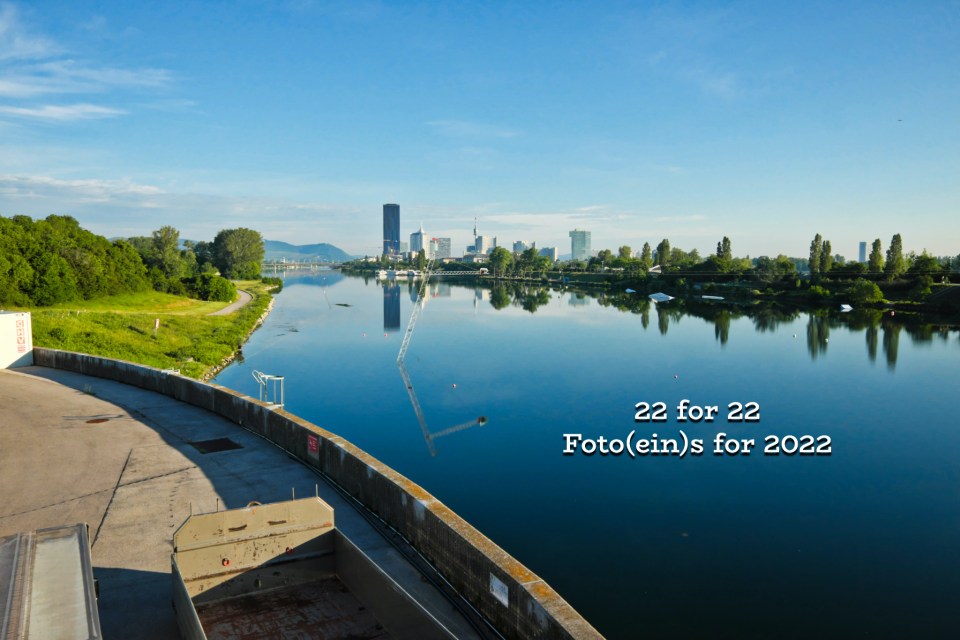
Kleinwasserkraftwerk Wehr 1, Neue Donau, 22. Bezirk, Donaustadt, Wien, Vienna, Austria, Österreich, fotoeins.com

22 for 22: Foto(ein)s for 2022

Above/featured: Vienna skyline from Kleinwasserkraftwerk Wehr I in early morning light. Photo, 7 Jun 2022.

For 2022, the act of looking forward and backward is dominated by a 4-week stay in the city of Vienna. In between the collected images is a reclaimed longing for the Austrian capital to which I was first introduced 20 years ago, but for which there was no camera and, sadly, no recorded pixels.

I’ve already described a set of images setting the urban scenes in Vienna from 2022. Below is an additional set of 22 images selected from a period of 35 days; the time interval represents only 10% of the year, but it appears to be a personally important “watershed moment” as well.


( Click here for images and more )