Fotoeins Fotografie

location bifurcation, place vs. home

Posts tagged ‘Fuji X70’

My Fuji X70: CineStill 800T (XTrans2 recipe)

Above/featured: Archangel Michael dispatching the devil: St. Michael’s Church, Vienna – 1 Jun 2023.

The Fujifilm X70 mirrorless fixed-lens prime camera has added a lot to my approach to photography for projects in domestic and international scope. To satisfy my curiosity about Fujifilm’s analog-film simulation (film-sim) recipes for varying “looks” and “palettes” applied to images, I’ve provided examples of X70 images with these recipes:

•   Ektachrome 100SW (saturated warm)
•   Fujichrome Slide
•   Kodachrome 64
•   Kodacolor
•   Kodak Platinum 200

Here I show images made with the “CineStill 800T” recipe, which Ritchie Roesch describes in Fuji X Weekly:

… CineStill 800T is Kodak Vision3 500T motion picture film that’s been modified for use in 35mm film cameras and development using the C-41 process. Because it has the RemJet layer removed, it is more prone to halation. The “T” in the name means tungsten-balanced, which is a fancy way of saying that it is white-balanced for artificial light and not daylight. … Even though the film that this recipe is intended to mimic is Tungsten-balanced, the recipe can still produce interesting pictures in daylight. It’s a versatile recipe, but it definitely delivers the best results in artificial light.

The recipe is for the X-Trans II sensor; the settings on my X70 are:

  • “Pro Neg Std” built-in film-sim
  • Dynamic Range: DR400
  • Color: -1 (Medium-Low)
  • Sharpness: 0 (Medium)
  • Highlight: +2 (High)
  • Shadow: +1 (Medium-High)
  • Noise Reduction: -2 (Low)
  • White Balance: 4300K; -3 Red, -3 Blue
  • ISO: Auto, up to 3200

I assigned this recipe for the “nighttime” setting as 1 of the 7 camera’s custom presets, but I also experimented in daylight at a variety of locations. The following JPG images are “almost” straight-out-of-the-camera; only adjustments to brightness level and a crop to a predefined image size have been applied, with no corrections to colour, contrast, geometric distortion, or rotation. I agree with Roesch’s statement about getting “best results” after dark in artificial light, but I got some interesting images in daylight as well.

( Click here for images )

Kleinwasserkraftwerk Wehr 1, Neue Donau, 22. Bezirk, Donaustadt, Wien, Vienna, Austria, Österreich, fotoeins.com

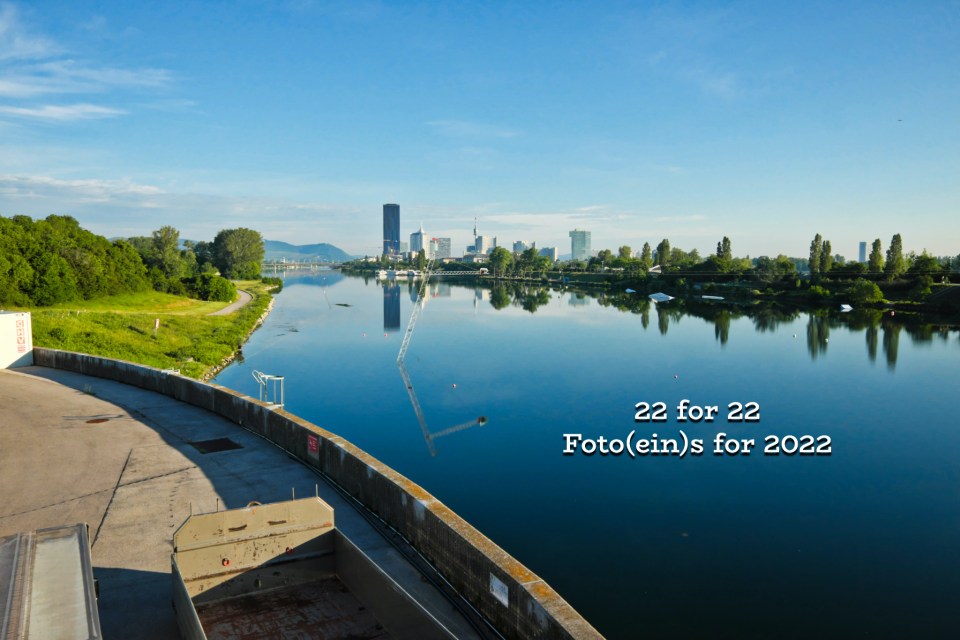
22 for 22: Foto(ein)s for 2022

Above/featured: Vienna skyline from Kleinwasserkraftwerk Wehr I in early morning light. Photo, 7 Jun 2022.

For 2022, the act of looking forward and backward is dominated by a 4-week stay in the city of Vienna. In between the collected images is a reclaimed longing for the Austrian capital to which I was first introduced 20 years ago, but for which there was no camera and, sadly, no recorded pixels.

I’ve already described a set of images setting the urban scenes in Vienna from 2022. Below is an additional set of 22 images selected from a period of 35 days; the time interval represents only 10% of the year, but it appears to be a personally important “watershed moment” as well.


( Click here for images and more )

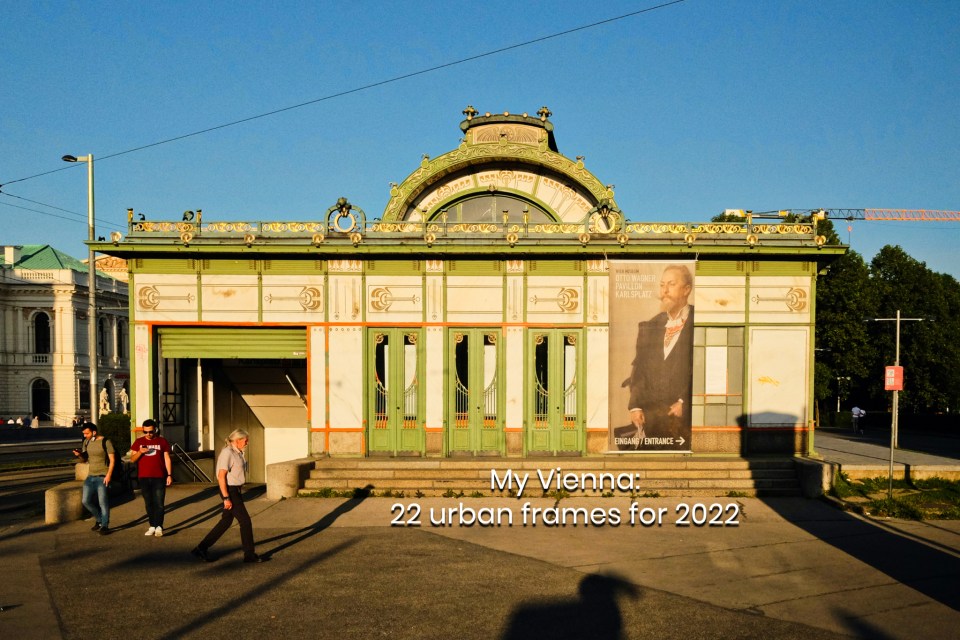
My Vienna: 22 urban frames for 2022

Above/featured: “The first Sunday.” Karlsplatz, 1st district – 15 May 2022.

Earlier in the year, I spent four weeks in Vienna, soaking in late-spring and early-summer weather in Austria’s capital city. I highlighted 3 images and scenes which in addition to time spent left personal impressions. Below, I highlight in a “last chance effort” an additional 22 visual examples of the urbanity in Wien, folding in splashes of colour, lines of focus, and accessibility to good timing.


( Click here for images and more )

My Fuji X70: Fujichrome Slide, Kodak Platinum 200 (XTrans2 recipes)

Above/featured: 1st Narrows, from John Lawson Pier.

My Fujifilm X70 mirrorless fixed-lens prime camera has been a big plus for photography at domestic and international locations. The built-into-camera film-simulations (e.g., Provia, Velvia) work beautifully in standard settings, but as I’ve never had a film camera, the advent of “camera recipes” to produce additional film-like settings stimulated interest in different colour or pictorial representations.

So far, I’ve tested these Fujifilm film-simulation (“film-sim”) recipes:

•   Ektachrome 100SW (saturated warm), simulating images with the Kodak colour transparency or slide films produced 1996–2002;
•   Kodachrome 64, simulating images with the Kodak colour film produced between the mid-1970s and 2009;
•   Kodacolor, “producing classic Kodak analog aesthetic closest to early-1980s Kodacolor VR200 colour film that’s been overexposed.”


( Click here for images )