Fotoeins Fotografie

location bifurcation, place vs. home

Posts tagged ‘Frankfurt am Main’

My Frankfurt: Berlin Airlift Memorial, planespotting at FRA

Above/featured: Taxiing “behind” the memorial is Finnair A350-900 (A359) with oneworld livery. In summer 2022, Lufthansa’s Eurowings Discover delivered flights between Germany and North America with “wet-leased” Finnair Airbus A359s. Photo, 14 Jun 2022.

The city of Frankfurt am Main is known as: gateway into Europe for the city’s international airport; the country’s financial capital nicknamed “Main-hattan;” the city where German parliamentary governance and federalism got their start with the first freely-elected parliament for all German states in 1848; the home of Grüne Sosse and Ebbelwoi, the local savoury speciality and apple wine, respectively.

But the history shortly after World War 2 tells of an important connection between the cities of Frankfurt and Berlin.

Post-war Berlin was a landscape of occupied zones by American, British, French, and Soviet forces, a partial reflection of similar occupation in post-war Germany. Over a dispute about what monetary currency would be used, Soviet forces in eastern Germany blocked all road, rail, and water access into western Berlin on 25 June 1948. In one of the largest aircraft operations in peacetime history, the United States and United Kingdom began airlifting vital food and fuel supplies from their airbases in western Germany to over 2 million residents in west Berlin. Among the three airfields in western Berlin, Tempelhof became a key centre for critical supplies for almost one full year.

The Soviets allowed western forces to fly solely in three narrow air corridors from western Germany, over Soviet-controlled eastern Germany, and into Berlin. Inbound flights to Berlin along the southern corridor began from the area around Frankfurt am Main. The Rhein-Main Air Base (1945–2005) operated as a hub for US Air Forces as “gateway” into Europe; the base occupied the southern side of Frankfurt Airport and served as essential staging point during the Berlin Airlift operation. On 12 May 1949, Soviet forces reopened road and rail access into western Berlin, ending the blockade.

After countless flights in and out from Frankfurt, I visited the Berlin Airlift Memorial next to Frankfurt airport, as well as the planespotting area.

Berlin airlift air corridors, from West Germany into West Berlin. From "To Save A City: The Berlin Airlift 1948-1949", by Roger G. Miller, US Air Force History and Museums Program, 1998.

1948 map of Germany, north at top. 3 approved “corridors” for the Berlin airlift from Western Germany over Soviet-controlled Eastern Germany and into western Berlin. North corridor: primarily inbound from Hamburg area (HH) to West Berlin. Central corridor: primarily outbound from western Berlin towards Hannover area (H). South corridor: primarily inbound to western Berlin from the Frankfurt area (F). The three airfields in western Berlin were Gatow, Tegel, and Tempelhof. Source: Miller 1998; with labels added for clarity.

Berlin Airlift, candy drop, Rosinenbomber, raisin bomber, candy bomber, Operation Little Vittles, Douglas C-54 Skymaster, C-54, US Air Force, National Museum of the US Air Force, VIRIN 050426-F-1234P-012

On approach to an airfield in west Berlin during the airlift operation, a U.S. Air Force Douglas C-54 Skymaster makes a candy-drop, seen as tiny parachutes below the tail of the plane. Aircrews dropped candy to children during the Berlin Airlift as part of Operation “Little Vittles”. Source: National Museum of the US Air Force, photo 050426-F-1234P-01, c. 1948 to 1949.


( Click here for more images )

My Fuji X70: CineStill 800T (XTrans2 recipe)

Above/featured: Archangel Michael dispatching the devil: St. Michael’s Church, Vienna – 1 Jun 2023.

The Fujifilm X70 mirrorless fixed-lens prime camera has added a lot to my approach to photography for projects in domestic and international scope. To satisfy my curiosity about Fujifilm’s analog-film simulation (film-sim) recipes for varying “looks” and “palettes” applied to images, I’ve provided examples of X70 images with these recipes:

•   Ektachrome 100SW (saturated warm)
•   Fujichrome Slide
•   Kodachrome 64
•   Kodacolor
•   Kodak Platinum 200

Here I show images made with the “CineStill 800T” recipe, which Ritchie Roesch describes in Fuji X Weekly:

… CineStill 800T is Kodak Vision3 500T motion picture film that’s been modified for use in 35mm film cameras and development using the C-41 process. Because it has the RemJet layer removed, it is more prone to halation. The “T” in the name means tungsten-balanced, which is a fancy way of saying that it is white-balanced for artificial light and not daylight. … Even though the film that this recipe is intended to mimic is Tungsten-balanced, the recipe can still produce interesting pictures in daylight. It’s a versatile recipe, but it definitely delivers the best results in artificial light.

The recipe is for the X-Trans II sensor; the settings on my X70 are:

  • “Pro Neg Std” built-in film-sim
  • Dynamic Range: DR400
  • Color: -1 (Medium-Low)
  • Sharpness: 0 (Medium)
  • Highlight: +2 (High)
  • Shadow: +1 (Medium-High)
  • Noise Reduction: -2 (Low)
  • White Balance: 4300K; -3 Red, -3 Blue
  • ISO: Auto, up to 3200

I assigned this recipe for the “nighttime” setting as 1 of the 7 camera’s custom presets, but I also experimented in daylight at a variety of locations. The following JPG images are “almost” straight-out-of-the-camera; only adjustments to brightness level and a crop to a predefined image size have been applied, with no corrections to colour, contrast, geometric distortion, or rotation. I agree with Roesch’s statement about getting “best results” after dark in artificial light, but I got some interesting images in daylight as well.

( Click here for images )

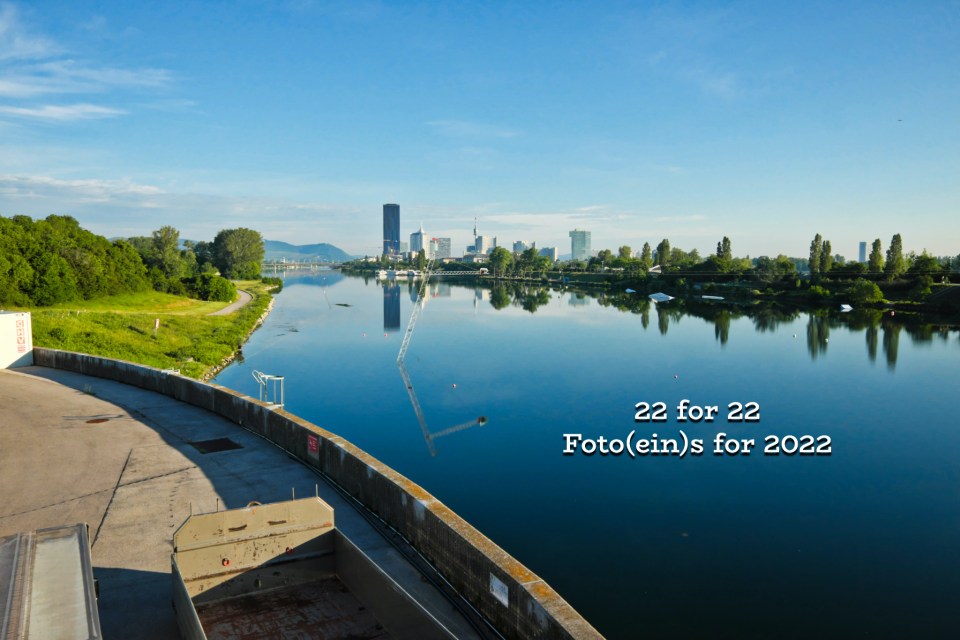
Kleinwasserkraftwerk Wehr 1, Neue Donau, 22. Bezirk, Donaustadt, Wien, Vienna, Austria, Österreich, fotoeins.com

22 for 22: Foto(ein)s for 2022

Above/featured: Vienna skyline from Kleinwasserkraftwerk Wehr I in early morning light. Photo, 7 Jun 2022.

For 2022, the act of looking forward and backward is dominated by a 4-week stay in the city of Vienna. In between the collected images is a reclaimed longing for the Austrian capital to which I was first introduced 20 years ago, but for which there was no camera and, sadly, no recorded pixels.

I’ve already described a set of images setting the urban scenes in Vienna from 2022. Below is an additional set of 22 images selected from a period of 35 days; the time interval represents only 10% of the year, but it appears to be a personally important “watershed moment” as well.


( Click here for images and more )

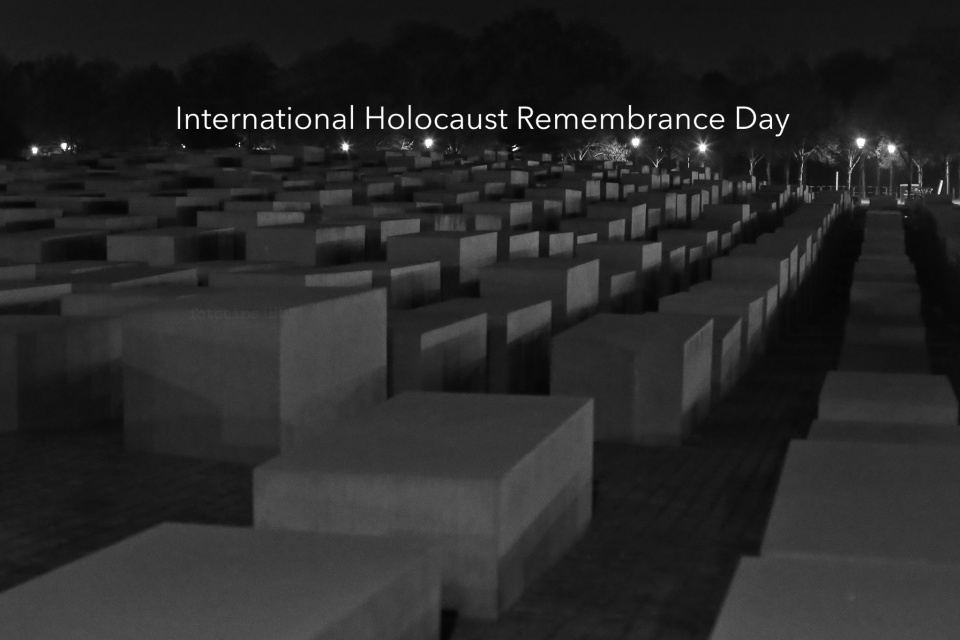
IHolocaustdenkmal, Berlin, Germany, fotoeins.com

International Holocaust Remembrance Day: observations from Germany

Primo Levi, Italian-Jewish author, chemist, and Auschwitz survivor, delivered a set of essays about life and survival in Nazi extermination camps in his 1986 book “The Drowned and the Saved”. Levi wrote:

… For us to speak with the young becomes even more difficult. We see it as a duty and, at the same time, as a risk: the risk of appearing anachronistic, of not being listened to. We must be listened to: above and beyond our personal experiences, we have collectively witnessed a fundamental, unexpected event, fundamental precisely because unexpected, not foreseen by anyone. It took place in the teeth of all forecasts; it happened in Europe; incredibly, it happened that an entire civilized people, just issued from the fervid cultural flowering of Weimar, followed a buffoon whose figure today inspires laughter, and yet Adolf Hitler was obeyed and his praises were sung right up to the catastrophe. It happened, therefore it can happen again: this is the core of what we have to say.

On 27 January 1945, Soviet Red Army troops liberated the Nazi concentration and extermination camp at Auschwitz-Birkenau in south-central Poland. Over 1 million men, women, and children were murdered.

The United Nations declared January 27 as International Holocaust Remembrance Day; the designation came during the 42nd plenary session of the United Stations when resolution 60/7 was passed on 1 November 2005.

Accepting and openly stating responsibility are critical first steps, but spending time, money, and effort to ensure the simple motto of “never again” is also an ongoing reality that isn’t solely up to the citizens of Germany. It’s a collective responsibility that we all should have to remain vigilant; that we all have to recognize and bolster actions which encourage and strengthen the universality of human rights, and reject the erosion and withdrawal of those rights.

I believe responsible tourism also includes paying appropriate respect at a memorial, especially the Holocaust Memorial in Berlin. It’s my view this important memorial is not (supposed to be) a playground.

And yet, there’s something to be said about what it means to have freedom in the early 21st-century, allowing people to laugh and frolic in the public space, an undulating sculpture of featureless massive grey cement blocks, a testimonial to the systematic murder of millions of people.

Naturally, you have the freedom to play here, take selfies, and have a grand time. But it doesn’t mean I’m gonna laugh with you; for example: Yolocaust art project (DW 2017).


( Click here for more )

Meral's Imbiss, Mainufer, Frankfurt am Main, Germany, fotoeins.com

My Frankfurt: taste of Istanbul on the Main

“This is like being in Istanbul,” my friend says, in between bites of his sandwich.

Ömer, his fiancée, and I are sitting on the south bank of the river Main in Frankfurt, Germany. We’re soaking the late-summer sun. The grassy meadows are full of people: some in animated conversation; some surrounded by a big spread of food, beer, and wine; others kicking the soccer ball back and forth with their children.

There’s a whole lot of happiness here, but there’s a long line of people, waiting to purchase food and drink at the boat parked by the riverbank.

We just left that very same line after waiting for an hour. What we’re eating now made the wait worthwhile.

Over the ten-plus years I’ve known Ömer, he’s never been wrong about food in Germany.

Meral's Imbiss, Mainufer, Frankfurt am Main, Germany, fotoeins.com

Speisekarte | Food menu

Meral's Imbiss, Mainufer, Frankfurt am Main, Germany, fotoeins.com

Hamsi (Sardellen) fried-fish sandwich, “Ominade”

We each have a fried-fish sandwich: lightly fried fish in thin crispy batter, crunchy lettuce, slices of juicy tomato, stuffed in fresh soft Turkish bread. There’s a choice of Sardellen (anchovies), Makrelen (mackerel), or Doradenfilet (gilthead seabream). Ominade, freshly-squeezed lemonade according to Oma’s (Grandmother’s) recipe, is the right amount of sweet-tart, providing cool refreshment for our afternoon snack.

“The guy, the family who runs that boat, they’ve got this right, and I’ve gotta admit this feels like we’re on the Bosporus.”

High praise from Ömer: born in Istanbul, raised in Köln, and who’s gone back to know Istanbul very well in adulthood.

We’re silent over the next few minutes, chewing slowly and contemplating Istanbul. I’m realizing the obvious. If the food is any indication, I’m missing out; I’ve not yet visited Istanbul.

But right now, I’m eyeing that long line: I want another fried-fish sandwich and lemonade. But I don’t want to move; this is summer-like weather on an early-autumn afternoon on the bank of the river Main.
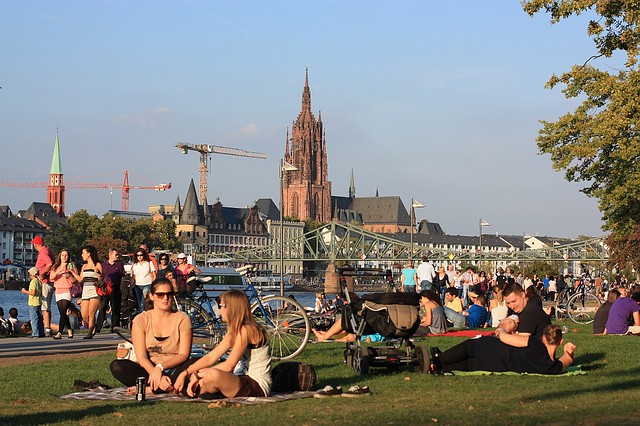

If you’re visiting Frankfurt am Main, make your way to the Main river to the boat called Meral’s Imbissboot (Meral’s Snack Boat). Naturally, they serve Döner, but their fried fish is too good not to try. Subject to weather conditions, the boat is open for service every day from noon to 11pm, between March and October.

Public transport: nearest U-Bahn station Willy-Brandt-Platz or Schweizer Platz.

I made the photos above on 3 October (German Reunification Day) 2011. This post appears on Fotoeins Fotopress at fotoeins.com as http://wp.me/p1BIdT-4n5.