Fotoeins Fotografie

location bifurcation, place vs. home

Posts tagged ‘fotoeins’

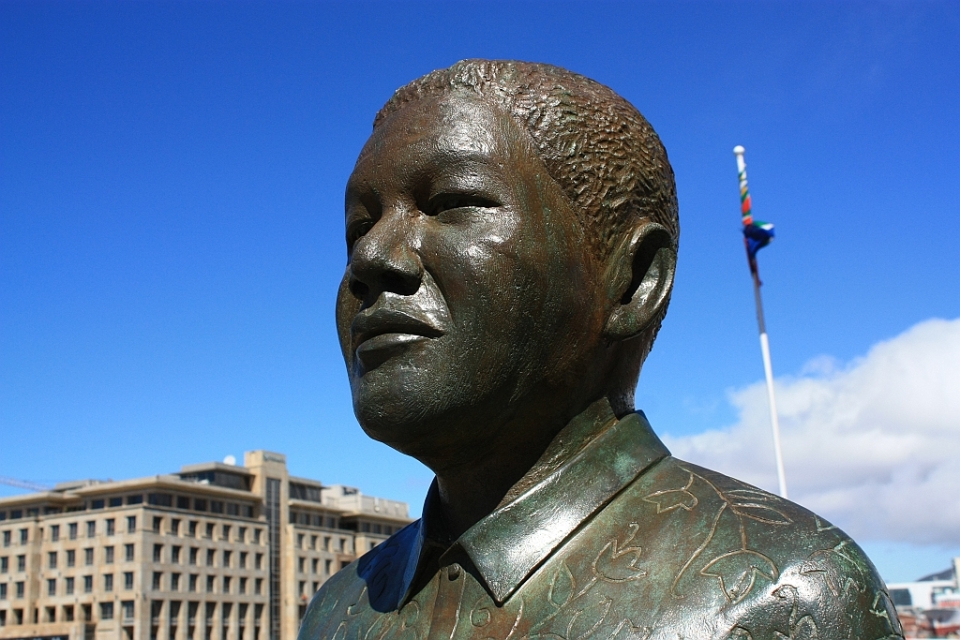
Nelson Mandela statue, Nobel Plaza, Victoria & Alfred Waterfront, Cape Town

Cape Town: remembering Nelson Mandela and 10 May 1994

On 27 April 1994, South Africa held its first post-apartheid elections with universal suffrage, where all people independent of gender and race could vote. The elections ushered the once-banned African National Congress (ANC) party into government. April 27 is Freedom Day, an annual national holiday in South Africa.

The ANC election victory brought another historic development. On 10 May 1994, Nelson Mandela was officially inaugurated as the first black person to be democratically elected President of South Africa.

2014 marked the 20th anniversary of the first freely run post-apartheid elections and of Nelson Mandela as elected President. National elections were held on 7 May 2014; these elections were the fifth held in the post-apartheid era, and the first held since Mandela’s passing in early-December 2013. With 18 years the minimum age for people to vote in South Africa, the 2014 elections included the first voting “born-free generation” who have never known a nation under apartheid.

Nelson Mandela and F. W. de Klerk both won the 1993 Nobel Peace Prize.
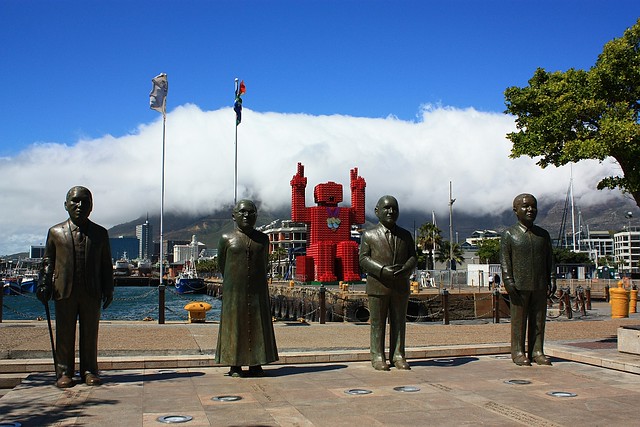
South Africa Nobel Peace Prize laureates, Nobel Square, Cape Town, South Africa

4 Nobel Peace Prize laureates from South Africa

I made the two photos above at Cape Town’s Nobel Square in October 2012. This post appears on Fotoeins Fotografie at fotoeins DOT com as http://wp.me/p1BIdT-45A.
Canberra: Remembering ANZACs at Australian War Memorial

ANZAC Day is held annually on the 25th of April to commemorate Australian and New Zealand Army Corps (ANZAC) from the First World War and ANZAC military personnel in subsequent service around the world.

The day also marks the 1915 anniversary when ANZAC troops landed on the Gallipoli peninsula in Turkey. The attempted move did not end well for the ANZACs, as the Ottomans successfully repelled the invasion force. The land invasion stalled after eight months with subsequent withdrawal from Turkey to Egypt.

ANZAC Day in Australia and New Zealand has surpassed the commemoration of Remembrance Day held annually on the 11th of November in Commonwealth nations, including Canada and the United Kingdom.

In the Australian capital city of Canberra, the Australian War Memorial is a grand structure, housing an impressive collection of historical artifacts, collections, and documents, outlining and describing Australian action at home and overseas. One day or an afternoon makes for a great introduction, but multiple visits are required to plumb the depths of their extensive archives. At the end of every day, the War Memorial closes its doors with a farewell to visitors in the “Last Post” ceremony, beginning at 455pm local time.

( Click here for images and more )

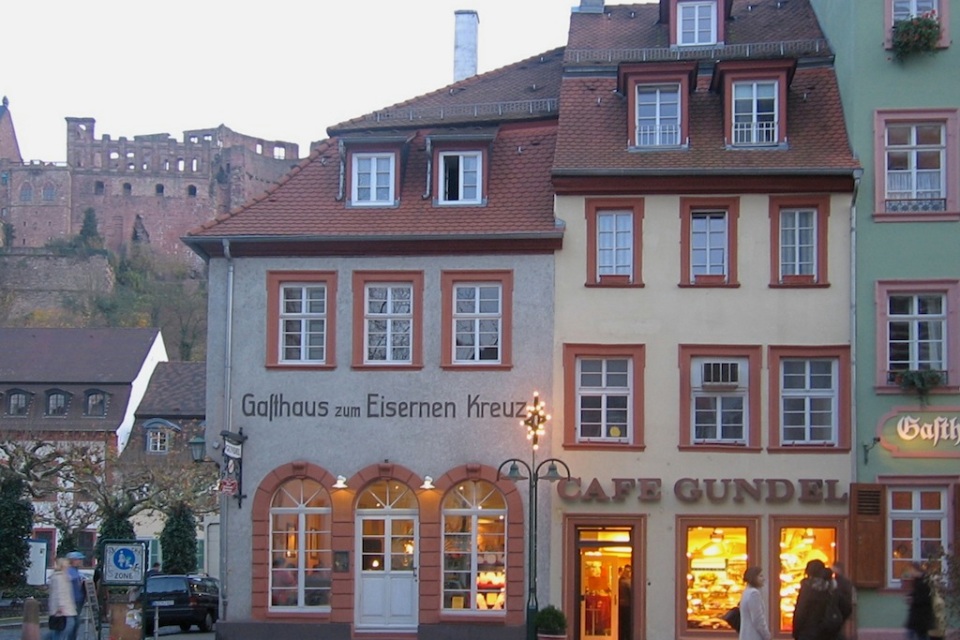
Cafe Gundel, Hauptstrasse (Karlsplatz), Heidelberg, Germany

My Heidelberg: 1st sweet taste at Café Gundel

In 2001, I moved across the big Atlantic pond from Canada to Germany. Knowing only “bitte” (please) and “danke” (thank you), I flew sight unseen to Frankfurt am Main, followed by a shuttle-bus to the German university town of Heidelberg. I would live and work in Heidelberg for two years, and I couldn’t have known the experience would change my life.

Heidelberg is a favourite “hometown” which includes many memories of firsts.


( Click here for more )

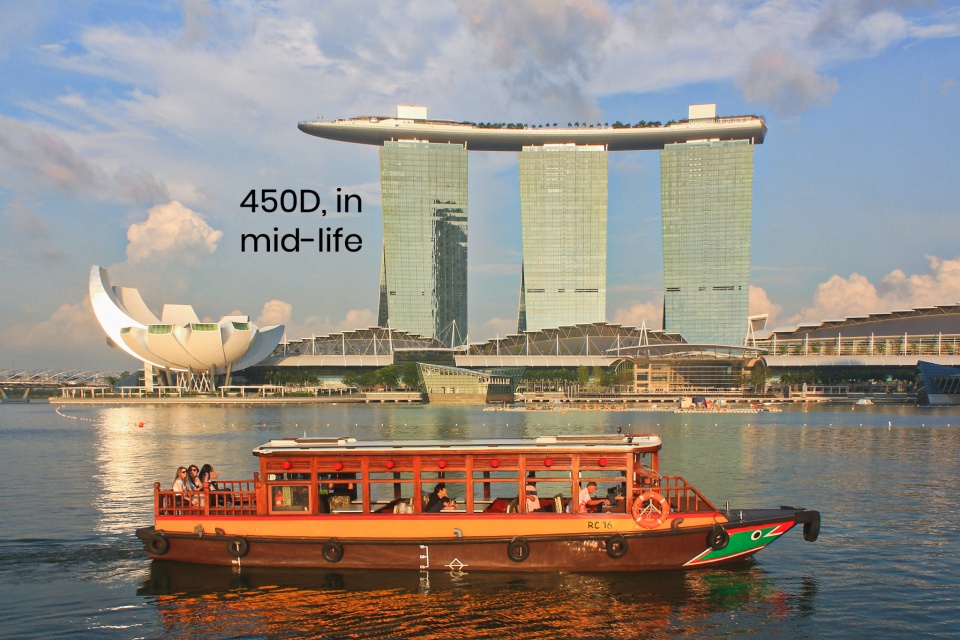
Singapore, my RTW, fotoeins.com

450D & 75000 clicks: a good in-camera life

Above/featured: Singapore, 3 Jul 2012 (no. 37629).

For the seventh time, I’ve “flipped” or “rolled over” the four-digit image-counter on my camera. I’ve made over 70-thousand exposures, which is a great accomplishment for both camera and me. Unfortunately, exposure number 75000 will prove to be a bad omen.

I own a Canon EOS450D (Rebel XSi), an entry-level digital crop-sensor camera which was introduced to the consumer market in the first-quarter of 2008.

The camera has no weather-proofing, poor to average low-light capability, and a small burst-rate, but the camera is affordable, portable, and easy to use. The kit-lens doesn’t have great build-quality, but the lens is lightweight with a decent range in focal lengths for my kind of photography.

But, all good things must come to an end.

( Click here for more )

Hong Kong: almost China at the Lo Wu gateway

I’m at the turnstiles, off to the side from the steady stream of people going through to the other side.

I’m standing on the one side in Hong Kong (香港).

The other side is the city of Shenzhen in the People’s Republic of China’s province of Guangdong (Kwangtung | 廣東 | 广东).

MTR trains come in from Hong Kong and stop here at the end of the line. People pour out of the trains, and head for Shenzhen. There are occasional lulls in between frequent arrivals and departures of the trains, reminding me I’m in the middle of the countryside and at the frontier section separating between what most people know as Hong Kong and China.

Over on the “other” side, Shenzhen is a strong economic force, helped along by its special designation as a Special Economic Zone (SEZ), but there’s still a special allure for many to working inside Hong Kong’s Special Administrative Region. MTR rail passengers depart Hong Kong and enter Shenzhen at either the Lo Wu or Lok Ma Chau (Spur Line) crossings. The average cross-border passenger traffic numbers are 220,000 and 80,000 people per day, at Lo Wu and Lok Ma Chau, respectively (Source 1, Source 2).

From an economic, urban planning, and logistics point of view, it’s no surprise there’s a push to amalgamate Shenzhen with Hong Kong to create a super-metropolis here at the mouth of the Pearl River. Hong Kong has over 7 million people, whereas the population of neighbouring Shenzhen exceeds 13 million. Many would like to see easier and faster movement of goods and people between the two cities, but many in Hong Kong fear an exacerbation of existing problems with overcrowding and overburdened resources.

But what of the people going back and forth? How many from China and/or Shenzhen enter Hong Kong for work or school, and reverse course at the end of every day? How many from Hong Kong go to work in Shenzhen?

I wonder what the daily routine is for someone going back and forth between Shenzhen and Hong Kong. I watch patiently, and I wonder what it’s like on the other side. I have no doubt there’s someone on the other side in Shenzhen who’s wondering the same thing.

( Click here for images and more )